
There aren’t a lot of distinguished biographies of famous historians. The reading public is largely interested in their works, rather than their personal lives, and while some achieved a certain fame or honor in their time — Thomas Babington Macaulay, Marc Bloch, A.J.P. Taylor, Charles A. Beard, a handful of others — details of scholarly careers and marriages are unlikely to enthrall readers.
Which is not to say that their lives are without interest. But this latest account of the life and times of Howard Zinn (1922-2010), the Boston University professor of political science and radical activist whose A People’s History of the United States (1980) has sold in the millions and exerted a disproportionate influence on the modern Left, in and out of academia, raises a question: should its subject be described as a historian or as an academic activist whose lifelong passions were ideological and whose acquaintance with history was largely in the service of a severely blinkered view of the American past?
Of course, it doesn’t help very much — and probably tells us something about Zinn’s validity as a scholar — that his biographer-champion here is neither a historian nor disinterested observer but the sports editor of The Nation and a longtime friend and comrade-in-arms on the campus rally-lecture circuit.
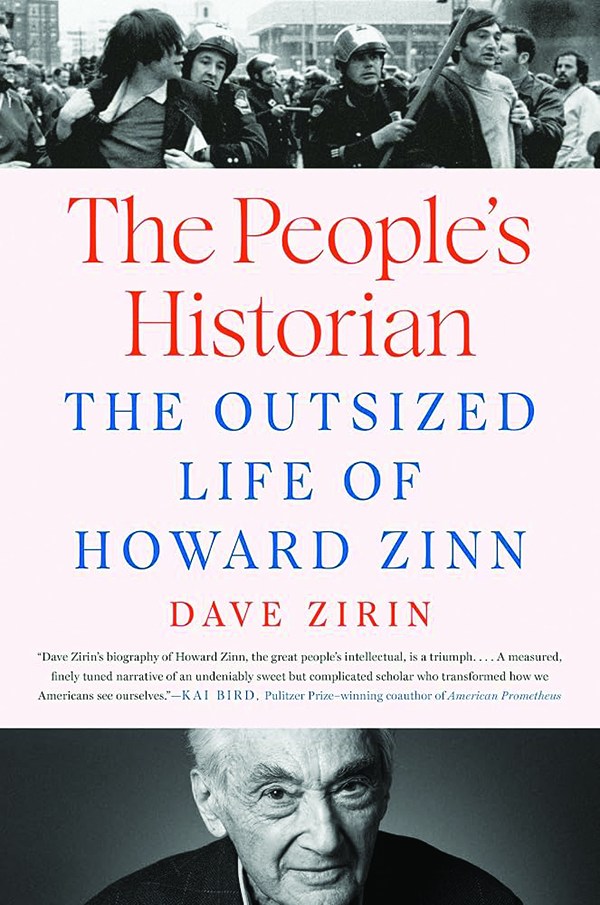
Zirin may be excused for his enthusiasm for an old friend and his delight in Zinn’s commercial success and status as what we now call a social influencer. But true to his background as a sportswriter, he tends to measure Zinn’s scholarly credentials by the number of books he’s sold, the number of people who turned out on campuses to hear him speak, or the number of his appearances on The Daily Show with Jon Stewart.
Worse still, Zirin’s partisanship is occasionally embarrassing to Zinn’s memory. For all his radicalism and village-atheist posturing, Zinn seems to have been a low-key, sometimes self-deprecating character whose rhetorical zeal was largely aimed at predictable abstractions — big shots of all kinds, capitalists, corporations large and small, centrist Democrats, union-busters, Madison Avenue, millionaires, the anti-communist Left — rather than individual villains. Zirin, by contrast, is unrestrained: Not only was Zinn right about everything, but his detractors are inevitably depicted as acting in bad faith, as conscious or unconscious agents of malicious forces, not to say liars, fools, ingrates, even criminals, doing the bidding of corporate paymasters.
Zirin’s language is so often impassioned as to be mildly unhinged, and so often expressed in such juvenile terms that one is tempted to guess that The People’s Historian was dictated rather than written, and now appears in printed form untouched by any of the many friends and agents, or readers and editors on the “team at Dutton,” thanked by name in his acknowledgments.
To what end? “Even though tons of people knew him better,” Zirin writes, “I get asked often: What would Howard say about the [s***]show that this country has become?” The question remains unanswered. Which is unfortunate, partly because Zirin seldom contends with the details of Zinn’s revisionist view of the American republic, except in occasional asides that presume a sympathetic knowledge of Zinn’s work, but largely because he concentrates on Zinn’s career as polemicist and political activist.
It is not for nothing that Zinn’s A People’s History was twice revised and updated in response not to archival revelations or deeper research but to the Reagan-Bush administrations, the Clinton presidency, and the Iraq war. Zirin informs us about Zinn’s association with assorted figures from the civil-rights and antiwar movements of the Vietnam era (Daniel Berrigan, Staughton Lynd, Daniel Ellsberg) and, at inordinate length, about the role played by Zinn’s book in the 1997 movie Good Will Hunting, as well as his small army of progressive celebrity-fans. Such admirers must have been gratifying, and perhaps even amusing, to Zinn, but this seems to be of supreme significance to his chronicler.
Zinn’s story is a familiar one in American annals. The Brooklyn-born son of impoverished Jewish immigrants from Central and Eastern Europe, the youthful Zinn was a conscientious student who early fell under the influence of the labor movement and local communists — he was always coy about the nature of his contacts with the party — and was an ardent opponent of American entry into World War II.
At some point, however, his isolationism was supplanted by a militant anti-fascism, and he served as a bombardier in the Army Air Corps. The sometimes-indiscriminate nature of aerial warfare, plus the effect of his postwar studies in history at Columbia University, pushed him in a stridently progressive-pacifist direction — in his old age, the lifelong socialist preferred to be identified as an anarchist — at a time when American higher education was not so thoroughly dominated by the Left.
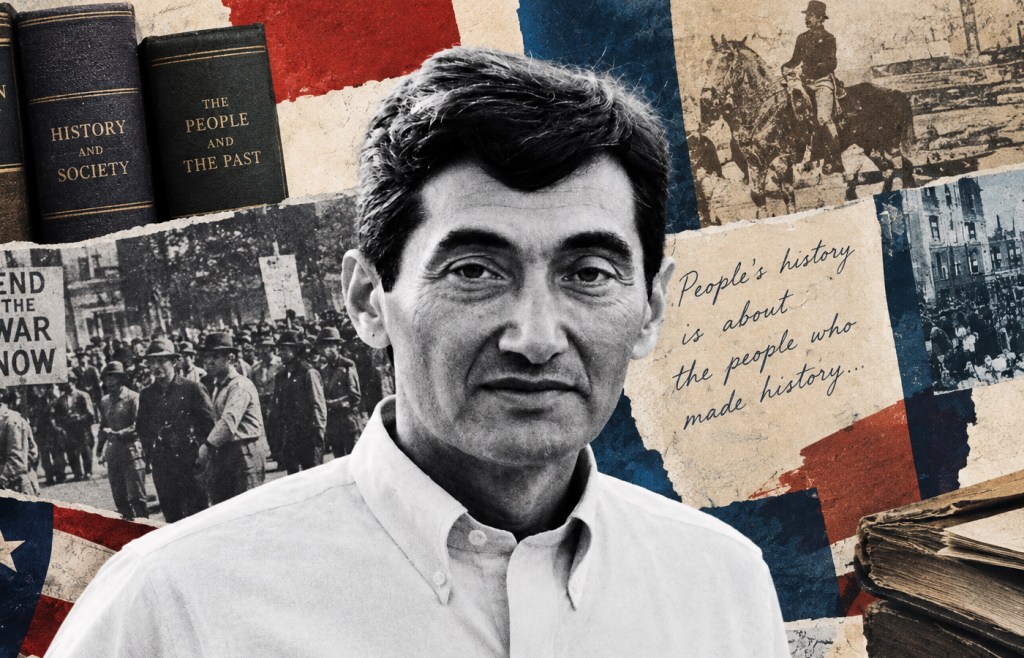
Accordingly, this put him in almost perpetual conflict with the academic administrators of his day. He managed to alienate the gentlemanly president of Spelman College, the historically black women’s institution in Atlanta, who, after seven years, seems to have taken some ill-disguised pleasure in summarily dismissing Zinn as professor of history. And the middle portion of Zirin’s account is almost entirely devoted to Zinn’s incessant warfare with the president of his final academic employer at Boston University, John Silber, later the Democratic nominee for governor of Massachusetts.
These extended accounts of academic discontent and extracurricular action make up the greater portion of The People’s Historian, very much at the expense of any close description of what Zinn believed and taught and what formed the substance of his A People’s History. Briefly stated, it was Zinn’s conviction that American historical writing, popular and scholarly, was largely an exercise in comfortable mythology, and that the role of unheralded people — whether Indian resisters to colonization, slavery abolitionists, black and white, anti-capitalists, agitators for labor and women’s rights — had not only been ignored by historians but actively suppressed in service to some scholarly establishment of Zinn’s imagination.
SALENA ZITO: MARTHA MACCALLUM AND THE STORIES THAT DEFINE US
Of course, Zinn was entitled to his singular views, and history is always the historian’s version of events. But Zinn was a mythologist in his own right. He misunderstood and misconstrued, sometimes intentionally, as much as any ideologue; he simplified at times to comic effect; he gave credence to some players while ignoring others. Worst of all, his particular conviction that no American historian had ever taken notice of such things is not just manifestly wrong but preposterous, made more dangerous by its current vogue on campus and in the popular culture.
It’s tempting to conclude that American history is too important to be left in the hands of movie stars, sportswriters, and political activists, but The People’s Historian teaches that historians can do damage as well.
Philip Terzian is the author of Architects of Power: Roosevelt, Eisenhower, and the American Century.