
Even before his nomination to the Supreme Court by President George W. Bush in 2005, Justice Samuel Alito was dogged by the nickname “Scalito.” The lazy conflation of Alito with Justice Antonin Scalia, both conservative jurists of Italian-American heritage, was irresistible to journalists who saw the court as a battleground for politics by other means, with the conservatives all on one side and the liberals on the other.
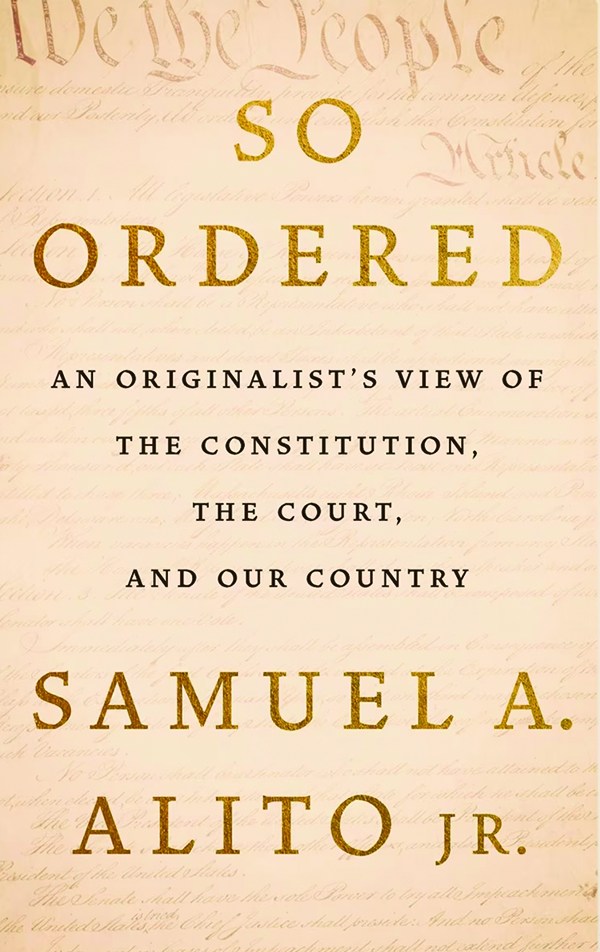
Scalia died a decade ago but still casts a long shadow over the court and the conservative legal movement. In a new book, So Ordered: An Originalist’s View of the Constitution, the Court, and Our Country, Alito reflects on the movement and the world Scalia made but also shows the ways in which he is far more than a clone of his departed colleague. While all originalists may sound alike to those who oppose the now-dominant theory of constitutional interpretation, the subtle differences between Alito and his various conservative colleagues not only show the diversity of thought within the movement but also the depth of Alito’s own reasoning and legal prowess.
The book is adapted from a collection of speeches Alito has given over his career. The subjects vary, but for those interested in the justice and his legal philosophy, the early chapters about originalism, textualism, and the craft of judging are the most relevant.
Textualism is the idea that laws should be interpreted primarily through their written text, not their perceived intent. Originalism is the idea that the Constitution’s provisions should be interpreted, as Alito writes, “to mean what the public would have taken them to mean when they were adopted.” The ideas are closely related: Laws are written down for a reason, and the definition of those words should be their ordinary meanings as they were understood at the time.
If that seems commonsensical, it certainly didn’t to the judges of an earlier generation. In those days, in what Alito calls the “Before Scalia” era, statutory interpretation was “a hodgepodge” that varied from judge to judge, decision to decision. As the law began to govern a large swath of human activity, laws became necessarily vague as Congress and state legislatures trusted executive agencies and courts to fill in the blanks based on legislative history (committee hearings, legislative debates, etc.) and other external sources of knowledge. Some judges even saw the courts as agents of Congress, carrying out its will in a master-and-servant sense, rather than as an independent branch with its own duties to the law and Constitution.
Scalia began his career on the Supreme Court as a lonely voice opposed to this practice, a proponent of these then-novel ideas. It was the start of a revolution in legal thinking, one to which Alito and most of his present-day colleagues on the Supreme Court now adhere. Even the left-leaning justices now often couch their opinions in the language of text and original public meaning. As Justice Elena Kagan said at her 2010 confirmation hearing, “we are all originalists.”
But growing consensus on the centrality of the text and public meaning does not mean that all originalists are the same, or that they never disagree. In some of his dissents over the years, Alito has found himself arguing with colleagues who would also call themselves originalist, textualist, and conservative. Alito’s discussion of the theory and practice of originalism here explains the reason for some of those disagreements.
One essay focuses on United States v. Jones, a 2012 case about police placing a GPS tracking device on a suspect’s car. Jones poses a challenge like that of many Bill of Rights cases: how to apply the timeless rights protected by the Constitution to new technologies that the founders never imagined. How should an originalist rule? The idea that a law enforcement officer could observe a suspect in public is not new, but as Alito notes, there is no caselaw in which “a tiny constable somehow suspended himself under a horse-drawn carriage and rode around in that position for twenty-eight days.”
The entire court believed the actions of the police were illegal but divided on the reasoning. Scalia, writing for the majority, extended the old common law tort of “trespass to chattels” (interfering with another person’s movable property) and found that the Fourth Amendment included a ban on any such trespass, whether the property was damaged or not.
Alito disagreed, as did three other justices. “What Jones called for,” he says in the book, “was not a search through the historical sand for old cases,” but rather “an exercise of judgement.” Is it plausible that the average person in 1791 thought trespass to chattels was an illegal search and barred by the Fourth Amendment? Alito doubts it and finds that this sort of “archaeological originalism” gets away from the core value of “original public meaning” and can serve as an excuse to help judges avoid judging.
This reluctance to tinker at the edges of scholarship and willingness to grasp the nettle in Jones foreshadow Alito’s more famous opinion in Dobbs v. Jackson Women’s Health Organization. There, he rejected the incremental approach proposed by Chief Justice John Roberts of pushing back the right to abortion created in Roe v. Wade and Casey v. Planned Parenthood. Instead, he (along with four other justices) made the hard but necessary judgment that Roe and its progeny never made sense, never protected anything that the Constitution actually guaranteed, and could not be salvaged consistent with an honest interpretation of the Constitution.

Alito’s essay on Edmund Burke, prudence, and the craft of judging also speaks to his decision-making process. Burkean prudence, he argues, “privileges long-established traditions, judgments, and beliefs over the sort of abstract reasoning that animated the French Jacobins.” He worries that the court departs from that prudence when it invents or recognizes new rights and privileges that Congress and the Constitution never mention — as in Obergefell v. Hodges, the same-sex marriage case.
On first reflection, it is hard to square Burkean prudence with the boldness Alito urges in Jones, but in Dobbs, the two guideposts point in the same direction. Because Roe departed from centuries of Anglo-American jurisprudence, and because neither the Constitution’s text nor its original public meaning establishes a right to abortion, overruling it could be both Burkean and bold. And because the decision in Dobbs returned the debate to the people and their legislatures, rather than replacing one judge-made rule with another, the result is the current patchwork of democratically enacted laws, not another invention of the judiciary.
MOLLIE HEMINGWAY’S ‘ALITO’ DIVES INTO HOW THE JUSTICE RESHAPED THE SUPREME COURT
Alito spends little time in the book on abortion and never mentions Dobbs directly. Fans (or opponents) looking for tidbits about the making of that holding will be disappointed. But the throughlines of his judicial approach and temperament explained here do shed light on his thinking.
There are other speeches-turned-essays in the book that give a glimpse of his ideas beyond the law. Combined with Mollie Hemingway’s insightful biography, published earlier this year, we now have a much clearer look at the sharp and discerning mind of Sam Alito. While all conservative judges and legal scholars are living in the shadow of Scalia, not all originalists are merely his clones. The long-running debate over constitutional interpretation began before Alito joined the court and will continue after him. Readers of So Ordered will come away with a clearer sense of just how consequential his contribution has been.
Kyle Sammin is the managing editor of Broad + Liberty.