
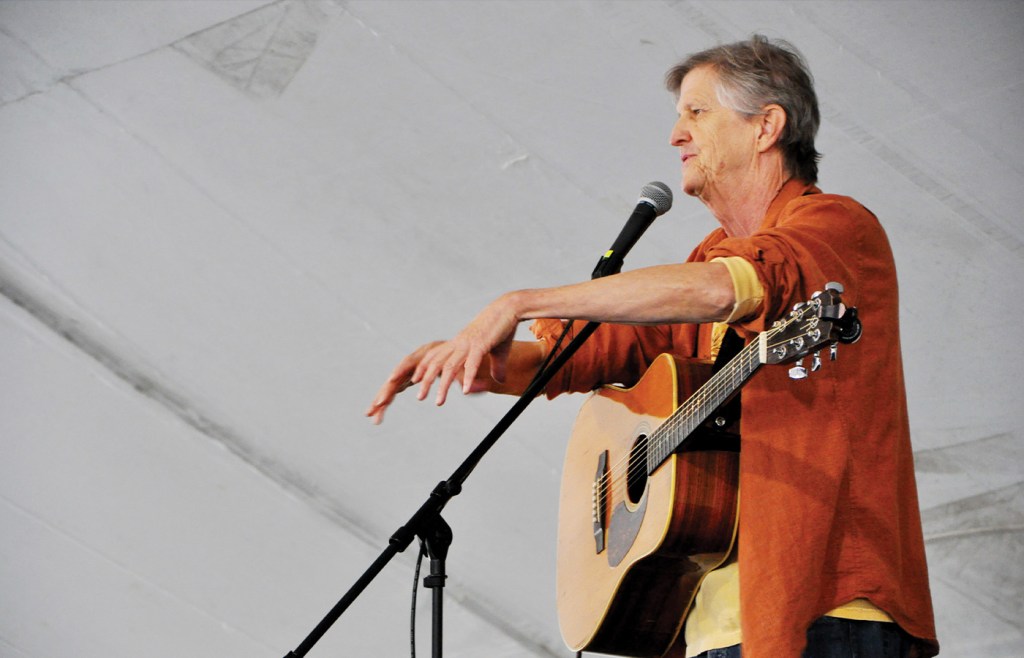
Josh Goforth, a storyteller and acoustic musician in his 40s, stood at the microphone beneath the Courthouse Tent in Jonesborough, Tennessee. He had decided to start his set with a song, and since the tent was just yards from the railroad tracks, he chose a bluegrass standard called “I’m Bound to Ride.” It follows a railroad worker as he travels from town to town, pining intermittently for the girl he left back home.
At Goforth’s urging, the crowd repeated the chorus after him. “Honey babe I’m bound to ride, don’t you want to go?” The musician frowned. “Y’all sound like Presbyterians,” he prodded. He was right. The crowd was reserved, half-mumbling the words. “I told that joke in a Presbyterian church one time,” he said. “This old lady up front nodded and said ‘mm-hmmm… the frozen chosen.’” The place erupted in laughter, and Goforth launched into the tune.
The town of Jonesborough is home to the National Storytelling Festival, now in its 53rd year in East Tennessee. The brainchild of the late Jimmy Neil Smith, the festival helped transform Tennessee’s oldest town into a hub for cultural preservation and heritage tourism.
The idea came to Smith, then a young journalism teacher at Johnson City’s Science Hill High School, almost as an epiphany.
In early 1973, he was driving a group of students to the offices of a local daily newspaper for production work when the voice of comedian Jerry Clower boomed over the car radio. Clower’s story about a Mississippi raccoon hunt gone wrong drew mixed reviews from the teenagers. But for Smith, the story signaled something significant: The ancient oral tradition was still very much alive. “What would you all think about getting people together to tell stories?” he asked his students.
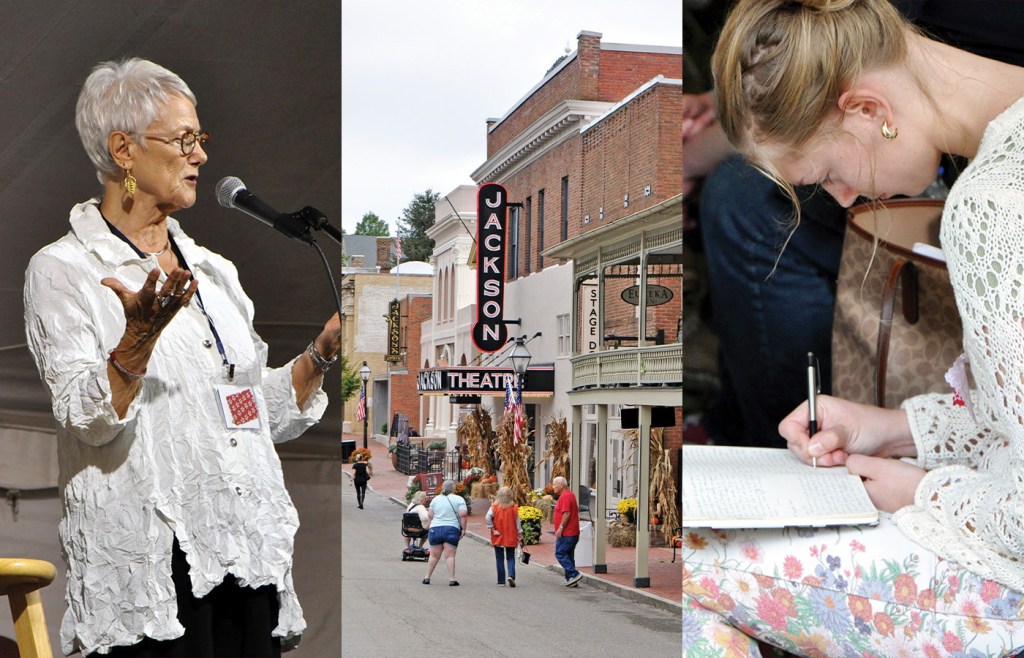
It didn’t take long for Smith’s idea to take a more definite shape. In October of that same year, Jonesborough hosted its first-ever National Storytelling Festival, named to reflect Smith’s outsized ambitions. Opening night saw the local high school gymnasium packed for a concert featuring Bill Monroe and the Bluegrass Boys opening for Clower, who would be inducted into the Grand Ole Opry just a few weeks later. On the second day of the festival, a crowd of about 60 people gathered around an old farm wagon in Courthouse Square to listen to storytellers from across the South. In the years that followed, the event grew, as did the audience, helping to ignite a traditional storytelling revival that spread throughout the U.S.
Though the festival now features stories of all kinds — including international folklore, personal narratives, ballads, lying tales, poems, and even folk dances — it has its deepest roots in the Appalachian folk tradition. The late Ray Hicks, a farmer and eighth-generation storyteller from the mountains of western North Carolina, was the first person Smith invited to the inaugural festival, and he came back to tell again and again. Hicks was a custodian of sorts for traditional European and Celtic tales, many of which feature a farm boy named Jack, who overcomes giants, witches, villains, and robbers with his quick wit and easy charm. When Hicks died in 2003, the New York Times said he was “perhaps the best-known traditional storyteller in the United States.”
It’s that sense of deep tradition that now brings some 10,000 people to Tennessee each autumn to hear a lineup of storytellers that includes ministers, teachers, musicians, authors, farmers, stay-at-home mothers, and service members. Listeners gather under massive circus tents with names like Creekside Tent and Tent on the Hill to hear tales old and new, known and unknown, true and… something other than true. Between the sessions, which each last about an hour, folks wander Main Street’s red brick sidewalks, browsing antiques and locally made crafts, and spinning yarns of their own. At the Oak Hill School, a historic one-room schoolhouse that now operates as a museum, there’s a dedicated Swappin’ Ground where amateurs can sign up to pass along their stories.
A good number of festival-goers have been making the pilgrimage to Jonesborough for decades, trading favorite stories like collectors trading glass marbles. Some of these are sorrowful, others eccentric, almost all soul-stirring. A woman named Ruth told me an account of a child who cost his Little League team a championship game by striking out during his final at-bat. Before his father (the teller) could think of what to say to him, his mother was at the plate, wrapping the boy in her arms.
“When I heard that story,” Ruth said, “I began to cry. And I thought, ‘Why am I crying?’”
As it turned out, her own mother was very sick. “I know I didn’t have much time with her,” Ruth said.
Another woman, Jane, recalled a line she’d heard years back, a line that changed the course of her life. “You might want to write this down: Once you lose your fear, you can do anything.’’
The whole festival weekend was like a workshop in the big, strange, sorrowful, gorgeous, impossible stuff of the human experience.
On Saturday, beneath a tent near the Jonesborough Library, storyteller and erstwhile United Methodist Minister Donald Davis reminisced about his own kindergarten class, which was held in the basement of a western North Carolina church. The heroine of his tale was his teacher, Mrs. Rosemary, who taught him and his classmates about love, tenderness, and — ultimately — death. “She could have taught Mr. Rogers,” he told a standing-room-only crowd, “because she knew that to teach children, you don’t speed up, you slow down.” The crowd was utterly still, entranced by the timbre of Davis’s voice.
Later that afternoon, at Tent on the Hill, three military veterans and a Gold Star mother, through the Wounded Warrior Project’s Warriors Speak program, shared stories about service. During a story from a guy named Dan Nevins about how a combat medic’s efforts helped save his life, an elderly Marine Corps veteran stood up in the crowd and shouted something I couldn’t hear. Meanwhile, at the edge of the tent, an Army veteran smoked cigarettes and cried as he shared his own memories with a member of the Warriors Speak staff. Every speaker earned a standing ovation. It was remarkable, an exercise in collective community healing.
Jimmy Neil Smith spoke often about how stories help people make meaningful connections across space and time.
“We are all storytellers,” he said. “We live in a network of stories. There isn’t a stronger connection between people than storytelling.”
There is some science behind that intuition. Uri Hasson, a professor of psychology and neuroscience at Princeton University, has described a phenomenon called “neural coupling,” in which patterns of brain activity can become aligned during the telling of a particularly effective story.
“Storytelling is not a one-way interaction,” Hasson has said, “it’s really a joint meeting of the audience and the storyteller.”
Peter T. Coleman, professor of psychology and education at Columbia University and author of the book The Way Out: How to Overcome Toxic Polarization, sees storytelling as a way of helping people reconnect or connect for the first time, which expands the world that human beings occupy.
“What’s happening in the time we’re living in,” Coleman said in an interview, “is that we’re oversimplifying everything. Part of that is about efficiency. Part of it is that when we feel anxious and angry, everything gets smaller, right? Our patience gets smaller, our timeline gets smaller, and we start to shrink.” Stories, he said, can be a way of resisting that. “That nuance, that opening process that comes from stories, that’s the antidote.”
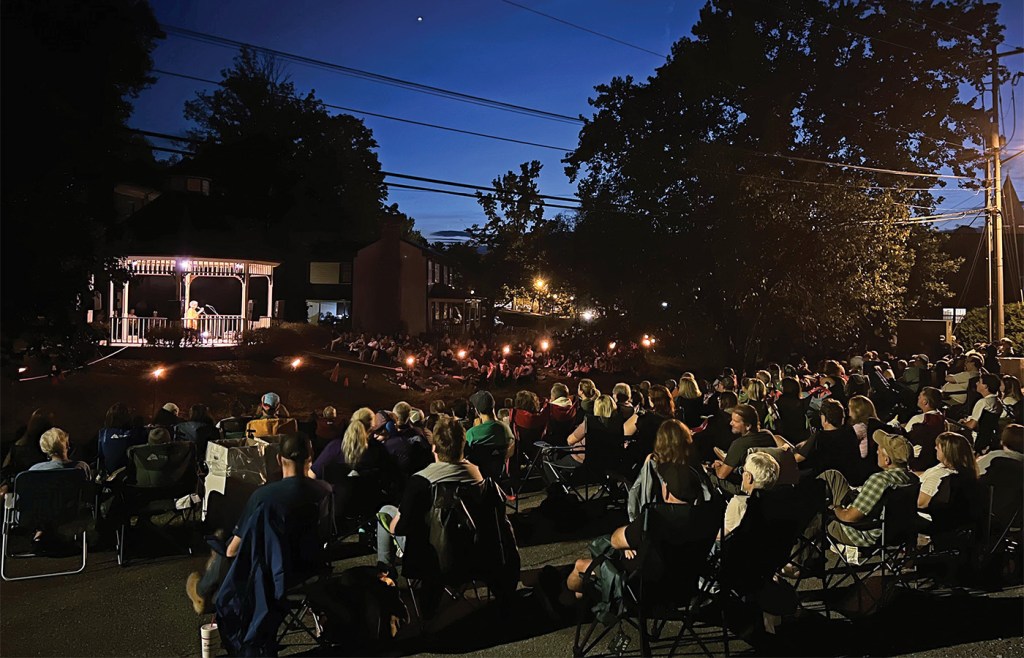
By evening, a crowd had descended upon Mill Spring Park, where tellers waited beneath a white gazebo to share stories of ghosts and ghouls, madmen and villains, witches and haints. In the meadows, families gathered in anticipation. The renowned storyteller Connie Regan-Blake, who learned from Ray Hicks and followed in his footsteps, approached the microphone. She told the grisly tale of a would-be bride who caught her suitor in murderous acts and exposed him to her brothers and to the townsfolk. When the story ended, there was raucous applause.
Then, a hush fell over the park. Lanterns cut through the darkness, and an easy wind moved through the trees. Regan-Blake addressed the crowd directly.
OVERALL SUCCESS: THE SMALL-TOWN APPEAL OF VINTAGE WORKWEAR
“That story has been told for at least 400 years,” she said. “And in the telling of that story, we can meet our ancestors.”
Somewhere far away, a train whistle pierced through the night.
Farahn Morgan is a contributing writer at Country Highway and a freelance writer living and working in the American South.