
The Nov. 3 midterm elections look to be another desultory election cycle for Republicans. Democrats are poised to, again, win every statewide office. Redrawn House maps endanger up to five GOP incumbents. And the legislature is set to remain a deep shade of blue.
But California Republicans have one bright spot, a bit over a month to go until Election Day. Not in a political candidate. Rather, a ballot measure for a cause that’s long been a Republican article of faith — the need for voter ID.
Proposition 39 would require Californians voting in person to present government-issued identification. Voters casting ballots by mail would have to designate a government-issued identification number and provide its last four digits on their ballot envelopes.
The proposed state constitutional amendment has a real chance of passing. Per a SurveyUSA poll sponsored by KGTV News 10 and the San Diego Union-Tribune, 48% of likely voters say they would vote in favor of the measure. While 38% say they would vote against it. An additional 13% of voters remain undecided, according to the survey, released on Sept. 21.
To be sure, passage is going to be tough. A Public Policy Institute of California survey released Sept. 15 found likely voters opposed the measure by 12 percentage points.
Yet the fact that such a measure is even remotely competitive in the nation’s premier Democratic state is a victory of sorts for supporters. California has spent years making voting easier. Now, the proposal championed by Republican Assemblyman Carl DeMaio (R-CA) is a political thumb in the eye to California Democrats. They have for years said adding another layer of verification between registration and casting a ballot is a form of voter disenfranchisement.
It’s a battle predating President Donald Trump’s false and misleading claims about the security, integrity, and vulnerability of U.S. voting systems. And it’s turning the Golden State into an unexpected battleground in the epicenter of a national debate over how aggressively states should police voter eligibility.
After all, California has millions of registered voters, an expansive vote-by-mail system, and a Democratic political establishment that has spent years fighting Republican efforts to impose stricter voting requirements. At the same time, Republicans see California as a place where skepticism about election administration has created an opening.
DeMaio’s case for voter ID
DeMaio is an apt public face for the voter ID ballot measure, as his up-and-down political career has been spent in fierce political combat. After a 2008 to 2012 stint on the San Diego City Council, he lost a San Diego mayoral bid. Then he was defeated in two congressional races. He won a race for the state Assembly in 2024 and represents a district that encompasses inland parts of San Diego County.
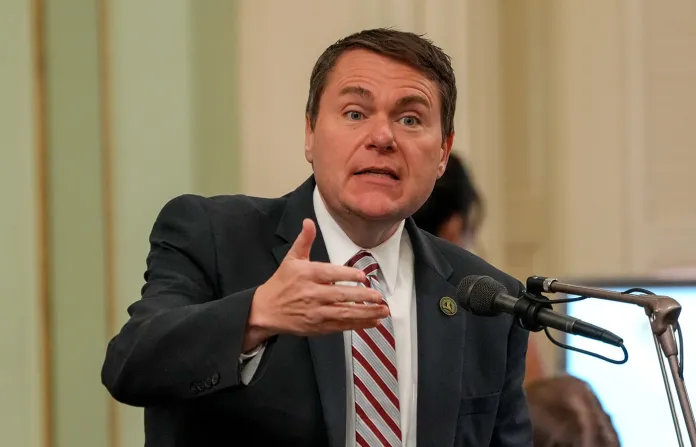
In Sacramento, DeMaio, 52, earned a reputation as a legislative brawler. His fiery state Assembly floor speeches have drawn repeated calls for formal reprimands from Democratic leaders.
Despite being a minority voice in the state Capitol, where Democrats dominate, DeMaio has a shot at statewide success with the voter ID ballot measure. Including parts straight out of the MAGA playbook. Proposition 39’s provisions would, among other things, require election officials to make “best efforts” to verify the citizenship status of registered voters using government databases and report the percentage of voters verified in each county. The state would provide free voter identification cards to voters who request them.
Supporters say the changes would strengthen election security and increase public confidence. Opponents argue California already has safeguards in place and that new requirements could create additional hurdles for eligible voters while costing state and local governments millions annually.
DeMaio argues the ballot measure responds to declining confidence in elections across party lines.
“This is a problem that is not just occurring among Republican voters,” DeMaio told the Washington Examiner, adding that Democrats and independents also have doubts.
He said his campaign conducted focus groups with a variety of voters to identify reforms with cross-party support.
“What we found is that even Republican voters in California like mail ballots,” he said. “They like the convenience of them.”
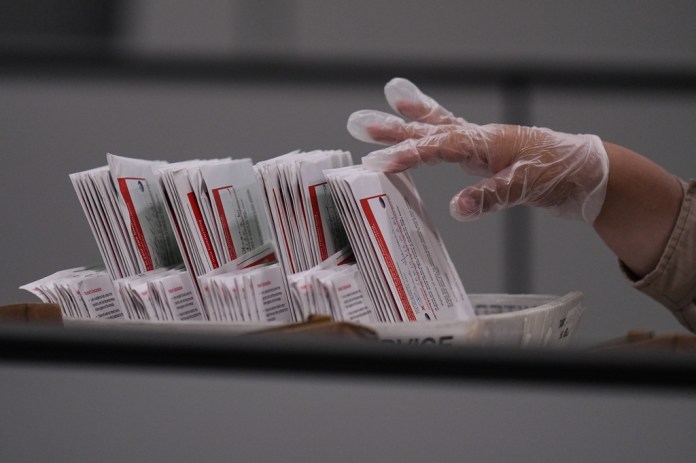
That distinction is central to his argument. Proposition 39 would preserve California’s vote-by-mail system while adding identification requirements. All registered California voters currently receive mail ballots, and in the November 2024 presidential election, about 13 million of the roughly 16 million people who voted did so by mail, according to the Legislative Analyst’s Office.
DeMaio said voters want the convenience of voting by mail but also want greater assurance that ballots are properly authenticated.
He also points to California’s signature-verification system, which officials use to verify mail ballots before counting them. DeMaio cited roughly 86,000 rejected ballots, though California’s rejection data include multiple reasons and should not be characterized as ballots rejected solely because of signature mismatches.
Democrats’ rebuttal
Garry South, a longtime California-based political expert, rejects the measure’s premise.
“The whole voter-ID and so-called election-integrity issue is a totally phony one promoted by Trump-led Republicans,” South said, arguing that illegal voting is an extremely small problem and has never determined the outcome of an election.
Dave Spencer, another political strategist, offered a more nuanced view. He said voter ID can be reasonable if voters have easy access to identification. But he questioned whether additional requirements could become a “slippery slope” toward proof of citizenship or further restrictions on mail voting.
DeMaio also rejected that argument, saying Proposition 39 was designed to preserve mail voting and avoid unnecessary burdens.
The citizenship provision creates its own questions. Election officials would have to make “best efforts” to verify that registered voters are U.S. citizens using government data and report annually the percentage verified in each county. The measure also would require the California legislature to pass additional laws addressing implementation details, including which forms of identification could be accepted and what would constitute “best efforts” to verify citizenship.
How much verification is enough?
California already requires people registering to vote to attest under penalty of perjury that they are U.S. citizens and to provide identifying information, such as a driver’s license number, state identification number, or the last four digits of a Social Security number. Proposition 39 would add verification requirements each time a voter casts a ballot.
The mail-ballot requirement could be particularly consequential. Election officials would have to verify that the identification information on the ballot envelope matches the voter’s registration information.
That raises practical questions: What happens if a voter replaces a driver’s license, changes a name, has outdated registration information, or writes the wrong four digits?
Irina Tsukerman, a geopolitical analyst and president of Scarab Rising, said implementation matters because California differs from states where voter-ID debates focus primarily on presenting a document at a polling place.
“California sends every registered voter a mail ballot, and most voters use it,” she said. “That feature will make the argument about implementation especially important.”
She said election security involves more than preventing fraud. It also means maintaining accurate voter rolls, authenticating ballots, catching errors, and giving the public enough information to trust the results.
Question of confidence
Supporters aren’t arguing that California elections are riddled with fraud. They believe that additional safeguards can increase public confidence.
Mike Fahey, a Democratic political strategist, said there is a legitimate debate over election security but cautioned that confidence alone cannot justify every new requirement.
“There is absolutely a legitimate conversation to have about election security,” Fahey said. “The question is whether a proposed safeguard solves an identifiable problem without creating a bigger one.”
The Legislative Analyst’s Office estimates Proposition 39 would increase state and local government costs by tens of millions to low hundreds of millions of dollars annually, with the exact amount depending on future implementation decisions. The office says any savings from removing ineligible voters or those who lack government-issued identification likely would not exceed the measure’s costs.
DeMaio disputes that assessment. He argues that more accurate voter rolls could save money by removing ineligible registrations and reducing ballots and election materials sent to people who are no longer eligible.
A fight over trust
The money flowing into the campaign also reflects the stakes.
As of Sept. 21, committees supporting Proposition 39 had reported $21.98 million in top-aggregated contributions, compared with $14.32 million for opposition committees. Richard Uihlein, the largest listed supporter, contributed $10.5 million.
DeMaio insists the measure is not designed to favor Republicans.
“I required that it have support of Democratic voters, Republican voters, and independent voters,” he said.
The official voter guide presents the competing arguments starkly. Supporters describe Proposition 39 as a bipartisan voter-ID measure intended to increase trust and confidence in elections. Opponents argue it could create barriers for eligible voters, expose personal information, and impose high costs.
For DeMaio, the argument is straightforward.
“Voter ID. … Just do it right,” he said. “Do it balanced.”
Ballot language lawsuit
The measure’s wording has become a fight in itself.
Proponents sued Attorney General Rob Bonta after his office issued the official ballot title and summary, arguing the language was misleading and partisan.
The official title now reads: “Prohibits Citizens From Voting Unless They Present Government-Issued Identification.”
CALIFORNIA SUES TRUMP OVER DEAL TO CANCEL OFFSHORE WIND PROJECTS
The official summary says mail voters would have to provide the last four digits of a government-issued identification number that matches the number designated in their voter registration.
A Sacramento County Superior Court judge rejected the DeMaio group’s challenge in August, ruling that the title, label, and summary accurately described the measure. DeMaio took particular issue with the phrase “prohibits citizens from voting,” arguing that supporters see Proposition 39 as protecting eligible voters’ ability to cast valid ballots.
Barnini Chakraborty (@Barnini) is a senior political reporter at the Washington Examiner.