
Embattled Maine Senate hopeful Graham Platner could wield his campaign cash in ways that help make or break a potential replacement Democratic nominee.
Platner has until Monday to withdraw from the battleground race against Sen. Susan Collins (R-ME) and kick-start the process of finding another nominee, a once unthinkable outcome that appears all the more likely after losing Democratic Party support over a rape allegation that Platner has denied.
The Platner campaign had just under $2.2 million cash on hand as of May 20, according to the most recent filing with the Federal Election Commission. It’s enough money that, when paired with the national party and allied groups, could bolster a new candidate starting from scratch. But Platner could also use it in ways that hinder a potential successor.
“Every dollar should go to the Maine state Democratic Party,” said Jon Reinish, a Democratic strategist and former aide to Sen. Kirsten Gillibrand (D-NY), who now chairs Senate Democrats’ campaign arm that’s pulled financial support for Platner. “He should do whatever is the quickest and easiest and step away from public life.”
Platner could make unlimited transfers from his campaign to any national, state, or local political party committee, according to federal election rules. That includes entities like the Maine Democratic Party and Senate Democrats’ campaign arm, the Democratic Senatorial Campaign Committee. Platner is capped at transferring $2,000 directly to another candidate.
Collins had $9.6 million in the bank as of May 20, underscoring the financial help that any new candidate would need to take on a longtime incumbent flushed with cash. WinSenate, a political action committee affiliated with Democrats’ main super PAC, the Senate Majority PAC, has $19 million in Maine ad reservations for the November general election compared to nearly $46 million from Republicans, according to the ad tracking firm AdImpact.
If Platner withdraws by Monday at 5 p.m., the state Democratic Party has until 5 p.m. July 27 to select a new candidate. In addition to the campaign funds, Platner would have undeniable endorsement influence with his voters.
Sources close to the Platner campaign have suggested to media outlets that the candidate, who’s yet to make a decision, could use the short timeline to insist on a “guarantee” that a replacement embody his progressive populist views. Maine Democratic Party Executive Director Devon Murphy confirmed the campaign was seeking to sway the outcome, saying in a video statement Tuesday night that Platner’s team “has repeatedly reached out to us in an attempt to put their thumb on the scale” but that the state party “repeatedly reiterated to Graham Platner’s team that they have no role” in determining another nominee.
Platner could also use his money for civil or criminal legal defenses that may arise as a result of the allegations against him, or any other litigation that may arise in relation to his candidacy.
A further option is to adopt an approach like Sara Gideon, the 2020 Democratic nominee who lost to Collins. Gideon, the former Maine speaker of the House, ended her campaign with more than $14 million and has since given much of it to other Democrats, organizations, and charities. But she still had nearly $2.7 million as of March 31, according to the most recent filing available, and has been floated by some Democrats as a potential option.
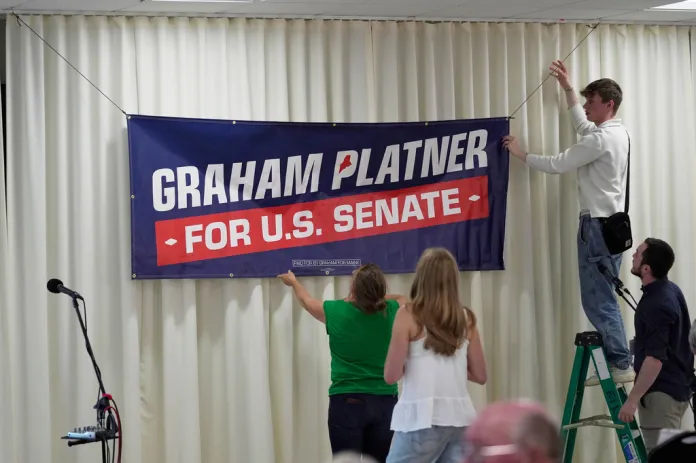
The Platner campaign and DSCC were previously in the process of establishing a joint fundraising committee, a move often used by Republicans to help coordinate fundraising and spending with candidates. Last week’s Supreme Court ruling that struck down coordination limits between political parties and candidates makes Platner’s funds all the more useful for a new candidate, if he transfers them to a party committee.
TROY JACKSON FILES EXPLORATORY BID TO REPLACE GRAHAM PLATNER
Reinish, the Democratic strategist, admonished the notion Platner should have any leverage to influence what comes next.
“He’s got not one card to play. Zero leverage whatsoever. Neither does his team, neither do the consultants who either didn’t vet him or who sat on information whistling past the graveyard that it wouldn’t come out,” he said. “These people should have absolutely zero say in who Platner’s replacement is as the party tries to scramble what should be the most winnable seat of all in the quest for the U.S. Senate.”