
A niche dispute over an Israeli communications regulator has exploded into a controversy so immense that lawmakers in the Knesset are invoking biblical narratives of exile and warning it could bring about an end to the country’s democratic system.
Israeli Prime Minister Benjamin Netanyahu’s Cabinet is refusing to accept a ruling from the High Court of Justice demanding the Second Authority for Television and Radio, its federal communications regulatory body, resume operations. It is the first time that the Israeli government has refused to comply with a ruling from the High Court, with Communications Minister Shlomo Karhi calling the judges “drunk with power” and comparing them to a Talmudic monster.
“After four years of a term in which I fought with all my might against the instigators of anarchy in the media and the judiciary, this week we brought an unprecedented decision to the government that returns the golem in the High Court to its natural place,” Karhi said on Monday.
Israeli President Isaac Herzog is warning that “noncompliance with a court ruling is a red line that must not be crossed under any circumstances,” and opposition leaders are comparing the situation to tragedies such as the destruction of the Second Temple and the Holocaust.
“If the government of Israel decides not to obey a Supreme Court ruling, from that moment every citizen is forced to ask himself: ‘Who do I obey? The government? The court?’” Naftali Bennett, former Israeli prime minister and leader of the Together party, said Monday. “And when there is no single answer, there is no single state. There is anarchy — chaos. That’s how they split Israel into two kingdoms.”

He continued: “It’s already happened to us twice, and twice it ended in destruction. The second time we suffered two thousand years of exile, pogroms, persecutions, and a terrible Holocaust.”
The source of unrest is the High Court’s order for the communications regulatory authority to resume operations despite a lack of quorum. Multiple members resigned in recent months in order to force the government body to pause, preventing the sale of outlet Channel 13 to a group of entrepreneurs hostile to the incumbent government.
The High Court ordered in June that the council resume operations despite the legally insufficient number of members. But Cabinet members voted unanimously over the weekend to reject any decisions made by the council until it meets the proper head count — claiming that the lack of quorum prevented the legitimate exercise of power.
“High Court judges are not the Knesset, and a fit of power does not grant authority to erase an explicit threshold condition from the law, even if it is inconvenient for them. The rule of law is not the rule of the judges,” the communications minister wrote in his joint statement with Justice Minister Yariv Levin.
The ministers continued: “Today the government has clearly stated — when the High Court tramples the law, the state will not lend a hand to it. Two-thirds is a legal requirement, not a recommendation, and a council that does not meet the threshold conditions set by the legislature does not exist, and its decisions are worth as much as a nutshell.”
Yair Lapid, leader of the centrist party Yesh Atid and official Leader of the Opposition, said that it is the culmination of a premeditated campaign by Netanyahu’s government to undermine the authority of the High Court.
“[Government officials] keep saying over and over again that the court is not the body that determines what the law is, so that we become accustomed to the idea,” Lapid said Monday. “The poison machine keeps relentlessly pushing this narrative until madness begins to sound reasonable.”
“This is a deliberate strategy. Its goal is to steal the election,” he said. “They will claim there is some security event, or they will create one, and delay the elections. And if there is no court, there will be no one to appeal to.”
Culture and Sports Minister Miki Zohar sought to deescalate the situation on Monday in an interview with public broadcaster Kan, assuring listeners that Netanyahu will “comply with the High Court’s decision.”
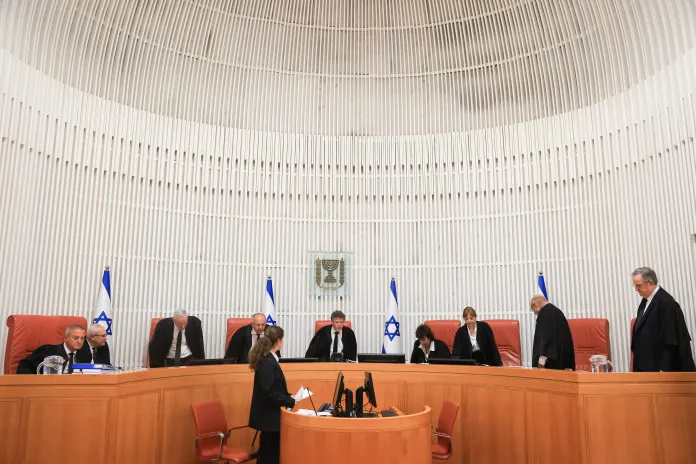
“There won’t be a constitutional crisis here,” Zohar said. “In my opinion, a constitutional crisis is the beginning of a slippery slope.”
NETANYAHU RIPS ANTI-ISRAEL ‘WOKE RIGHT,’ REBUFFS VANCE’S ‘ONLY POWERFUL ALLY’ REMARK
Zohar attempted to flip the narrative against the High Court and its supporters, asserting that the rebuke issued to the High Court on Sunday by Karhi and Levin “did not create a constitutional crisis, but sought to prevent one.”
“We told the High Court that its behavior was against the law,” Zohar insisted on Monday. “We must obey the High Court’s decisions, but we are saying that we are on the verge of a constitutional crisis.”
Netanyahu has not yet publicly commented on the situation. He is currently embroiled in a series of trials examining whether he engaged in bribery and corruption with media titans in order to secure more flattering coverage.