
Andy Serkis, the director of Angel Studios’s new Animal Farm adaptation, practically admits that it’s about whatever kind of authoritarianism you want it to be.
“The debate is the thing,” he told the crowd at an early screening of the film in Washington, D.C. “Ideally, it would be parents listening or the grandparents listening to their kids having watched it. That’s the goal. We want them to be the ones who have the voice because they are the ones who will inherit our very, very troubled and untrue world that we’re living in.”
Serkis has spent much of the press tour doing one kind of damage control or another. When the first trailer for the film came out in December, it immediately went viral, and not for good reasons.
Whether it was because of Napoleon the pig performatively shaking his rump, or the bouncy background tones of “Feel It Still” by Portugal. The Man, audiences worried that the film may be too glib an adaptation of George Orwell’s 1945 masterpiece, a book that criticized a regime responsible for millions of deaths. Then there was Mr. Pilkington, the farmer who was meant to represent the Allies in the book, who was turned into a high-tech evil capitalist girl boss voiced by Glenn Close. Was the film actually criticizing capitalism, not communism?
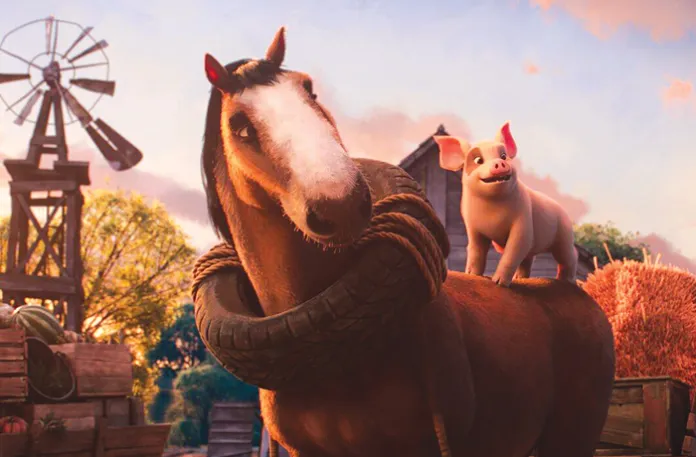
The makers of the movie don’t like to weigh in too definitively. At the Washington screening, Serkis ambiguously nodded to “the commonality actually between people on the Left and the Right who both felt that in some way we betrayed Orwell” and referenced the criticism that “we were telling a story about capitalism and not communism.”
“It was fascinating,” he said, “because it really just got people up, and that’s exactly what we wanted to do with the film.”
Words such as “interesting” and “fascinating” are often employed by people who have more to say than they’re letting on, and the messages about what’s really going on in the film have been mixed. While a USA Today story suggests that Serkis “gravitated toward themes of capitalism, wealth and overconsumption,” co-producer Jonathan Cavendish pushed back on the idea that the film was anti-capitalist, pointing to a scene where the animals sell produce at a farmers’ market.
The film itself is similarly equivocal, certainly more focused on consumption than Orwell’s original, but not as anti-capitalist as some have made it seem. In Animal Farm, the political figures you recognize may depend on your own leanings. Is Napoleon like President Donald Trump? Or socialist New York City Mayor Zohran Mamdani?
Ultimately, Animal Farm is too forgettable to warrant this much investigation.
There are positive elements to the film. Like the protagonist, Lucky, a young pig who’s not in the book, and gives the story a happy ending.
After the animals band together to take down the despotic Napoleon, Lucky concludes that no one has all the answers and that the animals should work hard because they choose to, not because they have to. These are two excellent free-market concepts. The great economist F.A. Hayek famously warned that no one person has the knowledge for effective central planning. As he wrote in The Fatal Conceit: The Errors of Socialism, “The curious task of economics is to demonstrate to men how little they really know about what they imagine they can design.” And the idea of choosing to work hard to benefit oneself and one’s community is unequivocally patriotic.
The movie’s flaws, however, are more prevalent. I’ll start with an artistic quibble, namely, that the animation style of the human characters is weirdly eerie and oddly reminiscent of the nearly 20-year-old Bee Movie. More seriously, the film’s moral messages fall largely flat.
In one scene, when Lucky and the horse Boxer are debating whether it’s wrong to drink extra milk without sharing it with the entire farm, Boxer refuses but quickly dismisses the conversation: “You worry too much, Lucky. Remember what I always say: Just look up at the stars. They take all our worries away.” Of course, the story of Boxer is really about how being stupid can get you exploited and killed, but I don’t think any kids are going to realize that Boxer’s pabulum is just that.
There are plenty of other things that will go over children’s heads but may bother their conservative parents. The character of Snowball is voiced by the transgender-identifying actor Laverne Cox, who, in a red carpet interview, compared the dehumanization of the animals in the movie to the experiences of male athletes who want to play in girls sports. Near the end of the film, Napoleon is soaking up the adoration of the crowd when he tells them that people who believe in limits on power are “losers,” creating a not-so-subtle nod to a certain prominent leader who’s fond of the word. (Angel Studios is also inexplicably selling a MAGA-style red hat that says, “Make Animal Farm Fiction Again.”)
It’s hard for even good artists to make politics-adjacent art in the Trump era, and that’s because every politician has to become a Donald doppelgänger. When Peaky Blinders introduced the real British politician Oswald Mosley in its fifth season, his rhetoric was distinctly Trump-like. Amazon’s The Boys was a clever twist on the hero genre until its lead villain became an obvious stand-in for Trump (and showrunner Eric Kripke would say so every chance he got).
At the Animal Farm screening in the district, Cavendish said that nobody knows who Leon Trotsky is anymore, but if Orwell were writing today, “it wouldn’t be communist totalitarianism. Probably, he would be writing a lot about America.” We’ve been informed by British media that fascism is on the rise in the United Kingdom, so I’m not quite sure that’s accurate. But everyone always wants to make the United States the main character, and it’s hard to complain about that.
Even more confusing than the film’s muddled messaging is the fact that it was distributed by Angel Studios, the company best-known for conservative and faith-based films such as Sound of Freedom, Cabrini, and The King of Kings. A spokesman for the studio pushed back on the criticism months ago, saying, “1. Angel is the distributor of this film, not its producer, nor with creative control. 2. Angel Guild members viewed the film and voted heavily to support it. 3. While the title is the same as the classic book, updates were made to make it relevant to a broad-based, values-centric, family-friendly audience. 4. This is an anti-communism film, and the Angel Guild will ensure that it stands by the principles of our members.”
The question of whether or not to celebrate the film because of Angel Studios or to criticize it because of the capitalism controversy is currently dividing conservatives. One could say that to the extent that any anti-communist messages remain in the film, they have the potential to reach a massive audience, considering the star power of voice actors Seth Rogen, Woody Harrelson, and Serkis himself. Or, as most seem to agree, perhaps the studio made a big mistake in picking this film to distribute.
ANIMAL FARM FILMMAKERS PUSH BACK ON ‘ANTI-CAPITALIST’ MOVIE CRITICISM
Amid the shopping sprees and the fart jokes, there is a good story hiding within Animal Farm, and that story is Orwell’s classic. It’s true that Orwell wouldn’t have liked Trump. Despite creating one of the greatest pieces of anti-communist literature, he aligned himself with “democratic socialism.” What he hated was totalitarianism, something that people on the Left never suspect may be erupting on their side.
What lesson children will take from the movie is really up to their parents, should they choose to take them at all.
Madeline Fry Schultz is a writer and editor based in the Washington, D.C., area.