
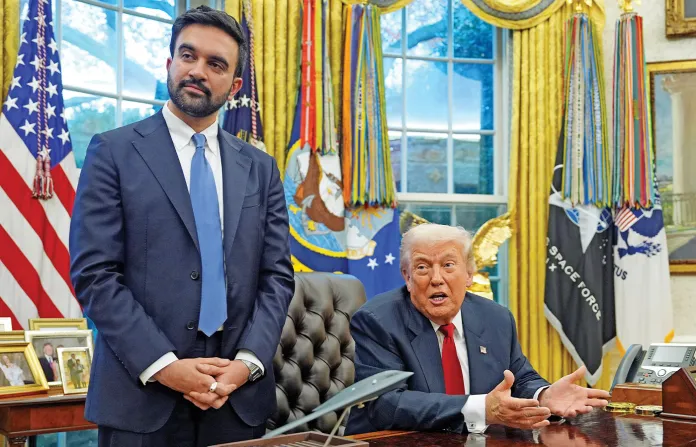
Political opposites President Donald Trump and New York City Mayor Zohran Mamdani continue to have a surprisingly friendly relationship. In an interview on Meet the Press last month, Mamdani called Trump “honest, direct, and productive,” not the kinds of words Democrats typically use about Trump. When asked about the unusual nature of their relationship, Mamdani attributed it to the fact that they are both New Yorkers, saying, “New York City holds a very special place for him as well as for me. We’re both from the same city.”
These friendly comments come in the wake of their initial November meeting in the White House, which shocked observers by turning into an unexpected lovefest. Even though the men had called each other quite critical names over the course of Mamdani’s successful mayoral run, including “communist,” “fascist,” and “despot,” they were all smiles when they met in person. Things remained friendly after the meeting, with the two men maintaining an ongoing texting relationship. The men were both genial and cooperative in a February meeting on housing investment in New York, and Mamdani got Trump to release a Columbia University student from ICE detention. Even though Trump has privately admitted to being irked by Mamdani on occasion, the mayor’s latest comments show that their friendship remains intact.
Perhaps the Trump-Mamdani friendship shouldn’t be so surprising. Trump, for his part, has long been known to be a bear in public but disarmingly gracious behind closed doors. As for Mamdani, presidential historian and former Mario Cuomo aide Harold Holzer told me that the mayor “has figured out that flattery will get him everywhere — and Trump is lapping it up.” It is also clearly not lost on Mamdani that the federal government spends $337 billion in New York, which is over $200 billion more than New York’s own annual budget. Without that money going to Medicaid, welfare, public housing, transit, and education, New York would be in even more dire financial straits than it already is.
All of this is true, yet there is another reason for their odd friendship, rooted in their apparent knowledge of New York political history. Both of these savvy politicians seem to recognize the reality that feuds between mayors of New York and presidents can be dangerous on both sides. In the past, fighting between New York mayors and presidents has often caused problems for both players, even when both men were of the same party.
Republican President Richard Nixon viewed New York Mayor John Lindsay as one of his “enemies” and offered to have Lindsay wiretapped for the benefit of New York Gov. Nelson Rockefeller, who hated Lindsay. In 1970, Nixon was angry with Jewish protests against French President George Pompidou over France’s stopping the shipment of planes to Israel. As part of the protests, Lindsay and Rockefeller boycotted a dinner with Pompidou. Nixon had to apologize to Pompidou publicly, and Nixon privately grumbled about the protesters, “Let ‘em get their planes from Rockefeller and Lindsay.”
On the Lindsay side, Holzer recalls that “Lindsay criticized the Nixon administration over Vietnam, and Nixon reacted by increasing his hostility towards New York.” According to New York City historian and Lindsay biographer Vincent Cannato, part of the problem in this case was that “Lindsay and Nixon were both vying for the moderate wing of the GOP. They really were kind of competitors.” Lindsay noisily quit the Republican Party in 1971, blasting the Nixon administration in the process for a “retreat from the Bill of Rights.” In addition, one of Lindsay’s aides, Francis O’Brien, later served as Chief of Staff to House Judiciary Chairman Peter Rodino during the Watergate investigation that ultimately sank Nixon’s presidency.
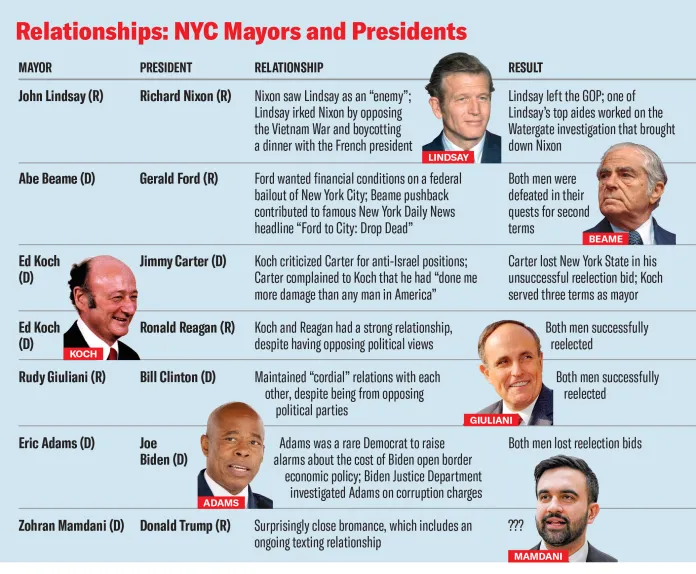
Nixon was replaced by Gerald Ford. New York was facing bankruptcy at the time, and Mayor Abe Beame sought a bailout from the federal government. According to Holzer, Ford’s “administration had no confidence in Beame” and therefore wanted to impose financial conditions on New York. This standoff led to the legendary October 1975 Daily News headline, “Ford to City: Drop Dead.” Mamdani demonstrated his knowledge of this history, and his certainty that Trump knew it as well, by gifting a mockup of that famous front page to Trump in February.
The bailout controversy did not serve either Ford or Beame well. Holzer notes that “Ford and his people infamously treated Beame as if he wasn’t a functional leader,” even though Ford was warned that his tough stance could hurt him electorally in New York State. In 1976, Ford lost a squeaker of an election to Jimmy Carter, losing New York State in the process, and blamed the Daily News headline for his loss. The next year, Beame lost the Democratic primary in his reelection bid, ending his troubled tenure.
Democratic congressman Ed Koch, the man who beat Beame, himself tormented the man who defeated Ford, Jimmy Carter. In contrast to Mamdani today, Koch recognized that it was smart politics for the mayor of America’s most Jewish city to be a big supporter of Israel. Carter, however, was an Israel critic, and some of his top aides were even worse, putting the Carter administration in Koch’s crosshairs. At one point, Koch referred to five top Carter officials as an “anti-Israel gang of five,” which was an unflattering reference to the murderous “Gang of Four” heading Maoist China’s Cultural Revolution. Carter was not happy with the comment, noting in his diary that Koch had been acting like “a fanatic.”
According to Holzer, Koch risked the loss of federal aid to New York “by fighting so personally with President Carter over Israel, but he deserves credit for standing on principle as a Jewish American.” In doing so, though, he alienated Carter, who confronted Koch at a fundraiser and told him, “You have done me more damage than any man in America.” Carter was right about that: He was unsuccessful in his reelection bid against Ronald Reagan, losing New York State in the process.
Even though Koch and Reagan were of different parties, they got along much better than Koch and Carter did. According to Cannato, “Reagan and Koch had a decent relationship, but I think it was relatively tricky for Koch because of the partisan leanings of the city.” Koch handled this challenge by taking an approach that he later characterized as, “I never voted for him, but I loved him.”
The Republican Rudy Giuliani and Democrat Bill Clinton also understood the fact that a New York mayor and an American president of different parties could get along. Clinton noted in his memoir that he and Giuliani had “cordial” relations, at least until Giuliani briefly ran against Clinton’s wife Hillary for Senate. Giuliani, citing health problems, pulled out of the race, thereby staving off a potential Clinton-Giuliani confrontation. Both New York and the country boomed under their administrations.
In recent years, New York State has become a solidly blue state, so its decision in presidential election years is no longer a question. But presidents and New York mayors can still make trouble for one another. Eric Adams caused headaches for Joe Biden’s administration by calling out Biden’s open borders policy, saying, “The president and the White House have failed this city.” Adams’s open criticism of a president from his own party irked the Biden team, which removed Adams from a Biden campaign advisory board. Biden’s Justice Department also investigated corruption charges against Adams, an investigation that helped make Adams’ reelection bid unviable.
It’s a little odd that the New York City mayor has such political power and resonance, given that the job is a terminal position whose inhabitants have a poor track record in seeking higher office. Many New York mayors have long aspired to more, but none have progressed beyond Gracie Mansion. Lindsay had his sights on the presidency, but his candidacy never got anywhere. Koch defeated Mario Cuomo for mayor, but Cuomo turned around and beat him when Koch sought the governorship in 1982. Rudy Giuliani briefly led in the polls for the 2008 Republican presidential nomination, but his career has been on a rapid decline ever since. Mike Bloomberg spent $1 billion to win 55 delegates for the Democratic presidential nomination in 2020, about $18 million per delegate. Despite some talk of Mamdani as a future presidential candidate, it’s unlikely that his extreme progressivism would gain purchase outside of deeply blue New York City.
WILLIAM F. BUCKLEY JR. AT 100: THE IRREPLACEABLE POLICEMAN OF THE RIGHT
As Mamdani’s Daily News headline gift to Trump shows, Trump and Mamdani are clearly aware of some, if not all, of this history. That knowledge appears to play into their unexpectedly friendly relationship. Still, no one knows what they really feel about one another, or how long this might last.
According to Holzer, “history shows us these truces are short-lived, because ultimately the Mayor has to represent the city’s interests, and the president, the national interest.” With those interests in mind, both men seem to have recognized the political benefits of putting a friendly face on things — at least for now.
Tevi Troy (@tevitroy) is a senior fellow at the Ronald Reagan Institute and a senior scholar at Yeshiva University’s Straus Center. He is the author of five books on the presidency, including, most recently, The Power and the Money: The Epic Clashes Between Commanders in Chief and Titans of Industry.