
The incontrovertible fact that legacy movie studios love making movies about their kindred spirits in the legacy media has survived even the collapse of the legacy media. Gone are the days when newspaper movies had something of the spark and spunk of His Girl Friday, Deadline — U.S.A., or — my personal, albeit arcane, favorite — the Torchy Blane series released by Warner Bros. in the late 1930s. In 1976, the film version of All the President’s Men, while artistically formidable, added a note of self-righteous sanctimony that has infected many of its successors, including the relatively recent Spotlight and She Said.
The Devil Wears Prada 2, though, is something else altogether: This is a movie that willingly admits that glossy, snobby, tone-deaf fashion magazines are on life support but imagines that the subject is still sufficiently fascinating to merit a sequel to a 20-year-old movie. Because ticket-buyers have made an unlikely hit out of the sequel, one of two things must be true: 1) there is a heretofore undocumented interest among moviegoers in the struggles of the legacy media; or 2) many millions of people wish to see Meryl Streep and Anne Hathaway have a series of passive-aggressive, fashion-related verbal brawls.
Alas, the latter seems the more probable explanation for the box-office success of The Devil Wears Prada 2, but director David Frankel and screenwriter Aline Brosh McKenna clearly had far nobler intentions in mind. Astonishingly, the filmmakers mean to mourn the death by a thousand cuts inflicted upon Runway magazine, which, though fictitious, is clearly a derivation of Vogue, just as Streep’s fearlessly cruel editor-in-chief Miranda Priestly is a stand-in for Vogue’s ex-editor-in-chief, Anna Wintour. In the movie, Runway is being squeezed from all sides: a magazine story in which unjust labor practices were glossed over has gone distressingly viral; Miranda’s boss, Irv Ravitz (Tibor Feldman), equivocates about her promised elevation to oversee all content across the parent company’s media empire; and Miranda’s one-time assistant, Andy Sachs (Hathaway), has been installed as the features editor to restore journalistic integrity and increase the frequency of sought-after clicks.
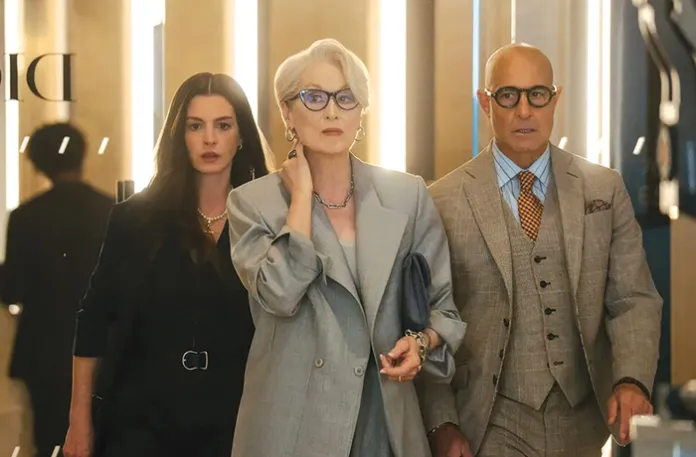
In the movie’s conception, Andy is a figure nearly as honest and incorruptible as Walter Cronkite, but with better clothes. This is among the first of the script’s contradictions: Although Andy has burnished a reputation as a hard-hitting, prize-winning journalist at the made-up New York Vanguard (apparently an alternative paper, if such things still exist?), the moment she is fired and the features position at Runway is dangled before her, she enthusiastically joins a publication whose idea of a scoop is a sit-down interview with a billionaire’s ex-wife about her estate and art collection.
Hathaway has always had a knack for embodying her characters’ wholesome, sincere qualities, but she wastes her reserves of earnestness on Andy. It is simply not credible that Andy should so mindlessly trade her uncompromising newspaper job for a succession of photo shoots, gala events, and international jet-setting. One minute, she rails against the well-compensated CEO of the New York Vanguard. The next, she covets a dress that she could wear to a fancy gathering in the Hamptons. “Runway does have a history of publishing great writing,” Andy says, but it is not clear if this statement is meant to be a reflection of her intelligence or self-delusion.
“Self-delusion” could also describe the film’s idea of Andy as a struggling ink-stained wretch prior to her elevation to Runway’s masthead: Her apartment, while trickling brown water when the sink faucet is turned on, would still be the envy of most struggling writers, and although her Runway colleague Nigel (Stanley Tucci) insinuates that her wardrobe has been acquired at TJ Maxx, the truth is that Hathaway is never allowed to look anything but glamorous. Naturally, the movie’s idea of showing a features editor at work is Hathaway jotting in her notepad or editing stories late at night while snuggled up on her couch.
Worst of all, The Devil Wears Prada 2 does not so much satirize its subject as wickedly kid it. Miranda may be coded as a ruthlessly imperious boss — she instructs an assistant to make a phone call for her while standing directly in front of the phone — but the film obviously delights in her presence and, worse, seems to admire her. Streep plays Miranda without shading, subtlety, or surprise because her single note of self-important viciousness is presented as preferable to the various forces that mean to sideline her, including the drearily unfashionable scion of the newly deceased Irv, Jay Ravitz (B.J. Novak), and a filthy rich, newly thin tech bro billionaire, Benji Barnes (Justin Theroux). That Jay intends to cut Runway’s budget to the bone, and Benji seeks to install his girlfriend Emily (Emily Blunt) as the new editor-in-chief, is a trivial distinction: each would involve the dethroning of Miranda Priestley, which is simply inconceivable. This is the same mentality that lamented the rebranding of MSNBC as MS NOW, or the federal defunding of NPR.
AI COULD HAVE MADE THE NEW MICHAEL JACKSON MOVIE
Oh, what would the world do without fashion magazines read by ever fewer numbers of people and run by editors even fewer people have heard of? In the world of the movie, such realities cannot come to pass: Having long forgotten the New York Vanguard, Andy engineers and then halts one corporate takeover, and then engineers a second, all to preserve a legacy media brand of obvious irrelevance and incredible pomposity. Late in the movie, when Nigel delivers some speech about the longtime relationship between his magazine and the Milan Fashion Week, it is presented as though it is oratory on the order of the “Declaration of Principles” scene in Citizen Kane. Perhaps it goes without saying that the male characters in this series are muted to the point of invisibility, including Kenneth Branagh as Miranda’s compliant significant other. How the Hamlets have fallen.
Of course, it is not lost on me that few of the moviegoers who have turned out for The Devil Wears Prada 2 care that they are being delivered yet another sermon on behalf of legacy media. They merely want to watch the sweet-natured Hathaway share screen time with the stern Streep, and though each actress seems slightly wearier than they did 20 years ago, the movie does deliver on such scenes. Maybe they just want to see shots of clothes on hangers and cameos by Lady Gaga and Donatella Versace. Here, too, the movie delivers. But the spectacle of Hollywood turning the survival of a fashion magazine, and the continued employment of its mean editor, into a moral crusade is a bridge too far. In All the President’s Men, at least Woodward and Bernstein had an impact on history. In The Devil Wears Prada 2, Andy Sachs merely contributes to the clutter for sale in the grocery store checkout aisle.
Peter Tonguette is the Life & Arts editor of the Washington Examiner magazine.