
World Health Organization officials on Thursday said that eight cases of Hantavirus have been confirmed as a result of an outbreak on a cruise ship, and five of those infected have died.
The outbreak involves the Andes strain of the Hantavirus, a rare variant of the rodent-borne virus primarily found in Argentina and Chile that can be contracted by exposure to infected rodent urine, droppings, or saliva, often when contaminated particles become airborne. It’s also suspected of being transmitted by human-to-human contact.
WHO officials held a briefing Thursday to give the latest updates on the virus and passengers aboard a cruise ship as the ship attempts to dock in the Canary Islands, something Spain is wary of allowing due to the risk of the virus spreading.
The WHO said its doctors are coordinating with officials in the Canary Islands to get passengers off the ship while avoiding the spread of the virus. Doctors from the European Center for Disease Prevention and Control and the Netherlands are aboard the vessel, conducting medical assessments and developing operation guidance for disembarking.
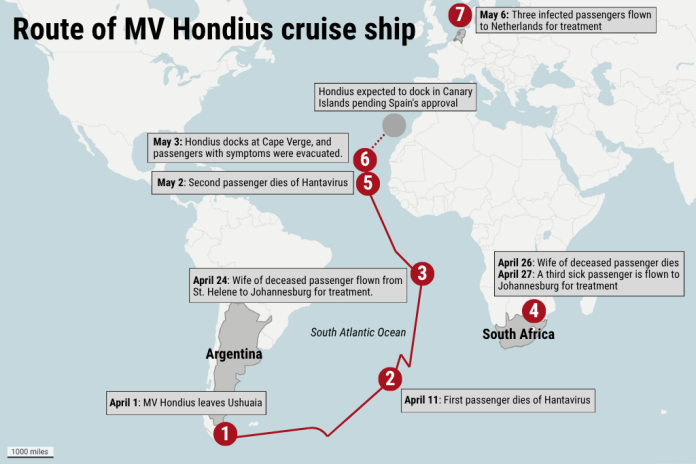
WHO Director-General Tedros Adhanom Ghebreyesus broke down each case of Hantavirus and the circumstances surrounding those who died from the virus.
Tedros said the first case was a man who first displayed symptoms on April 6 and died five days later, but the individual’s symptoms were similar to other respiratory diseases, so the virus was not suspected.
However, when the man’s wife went ashore to St. Helena Island when the ship docked there, she was showing symptoms. She “deteriorated” during a flight to Johannesburg, South Africa, and died one day after arriving there. Tedros said samples were taken from the couple in South Africa, which confirmed they had contracted Hantavirus.
Officials said the couple had traveled through Argentina, Chile, and Uruguay on a bird-watching trip, which likely led them to come in contact with sites where rodents carrying the disease dwell.
The third death from passengers on the ship was a woman who developed symptoms April 28 and died May 2, Tedros said.
An additional passenger with confirmed infection was a man who went to the ship’s doctor with symptoms on April 24 and was evacuated the next day. He remains in intensive care in South Africa.
When the ship arrived in Cape Verde, doctors boarded to provide care for three other passengers with symptoms who were later evacuated to the Netherlands for treatment.
HANTAVIRUS: WHAT TO KNOW ABOUT RARE DISEASE ON ATLANTIC CRUISE SHIP
Tedros said the eighth case was in a man who disembarked in St. Helena at the direction of the ship’s operator and reported symptoms in Zurich, Switzerland. He was confirmed to have been infected with the Andes virus Wednesday.
Health officials have stressed that the overall public risk remains low and emphasized that Hantavirus and its Andes strain do not pose the risk of a global pandemic like that of COVID-19.
The cruise ship departed Argentina in April with roughly 150 passengers and crew before multiple people developed flu-like symptoms that later escalated into severe respiratory illness.
The ship made stops in Antarctica and several other islands on its way to Cape Verde, an island chain in West Africa. Three patients were evacuated from the cruise ship in Cape Verde on Wednesday, while two others have landed in the Netherlands to get medical attention.