
At about 10:04 p.m. on Nov. 3, the Associated Press called the Texas Senate race for James Talarico. Roughly 16 minutes later, Ken Paxton conceded. The Republican attorney general had spent the better part of a year, in one of the most expensive Senate contests in American history, trying to hold a seat in a state that had not elected a Democrat to the Senate since 1988. He finished with about 43% of the vote to Talarico’s 55%. “We just took back Texas,” the Democrat told supporters in Austin.
Texas was the most dramatic result of the night, but it was hardly the only one. By the Associated Press count at this writing, Democrats had won 55 Senate seats to the Republicans’ 44, with Alaska still uncalled. In the House, the tally stood at 255-169, with 11 races outstanding. Democrats flipped five governorships: Georgia, Iowa, Nevada, Ohio, and Texas. The Democratic lead in the national House vote stands at 13.7 points.
Honest conservatives should begin with the obvious. The political environment was brutal. We all know very well by now about the toxic miasma that was created for Republicans by the unpleasant mixture of the Iran war, higher gas prices, tariffs, aggressive immigration enforcement, and the persistent affordability crisis. Republicans have been saying so themselves, to greater and lesser degrees. Sen. Ted Cruz (R-TX), for instance, admitted that too many GOP politicians seemed not to grasp how much voters were hurting at the grocery store and the gas pump.

Yet weather does not explain why some boats sank faster than others. A hostile environment sets the water line, and the quality of the candidates determines who is already taking on water. On the evidence of this election, Republicans launched too many leaky vessels at the top of too many tickets. The good news is that that is a fixable problem. Whether the national mood can be fixed —and, if so, when — is another matter.
An old lesson, relearned
Sen. Mitch McConnell (R-KY) said it plainly in August 2022, when he told a Kentucky audience that “candidate quality has a lot to do with the outcome” in Senate races, because those contests are decided statewide. Four years later, it reads like a warning.
The principle is older than McConnell. William F. Buckley Jr.’s famous rule of thumb held that conservatives should back the most conservative candidate who can actually win. Republicans relearned the lesson the hard way in 2010 and 2012, when they nominated Christine O’Donnell in Delaware, Todd Akin in Missouri, and Richard Mourdock in Indiana, and lost all three Senate races. Postmortems were written and filed away then. That process will now have to be undergone yet again.
Texas: A champion with too much baggage
Paxton’s path to the nomination shows how a primary victory can result in a November punishment. In the March 3 primary, Sen. John Cornyn (R-TX) took 41.9%, Paxton 40.8%, and Rep. Wesley Hunt (R-TX) 13.5%, which sent the top two to a May runoff. Paxton won it with President Donald Trump’s backing. Texas primary voters had their reasons for choosing Paxton. The state’s attorney general had won legal fights against the Biden administration, including over pandemic-era mandates, and he was a willing combatant in a party that prizes fighters.
But Paxton, as I discussed in this space before the election, was never going to be an appealing candidate to the wider general electorate audience. The Republican-led Texas House impeached Paxton in 2023, though the Senate acquitted him. A securities-fraud case dating to 2015 ended in 2024 with a pretrial diversion agreement. His wife, state Sen. Angela Paxton, cited infidelity when she filed for divorce. None of it produced a conviction. But voters are not jurors, and the question in November is whether a candidate has earned their trust. A large number of Texans, including many Republicans, concluded that he had not.
The numbers are rough. According to the Texas Tribune, Paxton’s 43% was the lowest share of any Republican on the statewide ballot, and no other Republican on that ballot fell below 45%. The result amounted to a 26-point swing from Trump’s 2024 margin in Texas, the largest in any Senate race in the country — ouch indeed. Democrats also flipped the Texas House and governorship.
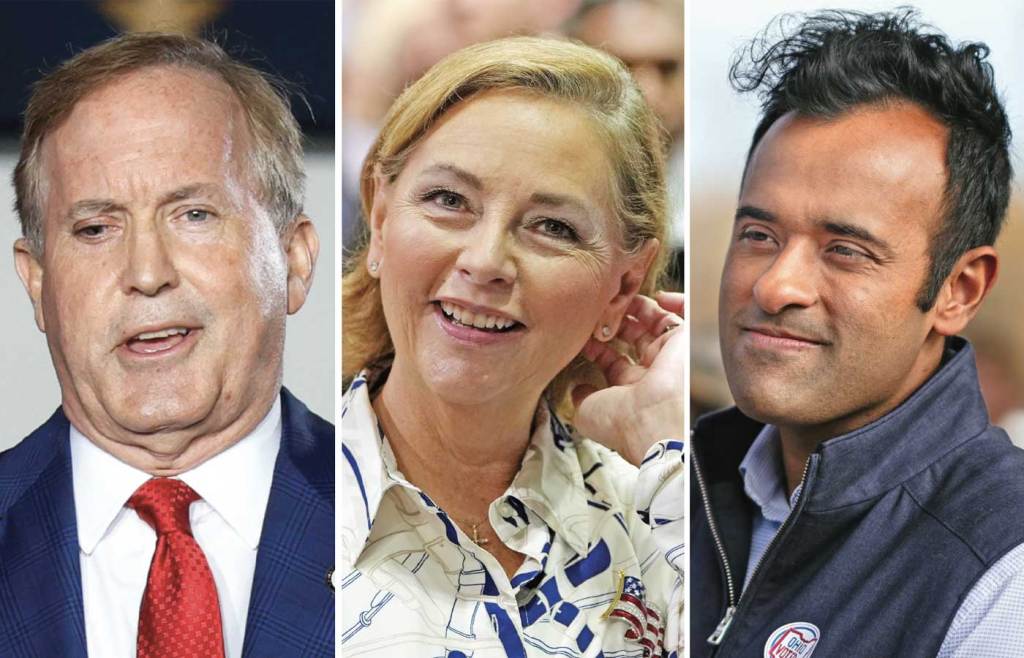
Cornyn, in a piece titled “Republicans Forgot How to Win Elections,” wrote in the Wall Street Journal the morning after the election that nominating candidates such as Paxton forced voters to weigh policy against personal character, a dynamic he warned would be fatal for the party. Rep. Chip Roy (R-TX), who has worked for both men, made a practical version of the same point: Ideological agreement cannot substitute for voters believing in a candidate’s leadership.
To be fair, it should be remembered that Cornyn lost the runoff to Paxton and is hardly a disinterested witness. The blue tsunami swept away everyone, including Gov. Greg Abbott (R-TX), long regarded as one of the most popular governors in the country. Cornyn could’ve easily been taken out by the “bluenami” too. Yet, both things can be true. Paxton was not the only reason that Democrats did so stunningly well in the state, but if we’re looking for a single Leatherface to pin the Texas Republican Massacre of 2026 on, it may very well be Paxton.
A novice in the deep end
Sen. Lindsey Graham of South Carolina, who had won his June primary, died suddenly in July. Gov. Henry McMaster (R-SC) appointed his sister, Darline Graham, to the seat at Trump’s urging, and the president endorsed her for the full term. She had never run for public office. She won the Aug. 25 runoff against Rep. Ralph Norman (R-SC) by a narrow margin, helped by a Trump visit and a last-minute turnout effort of more than $800,000 from MAGA Inc.
In an Aug. 18 debate, she said she was “not that informed on national security,” a striking admission for the successor to one of the Senate’s leading foreign policy specialists. Trump defended the answer as honesty. It was candid. It was also the kind of sentence an opposing campaign can turn into an embarrassing ad.
With the benefit of hindsight, it now appears as if Graham was expected to be a placeholder, and that Trump’s surprise choice of a political novice for the full term caused many South Carolina voters to rebel. In November, Democrat Annie Andrews, a pediatrician, defeated Graham. Trump carried South Carolina by about 18 points in 2024, and Lindsey Graham won reelection by roughly 10 points in 2020. One post-election analysis found that Trump-won counties in the state swung left by an average of about 21 points. If we’ve learned anything from history, including from the history of the home country we broke away from 250 years ago, it might be that it’s often not the best idea to keep political power within the hands of the same family merely because they happen to be related to one another.
None of this makes Darline Graham a villain. Au contraire: She stepped into a situation nobody would have chosen, and performed admirably, given her capabilities and the weight of expectations, and the burden of an esteemed family legacy, that were suddenly thrust upon her. The responsibility rests more upon those who made a first-time candidate the nominee in a 10-week sprint.
A dazzling resume, a hard sell
Vivek Ramaswamy arrived with everything a modern campaign could want: a biotech fortune, a 2024 presidential run, Trump’s endorsement, and an Ohio Republican establishment that cleared the field for him like an offensive line creating a wide-open lane for the running back. The AP reported that backing a newcomer to Ohio politics left several veteran Republicans scrambling. In the primary, Casey Putsch, a vehicle designer and YouTube provocateur running on a $130,000 budget, took nearly 18% of the Republican vote. Before November, he announced he would vote for Amy Acton.
Voters never warmed to Ramaswamy. A Bowling Green State University poll in September found him with only 36% favorability compared to 47% unfavorability. Acton stood at 41% and 42%, respectively. On Election Day, preliminary results showed Acton at 52.3%, ahead of Ramaswamy by nearly 8 points. Democrat Sherrod Brown beat Sen. Jon Husted (R-OH) by 4.8 points. Ramaswamy ran roughly 3 points behind his ticketmate.
He did so despite the enormous resources he had at his disposal. The AP reported that more than $100 million was spent against Acton and that Elon Musk put at least $5 million into a Ramaswamy-aligned PAC. Trump and Vice President JD Vance also made repeated trips to Ohio.
The defining moment came in the final month, when the campaign aired a spot featuring Acton’s estranged mother, who called her daughter a liar and urged Ohioans not to vote for her. The AP noted that the mother had lost custody of her children decades earlier after her husband was indicted on a charge of raping Acton as a child. Five Ohio governors, including incumbent Republican Mike DeWine, denounced the ad. Even though the campaign pulled it about a week before the election, Ramaswamy continued to defend the spot as fair criticism of a pattern of deception, and Trump and Vance defended it as well.
The episode encapsulates the stumbling block Republicans bumped into this fall. A candidate who already struggled to be liked took a step that made being liked harder, in a race polls had placed within the margin of error, against an opponent whose childhood included stretches of homelessness and a winter in a tent. Ramaswamy is formidable on a debate stage and skilled inside a podcast studio. Those attributes can win arguments. But general elections are won by becoming someone ordinary voters want in the governor’s office, and Acton’s campaign used his wealth and subsequent tactics on the campaign trail to paint him as out of touch with families who’ve been squeezed by fuel costs and rising prices.
Caveats and bright spots
Candidate quality was far from the sole factor that decided this election. Experienced, well-regarded Republicans lost too. Sen. Susan Collins (R-ME), after nearly three decades in the Senate, fell to Troy Jackson. John Sununu lost to Chris Pappas in New Hampshire, Mike Rogers lost to Abdul el Sayed in Michigan, and Michael Whatley, the former Republican National Committee chairman, lost to Roy Cooper in North Carolina. Husted, a sitting senator, lost, and so did Abbott. But where Republicans carried visible liabilities, as was the case with Paxton, Graham, and Ramaswamy, their numbers fell further.
There were also bright spots. Rep. Byron Donalds (R-FL) won Florida’s governorship, and the Florida Republicans held their statewide seats. Texas state Reps. Morgan Meyer and Mano DeAyala campaigned as centrists and held House seats that Talarico carried. Some of these candidates — Donalds comes to mind here in particular — may have futures in national politics, especially when they’ve proven that they can win as conservatives and Republicans in heavily Democratic political environments. Think Curt Cignetti being able to win at James Madison before taking the helm in Indiana.
Speaking of which: What would the political equivalent of a Coach Cignetti do to overcome this midterm loss and get the party back into national (championship/office) contention?
First, scout early, and scout often. Paxton’s impeachment was public record. Graham’s inexperience was a central controversy of her runoff. Ramaswamy’s primary showing hinted that he had a ceiling, and a low one at that, as a general electorate candidate. Like a football team self-scouting its players before putting them out on the field, the party should find such vulnerabilities in June and July, rather than wait for Democrats to find them in October and November.
Second, build a bench. The best football teams, college and professional, know the importance of having deep rosters, especially when going into battles that often become wars of attrition. Republicans, going forward, will need to cultivate a capable depth chart comprised of “practice-squad” players — state legislators, mayors, county officials, and veterans tested in smaller arenas — who can step up and fill larger roles when called upon.
Third, use endorsements like time-outs — sparingly, rarely, and with the end (November) in mind. A team ideally shouldn’t burn its timeouts until the last minutes of a half, or, in the second half, in the final minutes of a game. The same should go for presidential endorsements. Sure, they can be effective at any time, but perhaps they shouldn’t be spent willy-nilly at any time — it would be more judicious to save them for when they’re really needed. And even then, they should only go to candidates who can win a general election, not merely a primary.
BLUE WAVE CRASHED; SURVEYING THE WRECKAGE FOR TRUMP AND THE GOP
Fourth, train for the general election like you’re training for the playoffs. Texas Republican nominees, including Paxton and Abbott, largely ignored Democratic calls to debate. Would a team turn down opportunities for intersquad practices with other top teams when those might be the only chances they have to truly test themselves before going into the season?
Conservative ideas still have an audience in Texas, South Carolina, Ohio, and elsewhere. The party’s task now is to find the right players — that is, the right messengers — whether through the transfer portal (disillusioned socialists and progressives who become conservative), the aforementioned bench, or elsewhere. A reascension into national contention awaits.
Daniel Ross Goodman (@DanRossGoodman) is a Washington Examiner contributing writer and teaches theology and religious studies at St. John’s University. His next book, Dante’s Guide to Life: How The Divine Comedy Can Change Our Fortunes, Our World, and Ourselves, will be published this fall by Angelico Press.