Many people who have been in the workforce for a while can think back to jobs that they stayed in too long and should have left earlier. Conversely, many people regret quitting a job they should have stayed in, usually in the hope that their next move would be an improvement, professionally and/or financially.
Rep. John James (R-MI) may fall into the electoral version of the latter category. James, in the Nov. 3 midterm elections, lost badly to Democratic nominee Jocelyn Benson, Michigan’s secretary of state for the past eight years, in the Wolverine State’s gubernatorial race.
Benson’s win was among a plethora of Democratic bright spots in the 2026 elections. Voters made clear their disdain for the country’s current course nearly halfway through President Donald Trump’s second term. While romping in states like Michigan, Democratic congressional candidates, too, demolished Republican opponents, winning both chambers of Congress. The incoming Democratic House majority could reach over 260 members in the 435-member chamber. And with only the Alaska Senate race uncalled, Democrats could hold up to 56 seats in the 100-member body, a stark improvement from the 53-47 GOP edge in the current Congress.
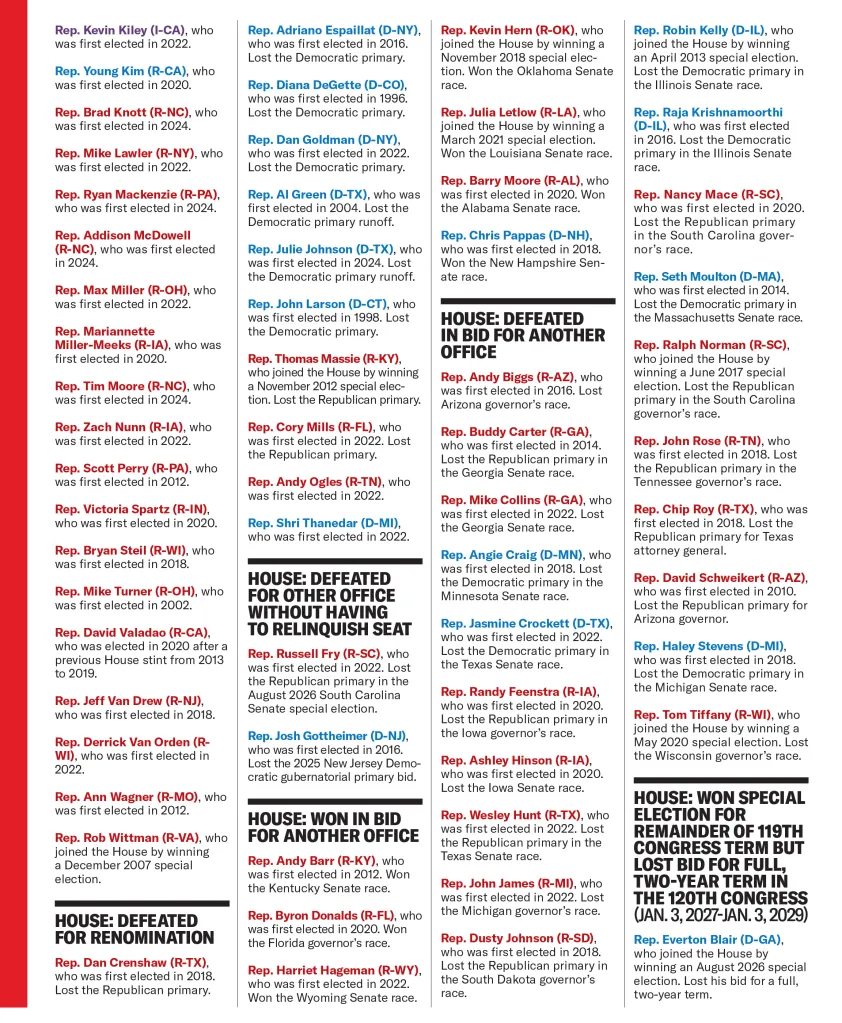
For Republicans, while they have to squint pretty hard to find any bright spots following the elections, there are a few data points available. Among them, six GOP House members won statewide office, compared to a single Democrat. Unfortunately for departing James in Michigan, he wasn’t part of the group. Rather, James was among the 21 House members who lost bids for statewide office in 2026 — Senate, governor, and state attorney general — making for a dismal 25% success rate among these politically ambitious members of Congress.
By itself, a statewide defeat need not be a political career-ender. After all, many aspiring politicians have lost statewide races and bounced back to other elected offices.
The problem for James, 45, is that the House seat he won in 2022 was itself a comeback bid after a pair of losing Senate bids. He came up short in 2018, losing about 52% to 46% to then-Sen. Debbie Stabenow, in what would turn out to be Michigan’s final race of her 24-year Senate career. In 2020, James was again the Michigan Republican Senate nominee but lost to Sen. Gary Peters (D-MI), 49.90% to 48.22%.
James rebounded in 2022 to win the open Macomb County 10th Congressional District, covering a politically diverse swath of territory north of Detroit. That would seem like a pretty good political sinecure after two statewide losses. Adding insult to injury, the seat flipped on Nov. 3. James will be succeeded by attorney Christina Hines.
Still, it’s easy to see why James would gravitate toward statewide races in Michigan, with an eye on a future run for national office.
“After graduating from the United States Military Academy in 2004, he served eight years in the Army, including as an Apache helicopter pilot during Operation Iraqi Freedom,” wrote the 2026 Almanac of American Politics. “After retiring from the military, James joined the family business, which blossomed into a global supply-chain management company. James eventually became its president.”
In other words, a political consultant’s dream: a military veteran, successful businessman, and one of four black House Republicans in the expiring 119th Congress — each will be gone starting next year due to state electoral wins, losses, or retirement. But James’s defeats in three statewide races may be the end of his statewide political ambitions.
Two departing senators will choose their replacements
Incoming governors include Sens. Marsha Blackburn (R-TN) and Amy Klobuchar (D-MN). Both have time left in their current six-year Senate terms, and each will likely, as their first act as governors, appoint their successor in D.C.
Gov.-elect Blackburn was elected to the Senate in 2018 after 16 years as a House member. Tennessee voters reelected her in 2024, and her successor will get nearly two years in office before presumably seeking election in their own right for the middle two years of the six-year Senate term. That person would then likely run in the 2028 special election for the seat’s final two years in office.
Many are likely to be tapped for the Senate seat. Rep. Tim Burchett (R-TN) has already spoken publicly about his interest in a Senate appointment. As for Minnesota and Gov.-elect Klobuchar’s Senate appointment, the situation is the same as Tennessee. Klobuchar, first elected in 2006, won reelection in 2024.
Blackburn and Klobuchar are joined in ditching D.C. for a governorship by Sen. Tommy Tuberville (R-AL). The Alabama governor-elect won a closer-than-expected victory, about 52% to 48% over former Democratic Sen. Doug Jones, whom he defeated in 2020. Since Tuberville’s six-year Senate term was already expiring, there’s no successor to appoint. Rep. Barry Moore (R-AL) won the 2026 Alabama Senate race and will soon move across the Capitol for his new gig in the upper chamber.
Governorships were among the many bright spots for Democrats in the midterm elections. The party is poised to win 30 governorships, 60% of the nation’s total. That will be the first Democratic majority of governorships since early 2010.