
If your household is anything like mine, as soon as the calendar flips from September to October, the Halloween movie marathons begin. And by itself, Hocus Pocus 2 might seem like a harmless remake of the original 1993 classic, but watched back-to-back, the differences between the two movies — especially when it comes to gender relations — are striking.
For those of you who are unfamiliar, the original Hocus Pocus stars Bette Midler, Sarah Jessica Parker, and Kathy Najimy as the Sanderson sisters, three witches resurrected on Halloween night by virgin teenager Max Dennison, who lights a cursed candle while trying to impress his crush, Allison.
Max, Allison, and his younger sister, Dani, must then stop the witches from draining the lives of Salem’s children. Helping them is Thackery Binx, a boy transformed into an immortal cat three centuries earlier when he tried to save his own little sister from the witches.
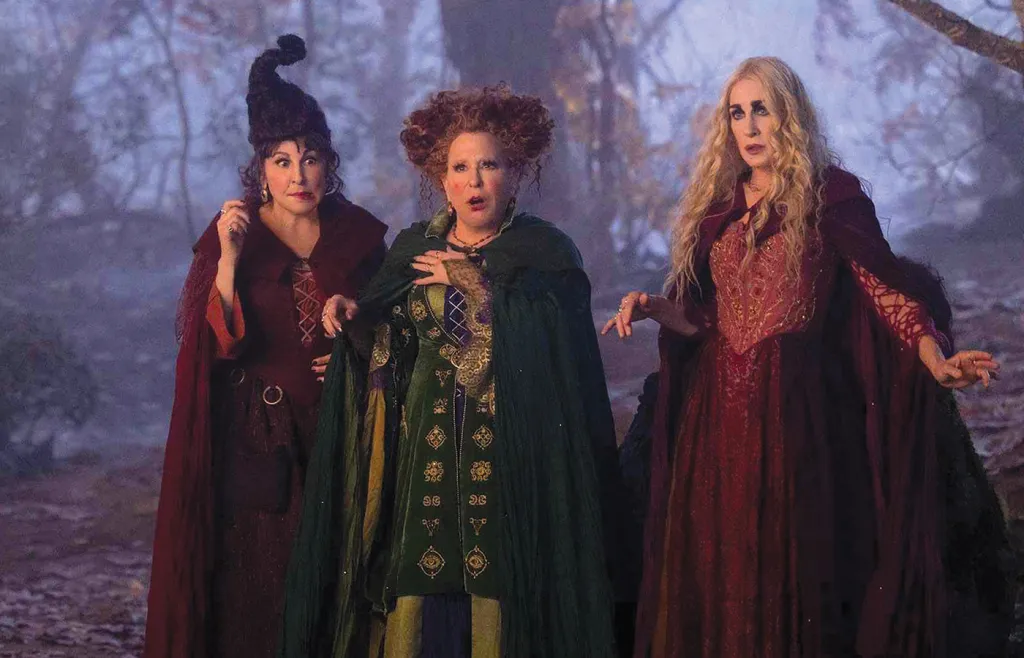
Max begins as a reluctant babysitter more interested in Allison than in taking Dani trick-or-treating, but he ultimately demonstrates courage by drinking a potion that makes him the witches’ target instead of his sister. Along the way, he and Allison develop a romantic relationship as they protect Dani.
Fast forward to the 2022 sequel, and the romantic love is completely gone. The heroes this time are three teenage girls, Becca, Izzy, and Cassie, whose friendship has fractured because Cassie has been spending too much time with her boyfriend, Mike.
An arrogant jock who mocks Becca’s and Izzy’s interest in witchcraft, Mike is treated as a dimwitted punchline throughout the movie, completely oblivious to social cues, and as a coward who immediately faints at the first sight of trouble. His only role in the movie is as a divisive foil to the sacred sisterhood of the three female protagonists, who eventually outwit the reunited Sanderson sisters despite the greed and stupidity of every other male character.
One sequel choosing to abandon heterosexual romance wouldn’t be worth mentioning, but this has become a well-established pattern in Hollywood.
Sleeping Beauty (1959) rewards its princess with love and marriage; Brave (2012) ends with its princess freed from an unwanted betrothal, without a romantic partner. The Little Mermaid (1989) makes courtship central to Ariel’s adventure, while Moana (2016) gives its heroine no love interest at all. Aladdin (1992) pairs Jasmine’s resistance to an imposed marriage with her choice of a man she loves, while Wish (2023) dispenses with courtship entirely.
In the original Star Wars trilogy (1977–1983), Han and Leia’s courtship is a driving force of the story, their growing devotion turning a self-interested smuggler into a man willing to risk everything for others. The sequel trilogy (2015–2019) offers no comparable love story, substituting an unconvincing kiss tacked on to the end of Rey and Kylo Ren’s incoherent relationship, immediately followed by his death. Where earlier heroes and heroines found adventure and a future together, their successors increasingly face the future without a romantic partner.
CONN CARROLL: ON GAMBLING, THE NFL HAS NO INTEGRITY
Too many filmmakers have come to associate female independence with freedom from romance, as though choosing to build a life with a man diminishes a woman rather than giving both partners something worth living for. Their preferred ideal is expressive individualism: discovering your true self and rejecting whatever obligations might constrain its expression. Marriage and parenthood require something more demanding: shaping your life around the needs of people you love.
Woke Hollywood has forgotten that stable pair bonds, sustained parental investment, and obligations across generations are the foundation of civilization. Falling in love and building a family deserve a place in the stories we tell young people.