
“MADNESS!! AUDITIONS Folk & Roll Musicians-Singers for acting roles in new TV series. Running parts for 4 insane boys, age 17-21. Want spirited Ben Frank’s-types. Have courage to work. Must come down for interview.”
Over 400 young men responded to the September 1965 ads in Daily Variety and the Hollywood Reporter. Five months later, NBC informed the world that the four finalists would be known as the Monkees, and that they would be portraying a fictional band on a television show of the same name. The show debuted on Sept. 12, 1966, to an American audience already enthralled with “Last Train to Clarksville,” the debut single of a band that wasn’t quite real but was not entirely fake. In hindsight, we can easily identify that evening on television as the most important single moment in modern popular music.
That’s a bold claim. What about Bob Dylan “going electric,” or the Beatles on The Ed Sullivan Show? But a quick check of the charts from 1966 to the present bears it out. The most popular band in the world, South Korea’s BTS, was deliberately assembled by a pair of producers who backed them with first-rate studio talent and then frogmarched them through an endless series of reality shows, web specials, and, at last count, seven films. BTS is the most successful group to follow the Monkees formula, but they are far from alone. If you don’t recognize XG, Blackpink, Katseye, or numerous other multiplatinum current global pop groups, perhaps you’ve heard of New Kids on the Block, Spice Girls, Nsync, Backstreet Boys, or Menudo. They trod in the path laid by the Monkees.
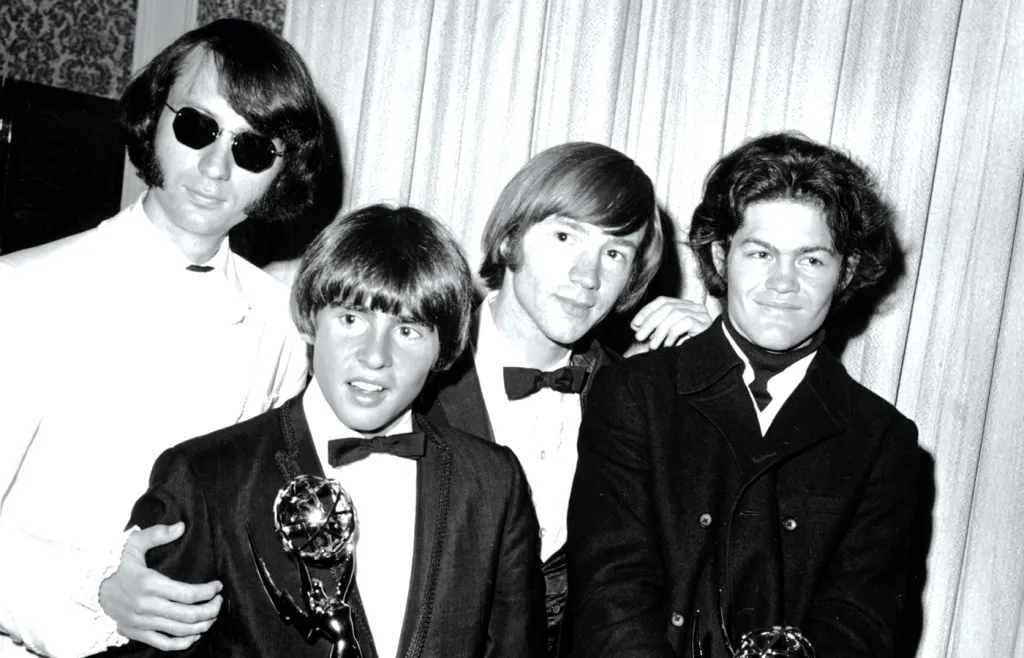
The show’s producers, Bob Rafelson and Bert Schneider, probably didn’t set out to change the world when they hired four actors to play a pop band, and then blurred the fourth wall between them and the audience, but today the audience takes it for granted that their favorite musical artists will come from a revolving door background of television, movies, reality shows, and social media. Drake, Miley Cyrus, Ariana Grande, Justin Timberlake, Britney Spears, Selena Gomez, Demi Lovato, Fergie — all of them, just like the Monkees’ designated heartthrob Davy Jones, started off as child actors before becoming Billboard toppers.
It’s worth taking a moment simply to recognize the magnitude of the Monkees’ accomplishments. If Rafelson and Schneider didn’t assemble the perfect “Prefab Four,” they certainly came close. And the speed at which they worked! The series pilot, which was financed by Screen Gems and used to sell the rest of the show to NBC, was filmed a month after casting. The entire Monkees debut record, and most of the first season’s episodes, were completed during the summer of 1966. The show was a hit with its intended demographic of viewers in their teens and early 20s, even if the overall Nielsen ratings weren’t great, and the album hit No. 1 on both the U.S. and U.K. charts. Finally, a proper salvo had been fired back against the British invasion.
The Monkees were portrayed as counterculture heroes on the very edge of acceptability to Middle America. The “Ben Frank’s” mentioned in the casting notice was a diner that had become a cherished late-night hangout for Frank Zappa, Jim Morrison, Andy Warhol, and others. The band Buffalo Springfield was founded there by Neil Young and Stephen Stills, who had failed his Monkees audition due to, legend has it, crooked teeth. Rafelson and Schneider settled early on Davy Jones, who was already contracted to Screen Gems and whose British birth made him a good foundation on which to build a fictional Beatles competitor. They filled out the roster with child actor and amateur musician Micky Dolenz, former aircraft mechanic Mike Nesmith, and Greenwich Village folk musician Peter Tork.
Even today, the two seasons of The Monkees make for amusing, if not always compelling, viewing. The best way to describe them is “better than they had to be.” The plots are tight, the execution is professional, and all four main characters are extremely likable. Over the course of filming, the Monkees assumed more and more creative control, with the apex of this being an “interview” between Nesmith and Zappa in the second season in which Nesmith portrayed a Monkees-hating Zappa and a Mothers of Invention tune is played by hitting an old car with a sledgehammer.
The much-mocked fact that would define the Monkees in the American consciousness, that they didn’t play their own instruments, was, in truth, simply a quirk of the way the band was assembled. Don Kirshner, the head of the music division at Screen Gems, was tasked with getting their first album written and produced. He quickly discovered that although all four Monkees could play at least one instrument, only Tork was close to studio-ready, and the best drummer among them, Jones, was intended by Rafelson and Schneider to be the frontman. So Kirshner called an audible, bringing in the Wrecking Crew, LA session heroes, to record a series of tunes contributed by professional songwriters from the famous Brill Building and elsewhere. The follow-up album, More of the Monkees, was done the same way.
The increasing media scrutiny of this embarrassing situation, combined with the desire of the Monkees themselves to play a live tour in 1967, forced a showdown between the band members and Kirshner. With Rafelson and Schneider firmly in their corner, the Monkees prevailed. Their tour was a wild success, and Kirshner was purged. Free to write and play their own music, the Monkees released Headquarters in May 1967 as a largely independent effort. It’s hard to believe nowadays, but the band had gotten three records out the door in seven months, the last of which featured studio performances and song authorship by the Monkees themselves.
To further burnish their authenticity, the band starred in 1968’s Head, an LSD-fueled boondoggle of a film written by Rafelson and Jack Nicholson. This, combined with a free-fall in album sales from Headquarters and its self-produced successors, proved temporarily fatal to the group. Citing exhaustion, Tork bought out his existing contract, which ruined him financially and led to his teaching high school during the ’70s. Nesmith soon followed, although his penury was eventually eliminated when his mother, the inventor of Liquid Paper, died and left him with half of a substantial estate. Nesmith became quite an innovator in media. His 1979 project for Warner Cable, PopClips, is commonly understood to be the immediate predecessor to MTV.
The Monkees outlasted the Beatles’ split in April 1970, but only just: Jones and Dolenz had their last recording session in September of that year.
When MTV began running the original Monkees TV show in the ’80s, it spawned a new generation of fans who combined with their parents to keep the Monkees touring in one iteration or another for nearly 30 years, though usually without Nesmith. Two more albums were released during this period. Jones was the first band member to die, from a heart attack in 2012. Tork followed in 2019, and Nesmith in 2021. Dolenz is the last living member of the Monkees. He tours periodically and is active on social media.
By the end of 1970, it was obvious to everyone that the Beatles had been the most important group in pop history, and the Monkees had been a regrettable footnote to the era. (Note that the Beatles themselves didn’t necessarily share that opinion: John Lennon spoke positively of the group, and George Harrison had Peter Tork play on Wonderwall Music.) If you consider the artistic output of the two groups, it’s inarguable that the Beatles had the better of it, and by some distance. Yet the circumstances that produced the Beatles, childhood friends honing their trade in small clubs before signing a record deal, have nearly disappeared from today’s music scene, replaced by a child-actor-to-manufactured-sensation pipeline taken directly from the Rafelson and Schneider playbook.
SALUTING AMERICA’S MOST AGREED-UPON BAND, TOM PETTY AND THE HEARTBREAKERS
The vast majority of today’s pop stars have at least some commonality with the process that produced the Monkees. Last year’s global No. 1 single, “APT.,” was written and performed by Roseanne “Rosé” Park with Bruno Mars, and co-written by many others. Park rose to fame as part of the manufactured K-pop group Blackpink before deciding that she had her own songwriting voice and striking out as a solo artist. Her collaborator on the track, Peter Hernandez, known professionally as Bruno Mars, was a child actor and stage performer who signed an agreement with two producers and developed under their careful tutelage before rising to fame as a musician and producer.
When you look at today’s musical landscape, with its near-total lack of self-made artists and its plethora of media-savvy, ultra-polished multidisciplinary performers, it’s clear that there is only one pop band that has ever truly mattered: They were the Monkees, and people said they monkeyed around.
Jack Baruth was born in New York and lives in Ohio. He is a pro-am race car driver, a former columnist for Road and Track and Hagerty magazines, and writer of the Avoidable Contact Forever newsletter.