
Diamonds are the New York City Ballet’s best friend, or so it would seem after their season-opening performance on Sept. 22 of George Balanchine’s Jewels, culminating in a radiant display by its raven-haired principal, Mira Nadon, dancing the role originated by Suzanne Farrell in 1967. Nearly 60 years after its wildly successful premiere, which brought star ballerinas Violette Verdy, Mimi Paul, Patricia McBride, and Farrell to even higher acclaim, Jewels remains one of the company’s most beloved pieces, yet among its most challenging artistically.
Made up of three sections — Emeralds, Rubies, and Diamonds — this plotless work requires dancers to conjure three contrasting atmospheres in response to music by Faure (excerpts from “Pelléas and Mélisande” and “Shylock”), Stravinsky (“Capriccio for Piano and Orchestra”), and Tchaikovsky (“Symphony No. 3 in D major,” minus the first movement), respectively. While some of the choreography draws from the physical characteristics of gemstones and jewelry — we see lines of dancers with arms linked like a chain, diamond formations, and geometric paths — it seems that Balanchine’s bigger aim, as always, was to make visible the peculiar qualities of each piece of music. While he demurred from explaining his work, many critics believe that in the romantic Emeralds, Balanchine was harkening back to story ballets from early 19th-century France; in Rubies, 20th-century Broadway stages; and in Diamonds, the imperial court of late 19th-century St. Petersburg.
The official origin story is that Balanchine, an acquaintance of the jeweler Claude Arpels, was inspired to create the work after seeing a display of glittering baubles at the Van Cleef & Arpels salon on Fifth Avenue in 1966, but he had been toying with the idea of a jewel-themed ballet for decades. He humorously attributed his well-known taste for luxury to his exotic heritage: “I have always liked jewels; after all, I am an Oriental, from Georgia in the Caucasus,” he said. The Russian émigré’s early experiences of severe deprivation and illness are perhaps the more likely culprit for his later indulgences. Suzanne Farrell, one of his greatest muses, observed in her autobiography that just as he loved to “feed his dancers champagne and caviar and clothe them in fine perfume and French silk, now he wanted to cover us in precious stones.” There was, unsurprisingly, a publicity photoshoot with Farrell dripping in Van Cleef designs.
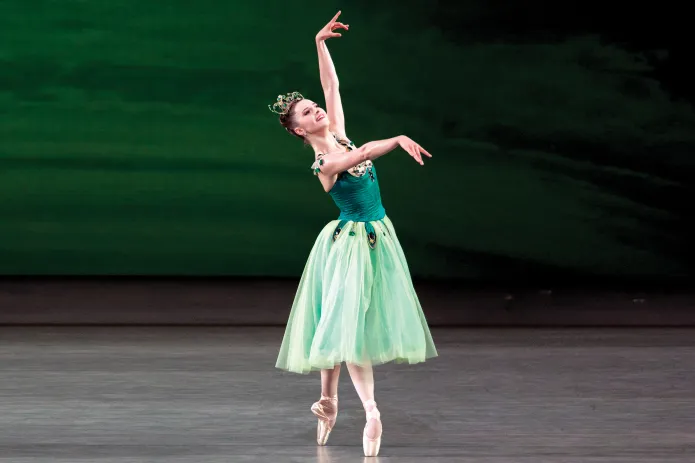
Emeralds — the opening dance consisting of 17 dancers, including seven soloists — is often described as evoking an underwater or magical woodland setting. The women wear Romantic-style tutus taken from the original designs of Balanchine’s favorite costumier, Karinska, with soft tulle skirts falling below the knee, while the men wear princely green and white jackets. While there were glimpses of enchantment throughout the opening night’s performance at the David H. Koch Theater, as suggested by Faure’s use of flutes, harps, and distant-sounding horns, it was unevenly sustained.
Paris-born principal dancer Indiana Woodward, taking on the role originated by French ballerina Verdy, performed one of the most famous sequences, in which the dancer’s hand appears to move through the air on its own, like an animated feather, with great care and a charmingly surprised expression, as if she were observing something truly miraculous. And at other times, the ensemble came together in bewitching ways, such as when they held a pose, gazes fixed off into the distance, and together breathed their arms open slowly, seemingly spellbound. While certainly very pretty, the dance still felt too often located in this world, rather than an ethereal realm.
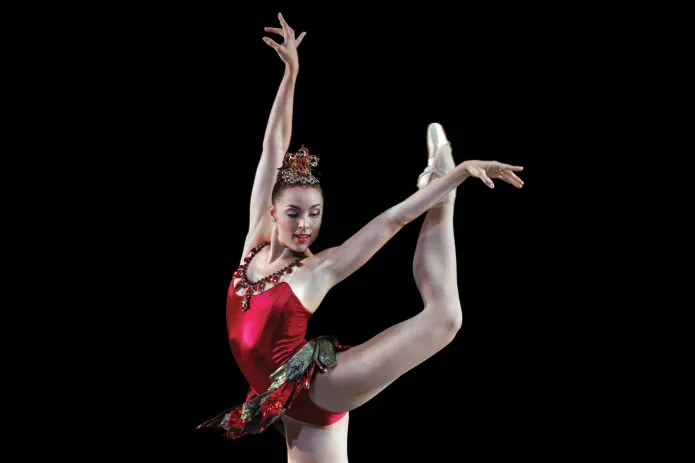
The pace picked up with Rubies, featuring three soloists and a 12-person ensemble, the women in short-skirted leotards, with rhinestone-studded flaps sewn on to the bodice that audibly “clack” with the choreography’s extreme movements. Peter Harvey’s set includes bolts of ruby-red lines that gather into a V-shape in the center of the stage ceiling, suggesting the bottom of an enormous gemstone, or a heart, as if we’d left the medieval forest and entered the court of Alice in Wonderland’s nemesis.
MORE THAN THE RINGO OF THE RENAISSANCE
The down-the-rabbit-hole effect was magnified by Emily Kikta in the Amazonian role known informally as the “Tall Girl,” who dances numerous acrobatic solos, echoed by the angular shapes created by the energetic ensemble dancers. Stravinsky’s menacing piano sequences were matched by her powerful, almost bun-scraping kicks to the back and deliberately awkward steps like a turned-in plié on pointe and sharp hand flicks. Tall and athletic, she easily towered over most of the ensemble while on pointe, including the four male dancers who eventually partnered her, giving her the illusion of mythical proportions. Tiler Peck, dancing the so-called “Short Girl” role, and her partner, Roman Mejia, were true virtuosos, sailing through jazzy technical feats beautifully while also appearing to have an absurd amount of fun, appearing sometimes in competition, sometimes in cahoots.
Diamonds was the largest scale and the strongest section of the night, featuring two soloists, Mira Nadon (stepping in earlier than scheduled in place of an injured Sara Mearns) and Chun Wai Chan, along with 32 ensemble members. The setting resembles an ice palace, accented with glittering diamond-like objects arranged into snowflakes. Tchaikovsky wrote his third symphony just before he composed Swan Lake, and in some of the female lead’s longing reaches toward her partner, Balanchine seems to deliberately quote Petipa’s choreography for the doomed Odette. Nadon’s Old Hollywood features and expressive eyes lent drama to the dance’s unspecified story, while her controlled développé extensions, soft bourrées, and sleek turns were supremely regal. The ensemble danced with impeccable order and solemnity where needed to evoke the grandeur of an imperial court, and later moved joyously in complex shapes and sharply layered lines, both in unison and in contrast with the soloists at the front. The majestic final polonaise made visible not only the symphonic music but also Balanchine’s genius.
Jane Coombs is an arts writer based in New York.