
NEW YORK CITY — Twenty-five years after the Sept. 11, 2001, terrorist attacks, a generation of Americans has no memory of the day that changed the country forever. Some are now learning about 9/11 for the first time through social media, including TikTok trends where young people have expressed empathy for Osama bin Laden’s “Letter to America.”
Megan Jones, vice president of education programs at the 9/11 Memorial and Museum, has taken on the task of teaching the next generation about Sept. 11 before they encounter distorted versions of history online.
“One of the best ways to challenge what is out there on social media, I think first of all, it starts with the factual foundation of what happened that day,” Jones told the Washington Examiner. “It’s our responsibility to pass on the stories of what happened here in this place to this generation, so that they can carry on the legacy and become the stewards of this history.”
Jones and the museum have developed educational resources to help students understand the people behind the tragedy.

Creating empathy for those who lost their lives
As the country approaches the 25th anniversary, Jones said more than 100 million people now have no lived memory of 9/11, creating a growing divide between those who remember the attacks and those who know them only as history.
“The heart of everything we do here in our education programs is storytelling,” Jones said. “Tell them the stories of people who were there… first responders, survivors, family members.”
One of the stories the museum uses to help students make that connection is Welles Crowther, a 24-year-old who worked in the South Tower and used the volunteer firefighter training he received as a teenager to help others after the attacks.
Crowther is known to have helped save as many as 12 people before he was killed when the tower collapsed.
“I think when students can see themselves in the story and also people who are different from them, that builds empathy,” Jones said. “Then once you have that empathy, it becomes much harder to sort of succumb to some of these things that swirl around.”
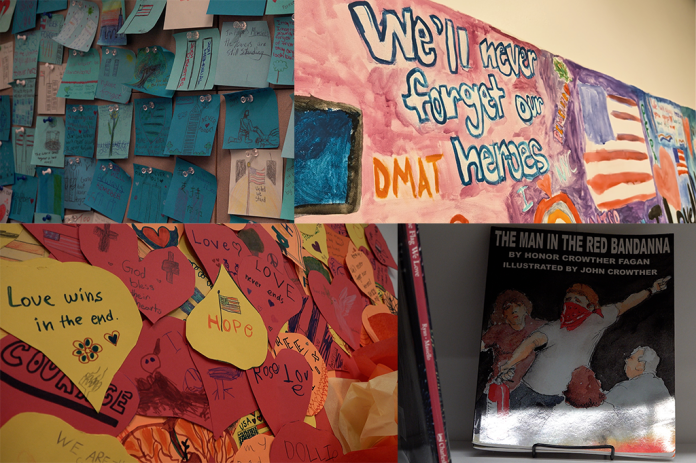
Educational materials are divided by grade levels, with resources for students in grades three through five, six through eight, and nine through 12. For younger children, the museum focuses on stories with themes of heroism and service. One example is “The Man in the Red Bandana,” a children’s book about Crowther written by his sister.
“We use art as a way for children who are very young to sort of reflect on what they’ve learned in the museum, and leave something behind,” Jones said, pointing to artwork lining the classroom walls. “We have survivor tree leaves that they decorate, sky paintings behind me, just a lot of different ways for children to reflect and respond to what they’re learning about.”
Those too young to remember are now teachers
The generational shift doesn’t apply only to students.
Jones used to ask teachers how many remembered where they were on 9/11. Everyone would raise a hand. But when she asked how many students remembered it, no hands went up.
Now, even some teachers have no memory of the attacks.
“Now starting to be like maybe four or five hands go up,” Jones said. “It’s a visual reminder to me that time is passing, and you have to adjust how you talk about 9/11 with these educators.”
The museum offers professional development both virtually and in person, along with lesson plans. The Digital Learning Experience is a major part of its educational outreach. Every year on Sept. 11, the program releases a 30-minute film and live chat featuring stories from first responders, survivors, family members, and people who were young on 9/11. The program has been going on since 2016.
“Since then, we’ve had over 5 million participate in this program,” Jones said. “Last year, we had 1.2 million students. We’ve had students from over 80 countries and territories participate. So this is really for anyone.”
The museum expects this year’s program to reach a record number.

Remembering the best of humanity
For Jones, however, teaching 9/11 is ultimately about more than remembering the destruction. It is also an opportunity to show students how people responded to tragedy.
“I think that it’s an opportunity to show our shared humanity,” Jones said. “At its core, 9/11 is a human story, it happened to normal everyday people going about their everyday lives, and I think even in an event that shows the worst of humanity, it also shows the best of humanity.”
The challenge for educators is to make sure that when the next generation asks what happened on Sept. 11, they hear the stories from the people who were there — not just the version of history that happens to be on their phones.
GARY SINISE 9/11 DOCUMENTARY WANTS TO INSPIRE AMERICANS WITH HOPE
“I think that it is a time to reflect on what brings us together,” Jones said. “Because there’s more that brings us together than divides us.”
Twenty-five years later, remembering 9/11 is no longer just about preserving a memory. It is about teaching history to a generation that will eventually become responsible for preserving it.