
Generation Z is constantly bombarded with news, media, and memes blaming capitalism for high rents, student debt, and wealth disparities. Socialism often sounds appealing — free stuff, less greed, and more equality — but it’s worth breaking down how it operates and why it doesn’t work.
Younger people are far more open to socialism than older generations. A Pew Research Center report finds 44% of youth aged 18 to 29 view socialism positively, with only 40% believing capitalism is the more favorable economic philosophy. They view that mounting student debt and housing unaffordability are evidence that capitalism has failed them, so socialism appears more attractive.
This sentiment was devastatingly apparent in New York City’s election of Mayor Zohran Mamdani and in primaries across the nation. An ABC News poll estimates Mamdani captured 78% of voters under 30 and 66% of voters aged 30 to 44. This underscores the need not only to reject socialism but to restore free-market capitalism for all Americans.
It also raises an important question: Does the younger generation understand capitalism and socialism?
At its core, capitalism is about private ownership and incentives. You have a right to own your property or ideas. You have the freedom to negotiate in your self-interest and engage in mutually beneficial agreements. Profit and competition motivate you to innovate. No one forces you to.
American economist Milton Friedman believed the “essential notion of a capitalist society … is voluntary cooperation, voluntary exchange. The essential notion of a socialist society is force.” The difference is simple: freedom versus compulsion.
Here’s how capitalism plays out in real life:
- Someone spots an opportunity to innovate. Perhaps it’s the need for a new product, service, or process.
- Strong rules ensure the innovator owns the idea or innovation and is protected from those who try to steal or copy it.
- Since the innovator is responsible for the creation, he or she is motivated to make improvements or perfect it.
- If the product is successful, everyone benefits. The innovator wins via the profit made, and society wins because they access a new, faster, or cheaper product — a better outcome.
Smartphones, Spotify, food delivery apps, and AI improve every year as innovators chase profit in a competitive market. Development doesn’t come from government mandates. Society advances when innovators reap the benefits of what they create.
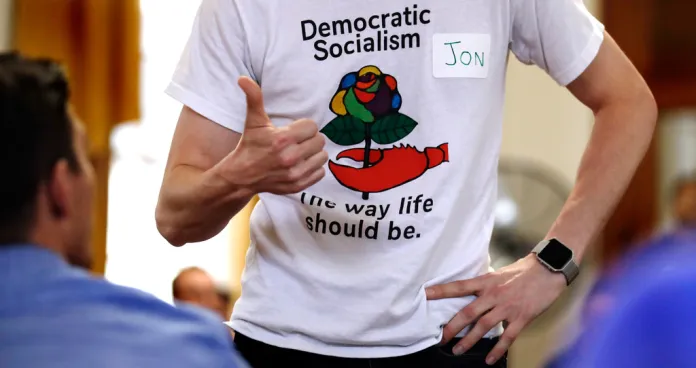
Socialism relies on coercion as central planners decide what gets made, how much, and who gets it. Private ownership of land, factories, or businesses is limited or taken over. The government needs taxes, rules, or force to do that.
Take Venezuela. History shows that top-down socialist directives and nationalization produced hyperinflation, shortages of food and medicine, poverty, and the collapse of public services.
Under socialism, where private ownership and property rights do not exist, outcomes get worse, and innovation suffers. This is the classic tragedy of the commons problem. Imagine public transit: filled with litter, graffiti-covered cars, and slow. No private individual cleans it because “it’s the government’s problem,” and government workers are slow to do so because they get paid regardless. When the state or collective controls public services, resources are misallocated, and quality deteriorates.
Many countries, including India, the United Kingdom, and Israel, tried socialist models for decades, then pivoted toward market solutions when central planning failed. Conservative thought leader Lee Edwards wrote, “all three finally rejected it for the simplest of reasons — it doesn’t work.”
Former British Prime Minister Margaret Thatcher’s observation is still relevant: “The problem with socialism is that you eventually run out of other people’s money.” The system ultimately collapses when the government loses the fiscal ability — taxpayers — to provide food, housing, or transit.
Gen Z is supportive of socialist “tax the rich” policies, but raising rates on the very people and companies creating jobs, products, and developments society benefits from is not the move. A Heritage Foundation report finds that among the wealthiest 0.1% of households, 88.2% of assets are linked directly to businesses and overall economic production. That means wealth is created from capitalistic endeavors that benefit both the innovator and society.
While capitalism has imperfections, it has lifted over 1 billion people out of extreme poverty, driven technological revolutions, and improved living standards faster than any other economic ideology. Socialism’s track record is much worse: social regression, economic stagnation, human casualties, and serfdom.
WHY ARE SOCIALISTS UNFAZED BY THEIR ABYSMAL HISTORICAL RECORD?
As the most connected, educated, and entrepreneurial generation yet, Gen Z must ask not “how can government make my life better?” but “what opportunities can I take advantage of today that make my life, and the lives of those around me, better tomorrow?”
Capitalism gives people the arena to succeed. All Gen Z must do is take advantage of it.
Nicole Huyer is a senior research associate in The Heritage Foundation’s Roe Institute for Economic Policy Studies. Emma Maslar is a member of Heritage’s Young Leaders Program.