
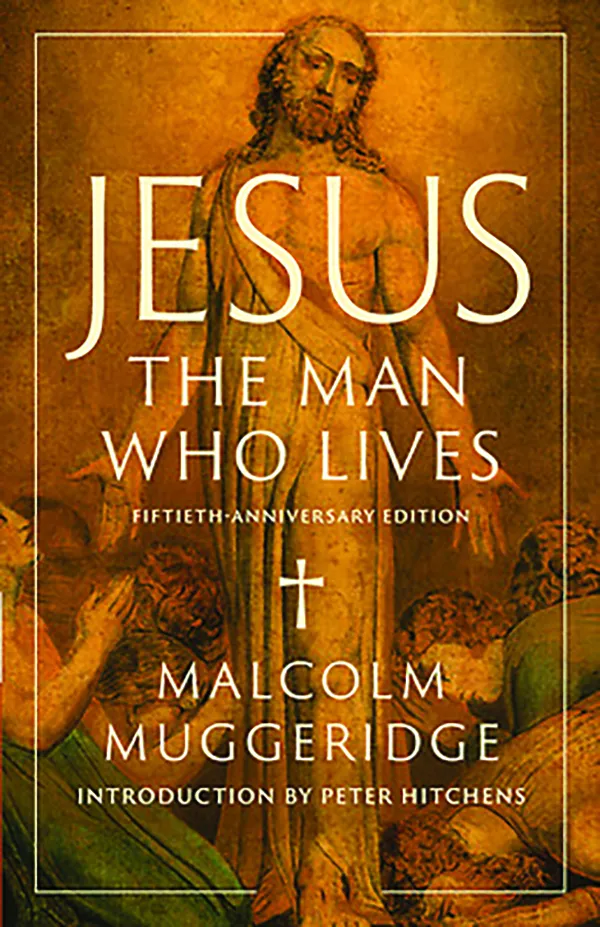
If Jesus Christ did not rise from the dead, 2,000 years of Christian preaching would be in vain — and the world as we know it would look completely different. That is the central theme of Malcolm Muggeridge’s Jesus, the Man Who Lives, and it’s his strongest position in a book that contains many inconsistent arguments. A famous convert to Christianity, the British-born Muggeridge (1903–1990) published this work in 1975, and earlier this year, Creed & Culture brought out a new edition with an introduction by the journalist Peter Hitchens.
Muggeridge’s narration of the life and ministry of Christ rightly lamented the abundance of new Bible versions, false Jesuses, and efforts to obtain peace and justice apart from God. What Muggeridge missed, despite his impressive prose and profound observations on human nature, was the entire point. Why did Jesus die and rise from the dead? Given how many pages he spent on comparatively insignificant Bible stories, one would think he’d have more to say on this subject. After all, it was the whole reason the “Incarnate God,” as Muggeridge called Him, was born.
For every time I said “Amen!” while reading this book, I found myself woefully perplexed two or three times. One page would undermine the other, over and over again, making what Muggeridge truly believed unclear. For example, did he believe the Scriptures to be the infallible, perfect words of God, as the Bible says they are? On one hand, he called the accounts of Jesus “four shaky Gospels,” full of “contradictions,” “imperfections,” and “inconsistencies,” suggesting certain events “may or may not have happened.” On the other hand, he wrote that “they may be called Holy Words … without blasphemy attributed to God Himself.” The Bible says God cannot lie, so both notions cannot be true. The Scriptures are either God’s perfect words or man’s imperfect words.
JAMES TALARICO SAID HE ‘HATES CHRISTIANITY.’ HERE’S WHY
Throughout the book, Muggeridge wrestles with the “historical” and “spiritual” truth of the Bible. At one point, he writes, “The story of Jesus as recounted in the Gospels is true to the degree that it can be, and is, believed; its truth must be looked for in the hearts of believers rather than in history.” He later discounts the reliability of the Gospels by suggesting that they were all written for the purpose of “evangelism,” not documentation. That’s false. While John’s Gospel is expressly written “that ye might believe,” Luke set out to provide an “eyewitness” account. Regardless of motive, they were never refuted by their contemporaries and cannot be discounted or separated from secular history.
In fairness, Muggeridge did believe many important aspects of Jesus’s story. He affirmed his “conviction” that the Gospels are “inspired” in their portrayal of Christ. On the book’s very last page, he writes, “That the Resurrection happened … seems to me indubitably true.” But two sentences later, he suggests that there are “dubieties” about nearly every aspect of Jesus’s life — although if He was resurrected, and He was, none of that matters.
Indeed, as Muggeridge put it, “if Jesus did not rise from the dead,” then “Jesus’s Kingdom is as illusory as all the others.” Historians generally agree on the following facts: Jesus was killed via crucifixion; His tomb was found empty; many people saw Jesus alive after His death; and the early Christians genuinely believed He had risen from the dead, despite having every predisposition not to — choosing to be tortured and killed rather than recant their eyewitness testimony. The Apostle Paul, for example, was a Pharisee who murdered Christians before Christ appeared to him. He went on to become the most influential Christian of all time. But he suffered greatly for Christ, enduring whippings, shipwrecks, beatings, stonings, and ostracization, and ultimately was beheaded. In short, to believe that Jesus did not rise from the dead requires more faith than to believe He did.
But that leads us back to the question: Why did Jesus die and rise from the dead? Again, Muggeridge is a mixed bag. At one point, he suggests that Christ lived “in order to guide all who came after Him.” While He does guide His followers, this wasn’t Jesus’s primary purpose. Rather, Jesus came to shed His divine blood to wash away all our sins and offer salvation as a free gift to anyone who will trust and call on Him alone for salvation. To that point, one of my favorite passages from the book was this: “As Man alone, Jesus could not have saved us; as God alone, he would not; Incarnate, he could and did.” This screams Hebrews 9, where the writer contrasts how the blood from mortal animals could not permanently wash away sins — it required God’s blood to accomplish this.
Yet it appears Muggeridge believed Jesus wasn’t even sure about His purpose at times. At Jesus’s baptism, Muggeridge writes that “his destiny settled upon him,” his domestic duties “came to an end,” and the “plans or expectations he might have in his mortal capacity must now be relinquished.” Muggeridge continues, “He was now God’s Son indeed, and only concerned to go about his Father’s business.” First of all, Jesus was God’s Son before He was baptized — even before He was born (“Before Abraham was, I am”). Second, Christ’s concern had always been on “his Father’s business.” Third, the Lord’s destiny had always been settled upon Him. There was no moment when these things were not true and then became true. Muggeridge also claims Jesus’s temptation by the Devil was “a time of great clarification; now he was absolutely sure about his vocation.” Again, there was no moment when He was unsure about His vocation.
Alas, Muggeridge makes something of a mess of the Bible. He writes that Jesus “died as Man” but rose from the dead “as God” — when the Scriptures say Jesus was God all along. He writes that Jesus was “very attractive … especially to women,” when Isaiah 53 says, “he hath no form nor comeliness … no beauty that we should desire him.” Muggeridge claims that every son is “a Son of God” and that “we are one with God, as God is one with us,” when the Bible clarifies this only applies to Christians. He also said Jesus brought “final fulfillment” to Israel, yet both testaments prophecy that God has future plans to judge and restore it.
Worst of all, Muggeridge was extremely inconsistent on salvation, which is central to Jesus’s incarnation, death, and resurrection. To name just one example, after stressing the need to be “born again,” and the role faith has in the forgiveness of sins, he suggests that repentance makes one “worthy” of heaven, yet the Bible says God sees our righteousnesses as “unclean rags” and that “none is good, no not one.” The Bible repeatedly says that salvation is a “free gift,” that God offers “by grace through faith,” and is not earned. When someone puts their trust in Christ, rather than their own righteousness, and calls on Him for salvation, they receive “everlasting life.”
IN WAR ON BIBLE, PASTOR CONVICTED FOR PREACHING GOSPEL
When Muggeridge said, “Jesus’s guilt is our innocence; as his captivity is our freedom, and his death is our life,” he couldn’t have been more right — but it’s unclear if he understood why. Galatians 2:21 says if righteousness could be obtained through works, Christ died in vain. Why did Jesus die if we must abstain from sins or participate in religious practices to be saved? Jesus died to set us free. As John 8:36 says, “If the Son therefore shall make you free, ye shall be free indeed.” That’s why Jesus died and resurrected, but Muggeridge spends more time questioning the authenticity of minute Biblical details than explaining how Jesus died to save us from the eternity in Hell that we earned.
The word “Gospel” means “good news.” And the good news is that God loves us enough to die a horrible death to pay for our sins, offering salvation to anyone who will accept it. Just as Jesus really did rise from the dead, the consequences for not trusting Him for salvation are equally real. As Muggeridge puts it, “If, contrariwise, Jesus had been released and Barabbas crucified, it is extremely improbable that Barabbianity would have swept over the Western World as Christianity did.” That’s because when Barabbas died, he stayed in the grave. Jesus’s tomb is empty. If it wasn’t, God’s “free gift” would be a counterfeit. There is value in this book, but not enough to make up for Muggeridge’s muddy thinking.
Peter Cordi (@petercordi) is the contributors editor of the Washington Examiner.