
EXCLUSIVE — Federal agencies sold off used or excess laboratory equipment flagged as high-risk exports that could be used in biological warfare to apparent resellers, according to an undercover investigation conducted by the U.S. Government Accountability Office.
The GAO found that from fiscal 2022 through 2025, the Department of Health and Human Services and the Department of Agriculture sold nine unneeded scientific instruments that were on the U.S. Interactive Commerce Control List to individuals and companies in the United States and Canada, some of which appeared to be resellers.
The control list is a federal database of highly specialized material, software, and technology that require an export license from the Department of Commerce. Those nine sold items, consisting of three freeze dryers and six mass spectrometers, were subject to strict export regulations because foreign countries could potentially acquire the government-grade lab equipment to develop biological weapons, intercept sensitive information stored on the devices, or gain a military advantage over the U.S.
Freeze dryers can preserve biological material, such as viruses and toxins, and produce powders for easier dissemination. Mass spectrometers are analytical instruments that can study proteins, particularly how proteins respond to viruses. Both are considered “dual use” because while freeze dryers and mass spectrometers have civilian uses such as food preparation or drug discovery, they can also be used in the development of biological threat agents. The commerce control list flags freeze dryers and mass spectrometers with advanced functions and features that are “most likely to be used by countries of concern to create large-scale biological weapons.”
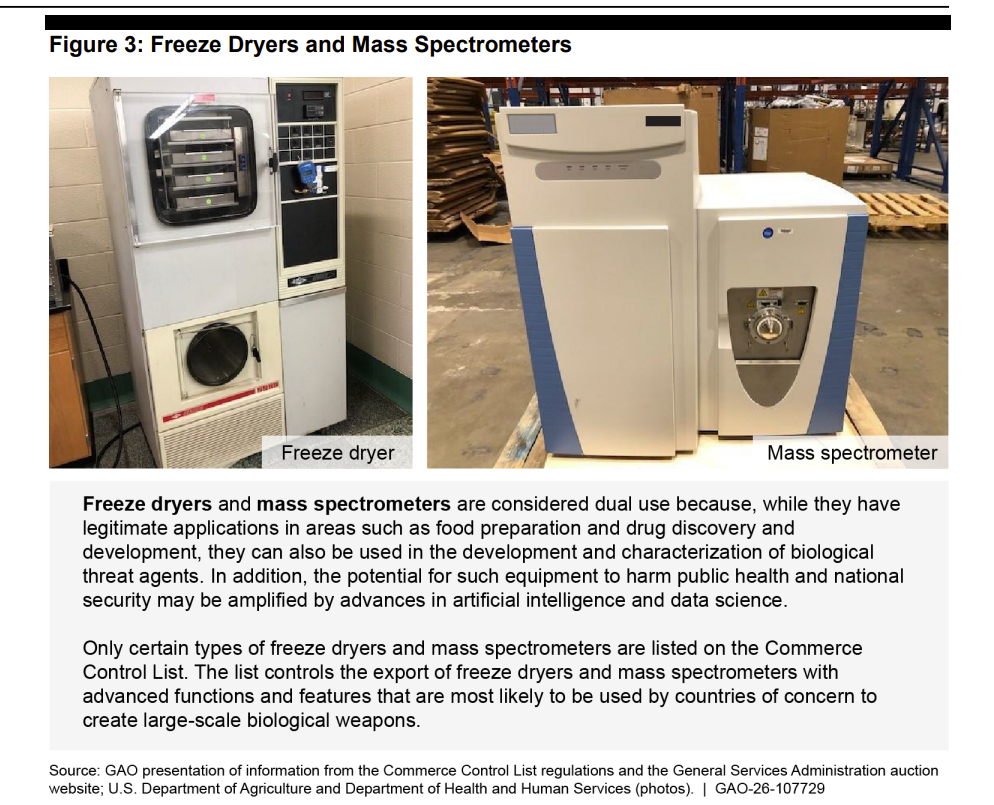
During the sale of the laboratory equipment, HHS and the USDA did not report their appearances on the export control list to the General Services Administration as required. Each year, HHS and the USDA, which both operate high-containment labs that research pathogenic threats to public health, dispose of hundreds of pieces of old or excess laboratory equipment. GSA handles the disposal process, including transferring inventory to other federal agencies, donating the discards to eligible nonfederal recipients, or auctioning them off to the general public. When warranted, agencies may recycle or destroy inoperable equipment.
According to a 46-page report released Thursday on GAO’s findings, some of the purchasers of the HHS and USDA lab equipment often bought other types of federally owned lab equipment. For example, one buyer who obtained a freeze dryer as well as a mass spectrometer also purchased more than 100 pieces of HHS inventory over the same three-year period, including imaging systems, DNA analyzers, and sequencers. Officials were not able to tell GAO what the buyer intended to do with his wares, nor whether he wanted to reuse, resell, or properly dispose of the acquired goods.
A company that purchased one of the mass spectrometers also made 14 other purchases of HHS and USDA lab equipment over the past three years. GAO discovered that this company sells refurbished laboratory and medical equipment on its website.
GAO determined that the individuals and companies were able to buy the nine restricted items, all listed as used and/or in need of repair, at a fraction of the original acquisition cost.
Two of the freeze dryers were sold to individuals through the GSA’s online auction for $29 and $208, respectively, with their conditions cataloged as either salvageable or repairable. The items originally cost about $12,000 and $25,000. The third freeze dryer was sold as part of a lot that included other laboratory equipment for a total of $10,000, compared with the roughly $234,000 the federal government paid. Meanwhile, the six mass spectrometers were purchased at auction for as little as $6,750 and up to $99,000. GSA data show their original costs ranged from $310,000 to $824,000.
WHY BIODEFENSE MUST BE A NATIONAL SECURITY PRIORITY
Over the course of GAO’s undercover operation, the federal watchdog also assumed fictitious identities, including that of a nonprofit organization, to successfully obtain four pieces of HHS and USDA laboratory equipment that experts say pose a biosecurity risk. GAO registered a fake nonprofit group in the donation program that gives surplus federal property to public and private entities. Investigators also used covert identities and counterfeit documents to create undercover user profiles and bid on the GSA’s auction website.
GAO conducted its investigation at the request of Rep. Brett Guthrie (R-KY), chairman of the House Energy and Commerce Committee, and other Republican leaders on the congressional committee.
In 2024, committee members had asked that GAO study how HHS and the USDA oversee the sale of discarded laboratory equipment and protective clothing that could potentially be used in acts of bioterrorism against the U.S.
Guthrie said the GAO report’s findings provide a path forward to remedy vulnerabilities in the federal lab equipment disposal program.
“We commend the Trump Administration for their swift efforts in initiating action and signaling a prompt response to the GAO recommendations,” Guthrie told the Washington Examiner.
All three agencies generally agreed with GAO’s corrective action plan. In response to one of the recommendations, HHS has already updated its manual to require staff to identify laboratory equipment on the Commerce Control List during the disposal process.
Guthrie said his committee has similarly examined ways to bolster U.S. biosecurity in the digital age and will continue to seek solutions that implement additional safeguards.
“With advances in AI and synthetic biology, bad actors and foreign adversaries of the U.S. already have enhanced access to scientific research information,” Guthrie said. “This underscores the need for the U.S. government to more carefully monitor and control disposal of federal laboratory equipment that could supercharge nefarious plots.”