
On July 8, 2026, outside Independence Hall in Philadelphia, Pennsylvania, the National Park Service held a reenactment of the first public reading of the Declaration of Independence, which occurred exactly 250 years earlier in roughly the same location. Beginning at noon, a crowd of about 150 people gathered, some dressed in 18th-century colonial attire, to witness one of the most pivotal moments in the history of human civilization.
“When in the Course of human events, it becomes necessary for one people to dissolve the political bands which have connected them with another, and to assume among the powers of the earth, the separate and equal station to which the Laws of Nature and of Nature’s God entitle them, a decent respect to the opinions of mankind requires that they should declare the causes which impel them to the separation,” read the National Park Service employee dressed as Col. John Nixon, an 18th century Philadelphian financier of the Revolutionary War, who gave the first public reading of the Declaration.
July 8, 1776, is not as widely recognized as July 4, 1776, but it is arguably just as important. The colonial delegates voted to adopt the Declaration on the fourth of July. Still, the eighth of July was the first time the public heard the contents of the document and the foundation that was being created to form a new country and, in many ways, a new world. July 4, 1776, is the date that established the resolution that Virginia delegate Richard Henry Lee introduced, declaring that “these united colonies are and of right ought to be free and independent states.”
On July 8, 1776, in Philadelphia, the city where America 250 all began, to the cheers of “huzzah” outside what was then known as the Pennsylvania State House, it was the true dawn of a new day in history.
“250 years ago, the Declaration of Independence was read aloud, and the reality of the battle for independence was just beginning,” Rich Zeoli, Philadelphia-based political pundit and talk show host, told me. “We must never forget that after the parchment was signed, blood was spilled by brave patriots who gave their lives to bring the words into action and create the Republic.”
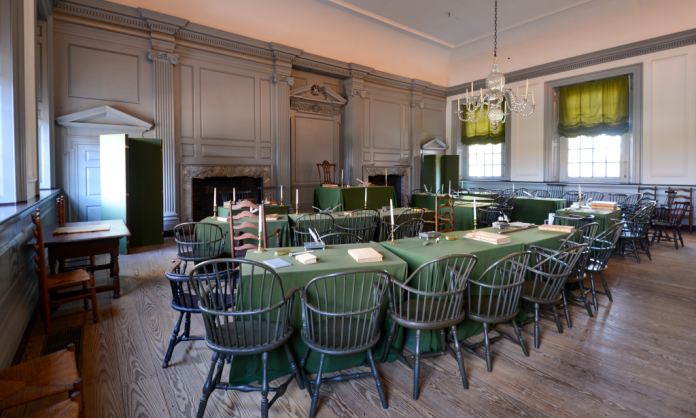
(Photo public domain)
“As the Liberty Bell tolled, the canons were blasting,” Zeoli added. “They didn’t just take pen to paper in Philadelphia, they launched a revolution when they threw the King’s Coat of Arms into the bonfire and cheered ‘God Bless the Free and Independent States.’”
July 8, 1776, and the wonderful reenactment of the events from that day put on by the good people at the National Park Service on July 8, 2026, are also indicative of Philadelphia’s importance in the nation’s founding. Often hailed as the “city where it all began,” Philadelphia is the epicenter of American history, the birthplace of the Declaration of Independence and the U.S. Constitution, two of the most important documents in Western civilization. It was also the capital city of the country in its early days. Historian Gary Nash dubbed Philadelphia “the most important city in America’s collective memory,” and it is the first U.S. city to be recognized as a World Heritage City, putting it on par with the historical significance of cities such as Athens, Jerusalem, and Rome.
Without Philadelphia, there is no America 250. It is a historical recognition that Lindy Li, a Philadelphia resident, political commentator, and author of the upcoming book Unburdened, boasts.
HONORING THE 250TH ANNIVERSARY OF CAESAR RODNEY’S HEROIC ‘DARK KNIGHT’ RIDE FOR INDEPENDENCE
“Being American and a Philadelphian in particular is the greatest blessing of my life — walking the streets of Philly is a journey straight through the annals of American history,” Li told me. “Running down Benjamin Franklin Parkway and beholding our beloved American flags is an experience that never, ever gets old.”
“I was born in an authoritarian communist regime and can tell you: anyone pushing communist ideology in our great nation is desecrating the legacy of our sacred Founding Fathers,” a prescient point given recent political elections and left-wing political rhetoric.