
In Focus delivers deeper coverage of the political, cultural, and ideological issues shaping America. Published daily by senior writers and experts, these in-depth pieces go beyond the headlines to give readers the full picture. You can find our full list of In Focus pieces here.
Speaking at the “American Dynamism” summit back in 2025, Vice President-elect JD Vance argued that the United States needed to “undo 40 years of failed economic policy in this country.”
It wasn’t the first time Vance pinpointed “40 years” as the onset of the nation’s alleged decline.
Forty years back, incidentally, puts us in the Ronald Reagan years. The vice president apparently wants to bring the country back to the glory of Jimmy Carter and the 1970s.
This week on Michael Knowles’s podcast, Vance went after the late Nobel Prize-winning economist Milton Friedman, a favorite of Reaganites, during a broader discussion about the state seizing the assets of AI companies — a Bernie Sanders policy plan that Vance also supports.
Vance, after all, is an economic leftist who believes politicians can make better decisions about economic activity than individuals and businesses. Which is why he’s had far nicer things to say about socialists such as Sanders, Rep. Ro Khanna (D-CA), and Zohran Mamdani than any fiscal conservative.
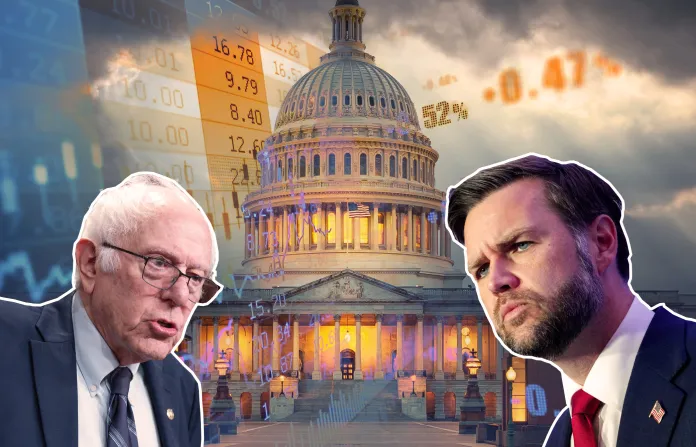
When asked at Yale Federalist Society to name his three favorite Democrats “purely in terms of policy outcomes,” Vance chose, in order, Sanders, Elizabeth Warren, and Tulsi Gabbard.
Though refusing to distance himself from the unhinged antisemitic podcast crowd led by his friend Tucker Carlson, a group he believes to be integral in the Right’s new coalition, Vance has no such hangups about free marketers, who he believes have no future in the conservative movement.
It’s clear Vance doesn’t believe human flourishing and a free-market system are compatible. And those who assure me the vice president is merely focused on a grand Hamiltonian prioritizing of national defense and strategic industries — Trump’s justification for taking major stakes in private companies — probably haven’t read his new book Communion.
Vance begins his chapter on economics by unsheathing one of his patented strawmen to argue that gross domestic product is a useless statistic. The cost of a $6 pint of Japanese strawberries is no different from a $6 pint of American strawberries if one only looks at cost, Vance notes. But the former batch tastes so much better. The lesson: one can’t judge the worth of things merely on price.
Which is a good thing, because no serious economist does. There are thousands of studies attempting to gauge quality and other factors of goods.
The entire strawberry incident leads the vice president to conclude: “Maybe economics is just fake.” The economy should be about the “dignity of the human person,” he tells Knowles, not numbers on a spreadsheet.
Like most economic leftists, Vance confuses intentions and outcomes. I’d love to hear of an example of a top-down planned or protectionist economy anywhere on the planet that has offered more dignity to more human beings than ours has in the past 40 years. One of the lessons of history is that the more control the state has over economic outcomes, the less human dignity exists.
Contending economics is “fake” is a convenient way to disregard the fact that the past 40 years have brought the public the greatest economy known to mankind, which is about more than GDP. Crime rates have plummeted over the past 40 years. The middle class has shrunk because the upper middle class is booming. Longevity has increased. Fewer people suffer from heart disease. Cancer survival rates are far better. The availability of nutritious foods and overall choices have exploded. Infant mortality has significantly declined. Auto safety is far superior. The environment is cleaner. Your workplace is safer. More people have reliable heat and air conditioning and bigger homes. Significantly more people can afford to travel. We have virtually infinite access to information. And so on.
The problem, writes Vance in Communion, is that “economic abundance coexists with intense spiritual misery.” Does abundance cause misery? One gets the distinct sense reading Communion that Vance believes the public has too many choices and too high a GDP.
At the same time, a reader might come away with the impression that most people are unemployed, addicted to heroin, and living in gloomy Rust Belt towns. Vance blames capitalism for undermining religious institutions, stripping workers of dignity, corroding goodwill among men, driving people to drugs, teenagers to smartphones, making us childless, hopeless, and suicidal.
Vance also argues, without any evidence, that “most Christians” in the 1990s only reluctantly supported free-market economics to join a winning coalition, even though they “didn’t care about lower taxes for global corporations or institutional investors” (one of his cartoonish leftist caricatures of laissez-faire economics). Vance notes that “one of the subtexts of the Trump rebellion in the Republican Party in 2016 was that the business elites found out the working-class members of their party cared far more about factory jobs than abstract libertarian economics.”
It’s true that populist class resentment is a potent political force. It is also true that cutting taxes and deregulation were cornerstones of Trump’s 2016 campaign, mentioned in virtually every speech. Many Christian voters, one expects, understood the abstract notion that high corporate tax rates are passed through to consumers and depressing salaries and opportunities.
Trump’s first major legislative accomplishment was the Tax Cuts and Jobs Act of 2017, which lowered the top federal corporate income tax rate from 35% to 21%, the biggest cut in history. Indeed, adhering to conservative free-market Reaganite economic policies led to a 50-year low unemployment rate, wage growth, low inflation, and a peak for the labor market and consumer confidence. Trump’s second term, bogged down in Vance-style protectionism, has been an economic and social failure.
“The decline of the industrial economy over the 1990s and 2000s,” he writes, “occurred at a time when national GDP growth was robust.” In truth, manufacturing output has grown consistently since the 1990s, reaching all-time highs in real dollar-value GDP in recent years. “Deindustrialization” is a political myth. As is the prevailing notion among populists that the country has been exposed to 40 years of destructive, unfettered capitalism and globalism. Just take a cursory glance at the thousands of regulations controlling economic activity.
It’s true that efficiencies have caused manufacturing jobs to decline overall, though the ones that remain have become more specialized and higher-paying. Americans are exceptionally productive at making high-end products, creating wealth, and launching new industries like the ones Vance funded as a venture capitalist.
There is, of course, nothing undignified about productive factory work. But populists seem to believe that getting working-class Americans back to inefficient, low-paying busy work making widgets will induce them to get married, have children, and go back to church. Every time I hear a politician romanticizing the lunch-pail union-protected manufacturing jobs of the 1970s, I can’t help but wonder if they envision their own children pursuing a dignified lifetime position on a government-protected factory line. Highly unlikely.
In any event, Trump’s protectionism has done nothing to create more manufacturing jobs because, abstract or not, the rules of economics always prevail. Manufacturing output has stagnated, and jobs, not incidentally, have declined virtually every month since Trump’s “Liberation Day.”
WHAT JEWS HEAR WHEN JD VANCE TALKS ABOUT ISRAEL
There’s no evidence that protectionism alters the trajectory of the underlying cultural dynamics that (rightly) worry social conservatives. Birth rates and church attendance have dropped under leftist governments, capitalist governments, and hybrid governments all over the world. Twice as many Japanese die every year than are born, even if a $6 batch of strawberries is tastier than ours. Highly protectionist countries such as Brazil and Russia have low marriage rates as do free-trade nations like Taiwan and Switzerland.
Not long ago, the vice president praised Richard Nixon, whose wage and price controls and protectionism helped drive the country into a decade of stagflation. It’s no surprise, I guess, that “national conservatives” mock the antiquated Boomer free-market economics that lifted us out of that decade of gloom.
Some of them, incomprehensibly, want to relive it.