
In Focus delivers deeper coverage of the political, cultural, and ideological issues shaping America. Published daily by senior writers and experts, these in-depth pieces go beyond the headlines to give readers the full picture. You can find our full list of In Focus pieces here.
Babies are contagious. Yes, often in the literal sense, in that they always seem to have one bug or another. But also, that they can spread baby fever at the drop of a hat. Encountering babies has a way of making one consider taking the plunge and becoming a parent, or becoming a parent again.
New research from the Institute for Family Studies backs up that anecdotal observation, highlighting just how susceptible to influence human beings are. The institute’s new research indicates that the decision to become a parent isn’t principally shaped by economics or government policy, but instead by what people see others are doing — and by whether they imagine they’ll have help when it’s their turn.
One of the most striking findings in the report is that public figures appear to shape fertility aspirations, particularly among women. The researchers asked nearly 4,800 Americans to identify the public figure they most admired, then compared that celebrity’s publicly known family size with the respondent’s own ideal family size. They found a measurable relationship: Each additional child an admired celebrity had was associated with an increase of up to 0.15 children in the respondent’s desired family size. The association was especially pronounced among women, leading the authors to conclude that “popular, peer, and public culture shape family size desires at least as much as family of origin or religion.”
In other words, influencers don’t merely sell handbags or skincare routines — they appear to shape how young women imagine their own futures, including whether motherhood is a part of them.
But the true contagion is not just being around babies casually, IFS found, but being surrounded by a community of families. Young adults with the most supportive friends — those who would bring meals, offer help with a newborn, or otherwise show up for growing families — wanted nearly one full additional child compared with those whose friends were the least supportive. Among couples who hoped to have more children, those with supportive social networks were roughly 10 percentage points more likely to actually intend another baby.
Governments around the world have spent decades trying to buy their way out of declining birth rates, with remarkably little success. Hungary launched perhaps the most ambitious pronatalist experiment in the developed world, offering interest-free “baby loans” that are partially or entirely forgiven after the birth of multiple children, generous home-buying subsidies, lifetime income-tax exemptions for many mothers, and even grants to purchase larger family vehicles. The policies helped lift Hungary’s fertility rate from roughly 1.23 children per woman in 2011 to about 1.59 by 2020, but the gains soon stalled. By 2024, the country’s fertility rate had fallen back to roughly 1.36 — still far below the 2.1 children needed to maintain a stable population.
South Korea took a different approach, pouring the equivalent of well over $200 billion into baby bonuses, subsidized childcare, expanded parental leave, fertility treatments, housing assistance, and cash incentives. Yet despite two decades of spending, its fertility rate continued to fall, reaching a world-record low of just 0.72 children per woman in 2023.
The lesson from both countries is the same: governments can reduce the financial cost of having children, but they cannot simply subsidize people into wanting or having them. But the women of the Trump administration may be using their positions as public figures in a far more effective way to boost the birth rate.
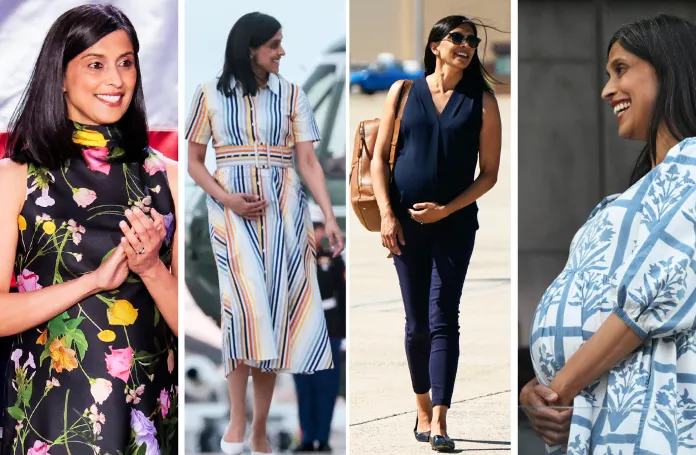
Earlier this summer, The New York Times published a fashion hit piece on the maternity wardrobes of second lady Usha Vance, White House press secretary Karoline Leavitt, and Katie Miller, wife of White House Deputy chief of staff Stephen Miller. The issue wasn’t fashion in any conventional sense; it was that these women weren’t using their fashion choices to hide their pregnancies. They were dressing in clothes that celebrated, rather than apologized for, the visibly pregnant body.
In the pages of the “Critic’s Notebook,” the Times writer, Vanessa Friedman, seemed genuinely unsettled by the mere fecundity of these women. The thrust of Friedman’s column is that women such as Vance, Leavitt, and Miller have abandoned what used to be the accepted political uniform for pregnant women, trading the loose tunics and oversized jackets favored by figures such as Cherie Blair for dresses that celebrate rather than conceal the pregnant form.
To explain why this matters, Friedman quotes Helen Lewis, author of Difficult Women, who observes, “It’s really noticeable that the MAGA women are not hiding their pregnancy. There is pride in being pregnant and being fertile.”
It was almost incomprehensible to the Times that conservative women are genuinely happy to be pregnant. That happiness represents a challenge to one of the central cultural narratives that modern feminism has spent decades constructing and that the Right desperately needs to deconstruct.
Conservative political influencers have rightly decided it’s time to challenge it, head-on.
For years, the message has been relentless that motherhood is physically and spiritually life-limiting. There has been a public relations campaign against motherhood, and judging by the birth rate, it’s been an extremely successful one. Like every successful PR campaign, it relies on imagery as much as argument.
What Friedman recognizes, even if she never says it outright, is that these conservative women with a deep understanding of public relations have begun fighting that cultural battle with imagery of their own.
Much of what IFS shared isn’t news to anyone who’s been following the birth rate decline; the numbers are stark. America is now in its third major period of below-replacement fertility, but this decline is longer, deeper, and more geographically widespread than past drops. Birth rates have fallen below 1.6 children per woman, slowing population growth so sharply that, if current trends continue, the U.S. population could peak around 351 million and begin shrinking in the 2050s, earlier than prior projections.
TRUMP’S NEW DEPUTY HHS SECRETARY HAS TIES TO THE FERTILITY INDUSTRY
How can the government convince people to take the plunge? How can we foster a society and culture where Americans believe in the future enough to make the ultimate investment in it? Better than almost any politician in history, President Donald Trump understands the power of images and media messaging. The women of his administration have learned it too, and aren’t just having babies, but visibly promoting just how wonderful that decision is.
For decades, we’ve tried to solve a cultural problem with economic policy. The new research suggests we’ve had the equation backward all along. The most effective pronatalist policy isn’t another tax credit, it’s letting young people see that motherhood is something to envy rather than escape. We can all do our part in our own communities to send that message, one baby shower and meal train at a time.