
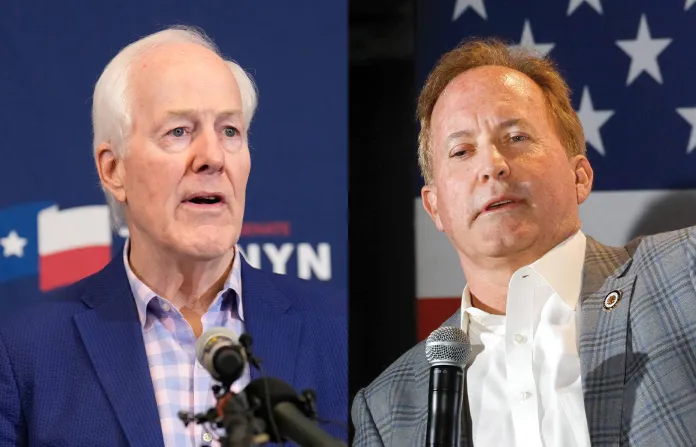
Sen. John Cornyn (R-TX) did everything right. The four-term lawmaker voted with President Donald Trump. He kept his head down when it counted, bit his tongue when Trump said time had “passed him by,” and quietly accepted the indignity of watching Senate leadership beg a sitting president to endorse an incumbent of their own party. It was not enough.
On May 26, Texas Attorney General Ken Paxton demolished Cornyn in the Republican primary runoff, pulling 63.8% of the vote in what was a watershed moment for GOP politics in the state. Cornyn became the first Republican senator from Texas to lose a party nomination for reelection. In January, his 24-year Senate career will end.
The lesson the activist base drew from the result is pretty clear-cut. Cornyn voted right most of the time. Paxton would always vote right. The man who was impeached by a GOP-controlled state House on bribery and corruption charges in 2023, acquitted by the state Senate, and whose wife filed for divorce last year on what she described as “biblical grounds,” walked into a victory party in Plano to chants of his name.
“Tonight we just sent a Texas-sized message to Washington,” Paxton said from the stage. “Change won.”
What changed, specifically, was the answer to a question that was once asked of candidates from both parties: Is this person fit to hold office? For a growing and influential slice of each party’s base, the question is no longer relevant. The activist wings of both parties, or at least significant parts of them, don’t really want members of Congress making decisions anymore. They just want them to vote the party line. No gathering of information. No hearings with experts. No debate. Vote the right way. It is all that matters.
That is a more precise diagnosis than the familiar lament about candidate quality. It is not merely that voters are willing to overlook personal failings or ethical baggage in pursuit of a win. It is that the job description itself has been rewritten. In this model, a senator or congressman is not a representative weighing competing interests and exercising independent judgment. He or she is a lever. Point them in the right direction, give it a stamp of approval or disapproval, and repeat. Character, competence, even intelligence and wisdom, are concerns for a different era.
The Republican side of this is Paxton. But the dynamic is not partisan. Flip to Maine, where Democrats handed their Senate nomination to Graham Platner, an oyster farmer and Marine Corps veteran whose campaign has lurched from one scandal to the next since he announced in August 2025.
There was the Nazi SS death-head tattoo on his chest, which he wore for 18 years, claiming he did not know what it was. There were the controversial social media posts. And then, just days before the June 9 primary, came reports that Platner had exchanged sexually explicit messages with multiple women while married. His wife recorded a statement calling the coverage “shameful.” Platner called it “journalistic malpractice” while acknowledging, “Amy and I went through something hard — because of me.” The latest to hit was a series of accusations from former girlfriends, including one who said he physically assaulted her and refused to allow her to leave a room.
None of it came close to costing him the nomination. Gov. Janet Mills (D-ME), the establishment candidate, suspended her campaign in late April after falling roughly 30 points behind in primary polling. Senior Democrats have largely held the line. Sen. Bernie Sanders (I-VT), who endorsed Platner early, offered the definitive statement of the new calculus when reporters pressed him on the sexting allegations at a Capitol Hill appearance. “We got a housing crisis. People can’t afford healthcare, they can’t afford groceries, they can’t afford to fill up their gas tanks,” Sanders said. “I think it’s important for us to focus on the issues facing working families a little bit more than Graham Platner’s marriage.”
Translation: He’ll vote the right way. And that’s enough.
The contrast with the not-so-distant past is striking. In December 2017, Roy Moore lost a Senate special election in Alabama, a state Trump had carried by 28 points just a year earlier, after multiple women came forward with allegations that he had pursued or sexually assaulted them when they were teenagers and he was in his 30s. Moore lost to Democrat Doug Jones. National Republicans abandoned him. The RNC pulled its support. Even Trump, who had endorsed Moore in the general election after unsuccessfully backing his opponent in the primary, tweeted afterward that Moore “cannot win” and urged Alabama Republicans to move on. The race was treated as a cautionary tale about the price of nominating damaged candidates.
What a difference eight-and-a-half years makes. Paxton was impeached, not accused of past misconduct by private citizens, but formally charged and tried by his own party’s legislators, and he won a Senate primary by 28 points. Platner seemed to have a new scandal hit the front page every day before his primary, but he still coasted to victory. The argument Sanders articulated in defense of Platner applies equally on the right: With the Senate majority on the line and a reliable vote within reach, activists have concluded that character concerns are a luxury reserved for competitive ideological battles, not party-line confirmation fights.
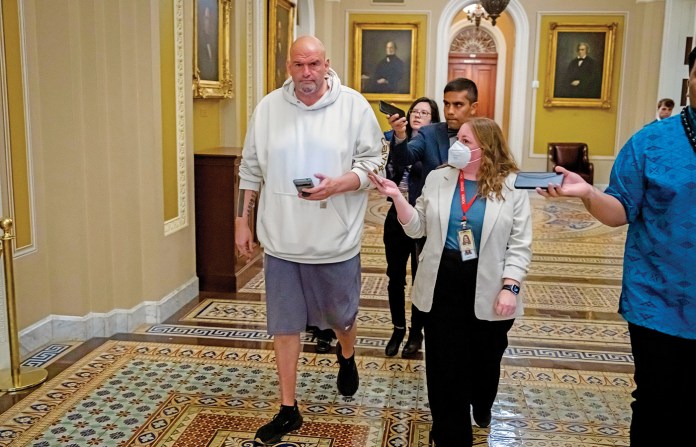
Sen. John Fetterman (D-PA) understood this dynamic before it was fully formed, and he has paid for the understanding. When Pennsylvania Democrats rallied behind Fetterman in 2022, they tolerated real questions about his health and cognitive fitness in the months following his stroke because he was their best shot at winning the seat, and he was going to vote with the party. And he did, right up until he didn’t. Once Fetterman began crossing the aisle with any regularity, supporting Israel, voting to reopen the government during the prolonged shutdown fight, and refusing to perform the ritual condemnation of Trump that Democratic activists demanded, the goodwill evaporated. By late 2025, 54% of Pennsylvania Democrats told Quinnipiac they disapproved of his job performance, down from an 80% rating in January 2024. The same voters who had forgiven his stroke were not prepared to forgive him for supporting Israel and voting as an institutionalist in the Senate instead of a partisan.
A New York magazine piece on Fetterman’s alleged cognitive struggles and erratic behavior, widely seen among his Senate colleagues as a coordinated smear, arrived almost precisely when his apostasies from the party line became too frequent to overlook. Fetterman noted the timing himself. “I vote a 91% Democratic line,” he told CBS Mornings, “and if Democrats have a problem with somebody that votes 91% of the same times as you, more than nine out of 10 times, then maybe our party has a bigger problem.” The health questions that Democrats had graciously set aside in 2022 were suddenly urgent again in 2025. What changed was not his health. What changed was his voting record.
There is a structural argument worth taking seriously that makes the activists’ position less cynical than it appears. If the Senate majority controls 51 votes and those 51 votes can do virtually anything, such as end the legislative filibuster, confirm nominees, pass legislation on party-line margins, and do so quickly, then the value of an individual senator’s independent judgment shrinks considerably. What matters is the number, not the person. Under those conditions, getting your party’s vote into the seat becomes the entire game. A Paxton who votes MAGA is worth infinitely more to MAGA voters than a Cornyn who votes MAGA 95% of the time, because that other 5% might be the vote that counts.
Candidate quality still matters in some respects. Paxton will face Democratic state Rep. James Talarico in November in what is expected to be among the most expensive Senate races in the country. Some of Cornyn’s Senate colleagues have warned privately that Paxton’s baggage could put a reliably red state in play and drain resources from other competitive seats. Texas, which Trump carried by 14 points in 2024, is unlikely to flip, but the concern is real enough that it registered.
Similarly, whatever Platner’s polling advantage was over Sen. Susan Collins (R-ME) before the latest scandal broke, the next five months will test whether Maine voters are as forgiving as Democratic primary voters. Collins has a long history of beating polling results at the ballot box, despite voters giving her negative marks for job approval.
But “candidate quality might matter in the general election” is a much weaker claim than the one that prevailed eight years ago, when the Roy Moore experience seemed to establish a firm floor for what Republican voters would accept. That floor held, sort of, through the 2022 cycle, when nominees like Herschel Walker in Georgia and Mehmet Oz in Pennsylvania underperformed in winnable races. The lesson seemed clear: Put up bad candidates, lose winnable seats.
The lesson of 2026 appears to be different, or at least more conditional. Paxton made the opposite argument. He said his ability to turn out Trump’s base in a midterm year more than compensates for whatever the consultants say about his liabilities. Primary voters obviously agreed with that sentiment, and it showed in the results.
WHAT KIND OF SENATOR WAS BEN SASSE?
What the Paxton primary and the Platner primary share, beneath the surface differences, is a common theory of legislative purpose. The people pulling the levers in both parties’ primaries are not, in the main, looking for statesmen. They are not looking for legislators who will weigh the interests of their constituents and the Constitution against the demands of national coalitions, or who will occasionally reach across the aisle when the moment calls for it. They are looking for reliable votes. The rest of it — the character, the record, the behavior in a marriage, the Nazi tattoo — is merely noise.
John Cornyn has spent nearly 24 years in the Senate. He was, by any conventional measure, a highly effective legislator and a reliable conservative. He built a record, cultivated relationships, and delivered for Texas. None of it was worth a damn when the question on the ballot was simply: Who will vote the way we want? Paxton had a better answer. In the new model, that is all the answer one needs.
Jay Caruso (@JayCaruso) is a writer living in Florida.