
“Subject to the jurisdiction thereof.”
That is the phrase, stuck in the middle of the first sentence of the first section of the 14th Amendment, that President Donald Trump is seeking to redefine as part of his campaign to overturn the more than century-old policy of birthright citizenship in the United States.
“All persons born or naturalized in the United States,” the 14th Amendment begins, “and subject to the jurisdiction thereof, are citizens of the United States and of the State wherein they reside.”
The Trump administration argued before the Supreme Court that the phrase, “subject to the jurisdiction thereof,” limits the grant of citizenship at birth to the children of parents who owe allegiance to the U.S. government and are therefore not subject to a foreign sovereign. For the administration, this means legal immigrants owe allegiance to the U.S., and their children are due citizenship at birth, while illegal immigrants do not, and should therefore be denied birthright citizenship.
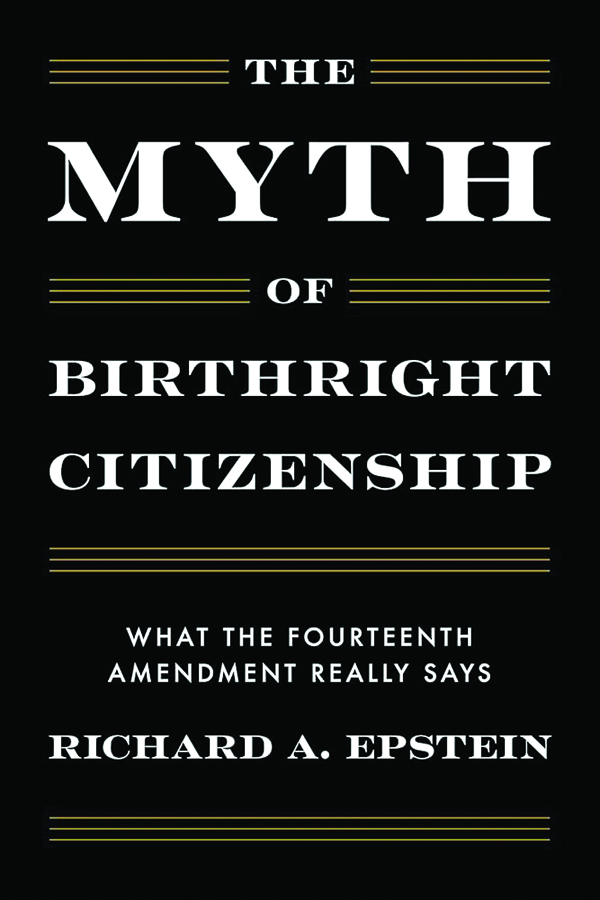
In his new book, The Myth of Birthright Citizenship, legal scholar Richard A. Epstein takes that argument a step further, making the case that granting citizenship at birth to any alien, legal or otherwise, “undoes everything about how naturalization had worked from the outset of the Republic.”
While Epstein’s book makes a strong normative case for why birthright citizenship is antithetical to our nation’s founding principles, the legal case he marshals that the authors of the 14th Amendment did not intend to create a new right to birthright citizenship is cherry-picked and flounders in the face of the full record.
The foundation of Epstein’s argument is built on the Naturalization Acts of 1790 and 1795, which required any individual seeking to be naturalized to take an oath renouncing all loyalties to any foreign sovereign and allowed the children of such naturalized citizens, under the age of 21, to become citizens as well. Nothing in the Naturalization Acts, Epstein notes, automatically bestowed citizenship on the children of aliens before their parents became citizens. Epstein then makes the logical leap that this silence means that the authors of the Naturalization Acts intended to deny citizenship to children born in the United States to aliens.
Epstein correctly notes that this interpretation flies in the face of the most commonly accepted common law view at the time, as recorded by 18th-century English jurist, judge, law professor, and member of Parliament William Blackstone. In his Commentaries on the Laws of England, Blackstone writes, “The children of aliens, born here in England, are, generally speaking, natural-born subjects, and entitled to all the privileges of such.”
“The American naturalization statutes of 1790 and 1795 had two powerful features,” Epstein argues. “The first was that naturalization of the parents bound their minor children, so no minor child born of unnaturalized aliens in the United States could claim citizenship via the ius soli [right of the soil] as defined by Blackstone. Second, the 1795 Act required all persons who became citizens of the United States to renounce all loyalties to their previous sovereign, which was impossible under the Blackstone rule.”
While there is a consistent logic to Epstein’s argument, the book fails to establish that it was commonly understood that the Naturalization Acts had abrogated the common law rule of ius soli, which was widely accepted in the U.S. at the time. More importantly, however, Epstein conveniently hand-waves away the best evidence that the authors of the 14th Amendment intended to specifically establish a right to birthright citizenship.
Epstein briefly quotes from Sens. Edgar Cowan (R-PA) and John Conness (R-CA), debating Sen. Jacob Howard’s (R-MI) amendment to the 14th Amendment that added the citizenship clause, but he glosses over their agreement.
Shortly after Howard introduced his amendment, Cowan rose to oppose it. “Sir, I trust I am as liberal as anybody toward the rights of all people,” Cowan began, “but I am unwilling, on the part of my State, to give up the right that she claims, and that she may exercise, and exercise before very long, of expelling a certain number of people who invade her borders; who owe to her no allegiance; who pretend to owe none … and whose adroitness and cunning is of such a transcendent character that no skill can serve to correct it or punish it.”
“I mean the Gypsies,” Cowan explained. “These people live in the country and are born in the country. They infest society. They impose upon the simple and the weak everywhere.”
“Are those people, by a constitutional amendment, to be put out of the reach of the State in which they live?” Cowan asked. “I mean as a class. If the mere fact of being born in the country confers that right, then they will have it; and I think it will be mischievous.”
Cowan was decidedly against Howard’s amendment because he clearly understood it to mean that children born to Gypsies, who gave no allegiance to the United States, would be citizens.
Conness, however, was for Howard’s amendment. And he defended it, arguing, “The proposition before us, I will say, Mr. President, relates simply in that respect to the children begotten of Chinese parents in California, and it is proposed to declare that they shall be citizens.
“We have declared that by law,” Conness wrote, referring to the previously passed Civil Rights Act of 1866, “now it is proposed to incorporate the same provision in the fundamental instrument of the nation. I am in favor of doing so.”
Looking back now, 160 years later, we can have a policy debate over whether Cowan was right that we should not grant birthright citizenship to the children of Chinese and Gypsy immigrants, or that Conness was right that we should. But what is absolutely not up for debate is that Cowan and Conness alike understood that the 14th Amendment, if ratified with Howard’s amendment, would grant citizenship to the children of those born in the U.S., unless they were part of an invading army or working as a diplomat for a foreign power.
Epstein skips past this entire debate, telling readers, “The entire matter was dropped.” That is false. The citizenship clause was not dropped. It became part of the 14th Amendment. Cowan opposed birthright citizenship, which is why he voted against the 14th Amendment. Conness supported birthright citizenship, which is why he voted in favor of the 14th Amendment. And Conness won, by a vote of 33-11.
Epstein may wish the vote had gone otherwise, and he makes a strong prudential case against birthright citizenship, but policy questions are not for the Supreme Court to decide.
It was well understood at the time that “subject to the jurisdiction thereof” meant those born “under the flag,” a common Reconstruction Republican saying. Those not born under the flag included Indians born on quasi-sovereign Indian land, diplomats serving foreign embassies, and foreign armies occupying American soil. Everyone else was considered “subject to the jurisdiction thereof” of the U.S., whether they were citizens or not.
TRUMP ADMINISTRATION FACES TOUGH QUESTIONS ON BIRTHRIGHT CITIZENSHIP AT SUPREME COURT
Projecting the terms “legal” and “illegal” immigrant into the 14th Amendment, as the Trump administration is attempting to do, is folly. As multiple Republican-appointed Supreme Court justices pointed out during oral argument, there was no such thing as “legal” or “illegal” immigration at the federal level when the amendment was adopted. It was not until the Page Act of 1875 that the entry of Asian male laborers and females suspected of prostitution was banned. And it wasn’t until 1882 that a general federal law defined lawful versus unlawful entry for immigrants as a class. The terms “legal” and “illegal” would have had no meaning to the authors of the 14th Amendment, which is why it is impossible to accept that is what they were referring to when they inserted the phrase “subject to the jurisdiction thereof” into the first sentence.
When Cowan and Conness were debating the merits of birthright citizenship in 1866, it took about 80 days to sail from China to California. By the time the Page Act became law in 1875, steamships could make the same trip in 20 days. Now a flight from San Francisco to Beijing is over in mere hours. Does the shrinking of our world change the policy trade-offs of birthright citizenship? Absolutely. Does it change the meaning of the 14th Amendment, as understood and passed by its authors? Not in the slightest.
Conn Carroll is the commentary editor for the Washington Examiner.