
With its ornate facade resembling an ocean liner, gilded portholes, and fat cherubs hanging festoons of grapes, the Hotel Lutetia is known as the Left Bank’s grand hotel.
The hotel’s motto, “Fluctuat nec mergitur” (“She is tossed by the waves, but does not sink”), is also the motto of Paris itself, suggesting the city’s resilience. That quality is in abundant evidence in Jane Rogoyska’s engaging new book, Hotel Exile: Paris in the Shadow of War.
Rogoyska is a Polish-born British author who started her career as a filmmaker. As a writer, she has retained a cinematic eye, writing vibrant narrative nonfiction that depicts history with an emphasis on character and setting. Her scenes come alive in striking detail: “The hotel was decked out with crystal chandeliers, mosaics, frescoes, parquet floors. There were sound-proofed bedrooms with leather-padded doors, telephones connected to the maître d’ and bells with which to summon the valet or the chambermaid.”
Rogoyska is the author of several books about conflicts of 20th-century history. She has received numerous awards, including the Columbia Journalism School’s Mark Lynton History Prize for her 2021 book, Surviving Katyn: Stalin’s Polish Massacre and the Search for Truth, which probes Joseph Stalin’s 1940 execution of 22,000 Polish prisoners of war and its subsequent cover-up.
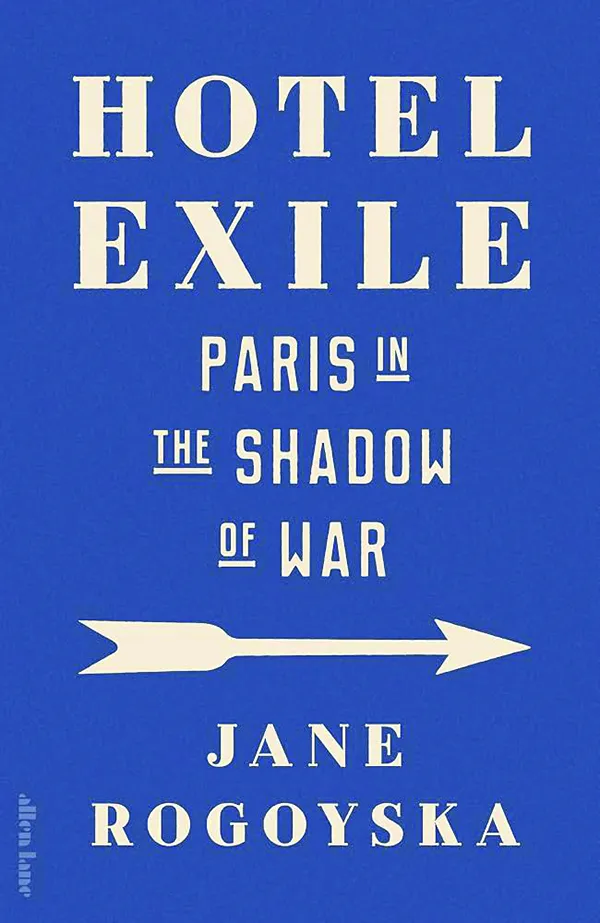
By Jane Rogoyska; Norton; 352 pp., $31.99
Hotel Exile concerns life before, during, and after World War II, covering the years from 1933 to 1945. Rogoyska presents the Lutetia as Paris in a microcosm.
The hotel was built in 1910 to accommodate wealthy shoppers at the department store Le Bon Marche. In the 1930s, it was a meeting place for famous intellectuals, politicians, and artists. In the early 1940s, it was an office and living space for the German intelligence agency, Abwehr. In 1944-45, it housed deportees returning from Buchenwald, Auschwitz, Drancy, and other prison camps. In 2014, it had a four-year makeover during which it was refurbished to its early eminence, and in 2018, it was renamed the Mandarin Oriental Lutetia, Paris.
The book contains three main sections, each consisting of brief chapters written in a mix of past and present tense, with the first summarizing the story and the second bringing the history alive and making it feel immediate. With its many characters and events, the book sometimes feels overwhelming. I would have liked a cast of characters and a timeline to be able to consult while reading.
The story is driven with descriptive detail and evocative language. The core of the narrative begins a few weeks after Adolf Hitler was named chancellor of Germany, and when the German parliament building was set on fire, the Reichstag fire.
Here is Rogoyska’s vivid account of the scene: “[The flames] leap up fiercely, breaking through the glass cupola to release plumes of black smoke which rise high into the sky. Behind the classical pillars of the front entrance a wall of orange illuminates the windows.”
As the Nazis threatened France, the German exiles who had sought a new life in Paris were desperate to leave the city. People packed their belongings, carrying them or tying them on top of cars. Approximately 10 million people left northern France for the south. Many were captured and sent to work and death camps. Paris was declared an “open city” to spare it from bombing and destruction.
Rogoyska names many people with connections to the Lutetia, including politicians, actors, directors, intellectuals, artists, writers, photographers, and other VIPs. Henri Matisse and Pablo Picasso spent halcyon days at the Lutetia. So did literary greats like Simone Weil, Joseph Roth, Samuel Beckett, Ernest Hemingway, Thomas Mann, Heinrich Mann, Andre Gide, and James Joyce. Gen. Charles de Gaulle and his wife honeymooned there.
The book’s emphasis is on the displaced people who disagreed with the Nazi agenda and who tried to escape Hitler’s regime. These include people like Eva Tichauer and her parents, who were taken to Auschwitz. They insisted she finish her medical degree — which saved her life. Photographer Gisele Freund, who photographed Joyce, escaped Paris by strapping her negatives around her body.
Irene Nemirovsky, a novelist, died of typhus at Auschwitz on Aug. 17, 1942, but her children were saved. Her husband, Michel Epstein, was gassed on Nov. 6, 1942, at Auschwitz upon arrival. Their two daughters survived and spent years taking turns waiting for the survivors of the camps and looking for their parents in Paris — to no avail.
After Germany invaded Poland and threatened France, the French government left Paris and relocated to Bordeaux. Priceless artifacts, paintings, and museum pieces were hidden and removed to other parts of France. Children were sent to the French countryside in areas south and west of the city.
The German intelligence group, Abwehr, moved to the Lutetia to conduct spy operations. Several, including Adm. Wilhelm Canaris, disagreed with Hitler’s policies and tried to thwart the Gestapo. Canaris was arrested and hanged for treason on April 9, 1945, at the end of the war.
As World War II ended, the Lutetia became a temporary home to Holocaust survivors. When the buses from the prison camps pulled up, thousands of people were clamoring to see a family member who had been arrested.
MAGGIE O’FARRELL’S LAND BEFORE TIME
Rogoyska sets the scene with the French flag fluttering, the band pumping the “Marseillaise,” and crowds watching people disembark in front of the Hotel Lutetia. Then the music stopped. As Rogoyska writes: “They are walking skeletons, their skulls covered with skin so thin it is almost transparent. Their heads are shaven, men and women almost indistinguishable. Most wear filthy clothes resembling striped pyjamas.” Their clothes are “riddled with lice,” so when they enter the Lutetia, they are sprayed with DDT. When their stay at the Lutetia ended, almost no one wanted to talk about their experiences until they were in old age. Several wrote memoirs.
From their stories, Rogoyska creates a compelling account of what she calls “one of the most complex and devastating periods in twentieth century history.” It was also one of the darkest periods. The irony is that it was connected to an opulent French hotel in Paris, the exquisite City of Light.
Diane Scharper is a regular contributor to the Washington Examiner. She teaches the Memoir Seminar for Johns Hopkins University’s Osher Institute.