
With the departure of Director of National Intelligence Tulsi Gabbard, we’ve now reached what can be called an actual Cabinet shakeup. Over the past six weeks, we’ve seen the resignation of Kristi Noem from the Department of Homeland Security, Pam Bondi from the Department of Justice, and Lori Chavez-DeRemer from the Department of Labor. When we include the departure of Food and Drug Administration Commissioner Martin Makary and Secretary of the Navy (once a Cabinet-level position) John Phelan, it is clear the Trump administration is in the midst of an appointee overhaul.
Cabinet shakeups don’t come around often. They are risky because they are often interpreted as a sign of political desperation, but that is not always the case.
In the 1829-31 Petticoat Affair during President Andrew Jackson’s administration, Vice President John Calhoun inspired a Cabinet rebellion against Jackson over disapproval of Secretary of War John Eaton’s wife, Peggy. It was a protracted affair, but eventually, in 1831, Old Hickory demanded that Cabinet members not on his side resign. They did, save for one person: Postmaster William T. Barry. In the wake of this realignment, Jackson relied instead on a Kitchen Cabinet of advisers. In addition, Secretary of State Martin Van Buren — who had supported Jackson during the controversy — joined Jackson’s ticket as vice president for Jackson’s 1832 reelection. Van Buren became the last vice president elected to succeed the presidents under whom he served until George H. W. Bush succeeded Ronald Reagan.
When it comes to Cabinet shakeups, it’s hard to beat the 1970s. This is perhaps unsurprising given that it was a decade of war, stagflation, malaise, and scandal.
Things started with an unforced error. In 1972, President Richard Nixon followed up on a historic landslide victory by asking for the resignations of all of the members of his Cabinet. He was inspired to do this after reading a book given to him by White House adviser Daniel Patrick Moynihan. The book, Robert Blake’s biography of British politician Benjamin Disraeli, included a description of William Gladstone’s Cabinet as “exhausted volcanoes.”
Nixon ended up accepting the resignation of eight of his 11 Cabinet members, but he later reported regretting it. Having a less experienced Cabinet may have addressed the “exhausted volcano” problem, but it also may not have served him well as he tried and failed to deal with the political fallout from the burgeoning Watergate scandal.
After Nixon resigned, he was replaced by President Gerald Ford. Ford had a tough time dealing with a bad economy, his unpopular pardon of Nixon, and seemingly endless White House staff strife. In addition, former California Gov. Ronald Reagan was a threat to defeat Ford in the upcoming 1976 Republican presidential nomination contest.
On Nov. 3, 1975, Ford initiated a staff shakeup to address his internal problems to better face the outward ones. Ford’s purge included the announcement that the liberal Republican Vice President Nelson Rockefeller would not remain on the ticket in 1976; that chief of staff Donald Rumsfeld would replace James Schlesinger as secretary of defense; that Henry Kissinger would lose his national security adviser role, even as he remained secretary of state; and that CIA chief William Colby would be out as well. A young Dick Cheney succeeded Rumsfeld as White House chief of staff.
The shakeup backfired. The press called the moves the “Halloween massacre.” James Reston of the New York Times wrote of Ford that “The feeling in Washington, so far as anybody can judge it, is that he has misjudged his problem, overestimated Mr. Reagan’s power, underestimated his early popularity, and misread the mood of the nation.” Ford was not happy with the results, either, later claiming that the massacre was “the biggest political mistake of my life.” While he managed to defeat Reagan and win the GOP nomination, the apparent desperation of the maneuver also contributed to Ford’s close election defeat to President Jimmy Carter in 1976.
Carter did not have things much easier, as he also faced a bad economy and an energy crisis. He tried to address his problems by bringing experts to a series of conversations at Camp David to discuss the nation’s challenges. After the meetings, he gave a July 15, 1979, speech called “Energy and the Crisis of Confidence.” The speech initially got positive reviews, but Carter unwisely followed up with a Cabinet shakeup, firing five Cabinet secretaries: Joseph A. Califano Jr., secretary of health, education and welfare; Michael Blumenthal, secretary of the treasury; Brock Adams, the stubborn secretary of transportation; Attorney General Griffin Bell; and Secretary of Energy James Schlesinger, who had also fallen victim to Ford’s Halloween massacre.
In the wake of the shake-up, the speech has become infamous as the “malaise address,” even though Carter never used that word in it. Carter lost his 1980 reelection effort to Reagan and was forever colored by the incident. When a statue of Carter was unveiled on an episode of The Simpsons, the words on the pedestal read “Malaise Forever.”
In 2004, after President George W. Bush defeated John Kerry for reelection, 12 Cabinet members left, mostly voluntarily. It’s not unusual for presidents to bring in new Cabinet members after a reelection, but in this case, what was unusual to some was a Cabinet member who did not leave. One of the departures was Secretary of State Colin Powell, who told Bush that he should shake up his warring national security team. As Powell told the president, “You really need to change this all, after the election.”
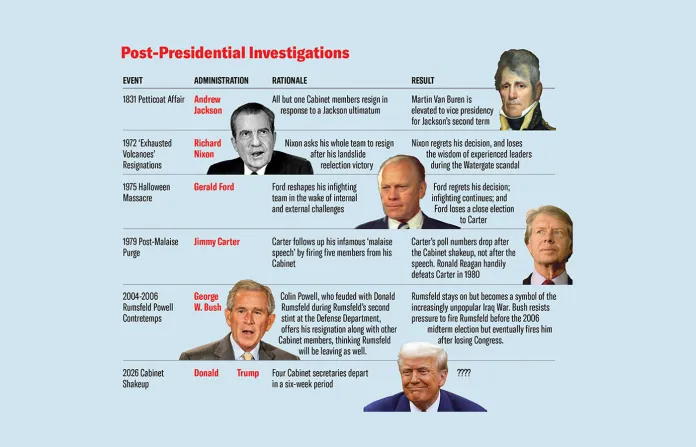
Powell expected that both he and his rival, Defense Secretary Don Rumsfeld, would resign, but was upset to learn that Rumsfeld was staying in place. As Powell later recalled, “I thought that when he began with me, it was not going to end with me.” During the first two years of Bush’s second term, with the Iraq War going badly, multiple advisers, including Rumsfeld, suggested that Bush ask for Rumsfeld’s resignation. These calls intensified as the 2006 midterm elections neared. It was only after Bush experienced a self-described “thumping” in the 2006 midterm elections that he accepted Rumsfeld’s resignation.
As for President Donald Trump, his second term has generally been smoother in terms of personnel shake-ups than his first. In fact, the entire first term itself could be seen almost as a continuing Cabinet shakeup, with multiple secretaries of state, attorneys general, HHS secretaries, and secretaries of defense, not to mention four chiefs of staff and national security advisers.
But this recent flurry of activity is indicative that Trump sees the need for some changes, which is not necessarily a bad thing. His predecessor, Joe Biden, stubbornly refused to make changes, even when Secretary of Defense Lloyd Austin went AWOL because of a health issue without notifying the White House. This is generally not Trump’s problem.
Some of the officials Trump has let go were not performing well, including Bondi and Noem, while Chavez-DeRemer was embroiled in a scandal. Gabbard long seemed out of step with the administration’s foreign policy. Given these issues, it makes sense to make changes.
TRUMP AND MAMDANI ARE SMART TO MAKE NICE
Yet while there may be good reasons for the shakeups, any president who shuffles his staff has to deal with the perception problem. A shakeup implicitly demonstrates a need to address serious problems, but they are also opportunities for a reset, and Trump seems to be in need of one now.
For a shakeup to be successful, the president needs to pick well-qualified replacements who not toady but are generally aligned with his policies; get them confirmed and in place before potentially losing the Senate this November; and, perhaps most importantly, explain to the American people why the reshuffling took place and how things will be better going forward. These may sound like obvious steps, yet the history of shakeups shows that presidents do not always do the obvious thing in their wake.
Tevi Troy (@tevitroy) is a senior fellow at the Ronald Reagan Institute and a senior scholar at Yeshiva University’s Straus Center. He is the author of five books on the presidency, including, most recently, The Power and the Money: The Epic Clashes Between Commanders in Chief and Titans of Industry.