
The convicted ringleader of the Feeding Our Future fraud is blaming her Somali co-conspirators for orchestrating the sprawling billing scheme that stole more than $250 million from a federal food assistance program, insisting ahead of this week’s sentencing hearing that she, too, was duped by the Minnesota-based network of Somali fraudsters.
Aimee Bock faces a statutory maximum sentence of 100 years in federal prison in what would be the lengthiest and most severe punishment yet in the Feeding Our Future fraud case, a penalty to be determined at Thursday’s sentencing hearing.
Federal prosecutors have recommended a 50-year prison sentence, maintaining that Bock was the brains behind the operation.
Bock, meanwhile, is requesting either time served or no more than 37 months, followed by supervised release with mental health treatment and vocational training, for the part she, according to her attorneys, unwittingly played.
Bock points the finger at Somali accomplices
In a presentencing plea, Bock claimed that she had been made the scapegoat for the federal government’s alleged failure to identify the actual architects of the reimbursement scam.
Bock’s attorneys are arguing that authorities knew that two high-ranking Feeding Our Future employees, Hadith Yusuf Ahmed and Abdikerm Abdelahi Eidleh, were the true masterminds of the Feeding Our Future fraud ring but pinned the bulk of the blame on Bock, the organization’s founder.
“Eidleh and Ahmed knew that Bock did not speak Somali,” her defense team said in a 75-page sentencing request. “They used Bock’s unfamiliarity with Somali to isolate her from uncovering their fraud.”
According to the defense’s filing, “Ahmed and Eidleh were the organizers and recruiters of the fraudulent [food] sites. They deceived Ms. Bock.”

The pair acted as on-the-ground operatives, according to charging documents, recruiting mainly members of Minnesota’s immigrant Somali community into Feeding Our Future’s sponsorship nexus.
Bock is the only white suspect who was charged, while most of the Feeding Our Future defendants are of Somali descent.
Ahmed, who pleaded guilty to conspiracy charges, solicited entities to enroll as food distribution sites under the sponsorship of Feeding Our Future, a Minnesota nonprofit organization that sponsored dozens of food pantries, many of them fraudulent, in the child nutrition program that was meant to feed children during the pandemic.
Food distributors were only able to claim compensation for the cost of meals supposedly served if an authorized agency, known as a sponsoring organization, sponsored the purported meal provider. Feeding Our Future retained a 10%-15% cut of the reimbursements in exchange as an administrative fee.
Ahmed, Bock’s self-described “right-hand man,” personally accepted kickback payments, charging them as “consulting” costs.
Eidleh, whom Bock had hired as a translator and recruiter, fled to Somalia when investigators raided his Minnesota residence in 2022. He remains a fugitive from justice.
“The man who built the machine is in Somalia,” according to Bock’s sentencing petition. “The woman who failed to stop it is before this Court.”
HOW MINNESOTA’S SOMALI FRAUD INDUSTRIAL COMPLEX HAS STOLEN MILLIONS FROM MEDICAID
Bock’s lawyer said Eidleh helped enroll 90% percent of the sites sponsored by Feeding Our Future, served as the point of contact for many of these sites, handled the site applications, gathered the prefilled meal counts from the sponsored locations, and instructed them to make copies as well.
Claiming that “Ms. Bock was not aware of Mr. Eidleh’s conduct” at the time, Bock’s attorneys said there is a difference that should matter at sentencing when it comes to criminal culpability between “the person who designed the fraud and the person who failed to detect it.”
“Eidleh created an archipelago of shell companies. … He did not merely collect money. He taught people how to commit fraud,” Bock’s legal team said.
One witness, according to a trial exhibit cited by Bock, said Eidleh was known as “the guy” to go to because of his perceived control over entry into the reimbursement system. When a site applicant tried to bypass Eidleh and contact Bock directly, the prospect’s application went nowhere, but when the applicant asked Eidleh, he allegedly said, “Give me 10%, and I’ll get you in.”
When another Feeding Our Future site operator complained to Eidleh that the per-meal reimbursements seemed small, he allegedly told her, “You get money by increasing the quantity of meals claimed.”
Bock said Eidleh trained sites to prepare fake invoices and embedded his family members in Feeding Our Future management positions that granted them access to documents, site monitoring records, and internal operations.
“He did not suggest,” Bock’s attorneys said of Eidleh. “He directed. He did not enable. He designed.”
Prosecutors say Bock was primarily responsible
According to the prosecution’s sentencing memorandum, Bock “unquestionably led” the largest COVID-19 fraud conspiracy in the United States, a leadership role that her underlings largely recognized.
“She took a social safety net program intended to serve hungry children and repurposed it to enrich herself, her nonprofit, her employees, and her co-conspirators, and to elevate her standing in the community,” trial attorneys for the Justice Department wrote. “Bock was not just central to the scheme but was routinely celebrated as its lynchpin.”
Federal prosecutors quoted Hanna Marekegn, one of the convicted Somali co-conspirators, testifying at trial, “Aimee was a god.”
Prosecutors also pointed to a 2021 party at Benadir Hall, one of the implicated Feeding Our Future sites, where Bock was captured on video celebrating her courtroom victory over the Minnesota Department of Education.
Bock sued the MDE, the state agency in charge of administering the child nutrition funds, to force the department to approve Feeding Our Future’s pending site applications. Bock claimed that the MDE’s delays were racially discriminatory and intentionally stalled sites run by Somali immigrants.
An entourage of Somali women at the banquet hall gave Bock an award titled “In Recognition and Appreciation of Your Outstanding Leadership to the Minnesota Communities.” After they presented her with the award, the women hugged and high-fived her before chanting Bock’s name in a circle around her. “Aimee! Aimee! Aimee!”
Text underneath an hourlong upload of the celebration read in Somali, “Thank you very much Feeding Our Future/Aimee Bock for fighting for minorities.”
“At that event, Bock was openly praised by both her co-conspirators and members of the [Somali] community, underscoring the extent of her influence and the culture of complicity she fostered,” prosecutors told Judge Nancy Brasel, the Trump nominee overseeing Bock’s sentencing.
Bock disputes ‘role enhancements’
Following a six-week trial, Bock was convicted in 2025 on four counts of wire fraud, one count of conspiracy to commit wire fraud, one count of bribery, and one count of conspiracy to commit federal programs bribery.
With an offense level of 43, the highest points possible on the seriousness scale of federal crimes, U.S. sentencing guidelines set Bock’s punishment baseline at life imprisonment. Offense levels, which raise or lower recommended penalties, are adjusted based on a defendant’s role within a criminal enterprise and the severity of the crime.
Bock is disputing several proposed sentencing enhancements, arguing that role enhancements in particular should not apply.
In the request asking Brasel to consider “mitigating” circumstances, Bock’s lawyers reiterated that “the fraud was organized by others,” namely Eidleh and Ahmed, and denied that she oversaw the scheme through her role as executive director of Feeding Our Future.
“That is not the same as proving she personally directed each independent operator’s criminal conduct, supervised each separate entity, or exercised decision-making authority over all of the actors whose losses are being loaded onto her at sentencing,” Bock’s attorneys argued.
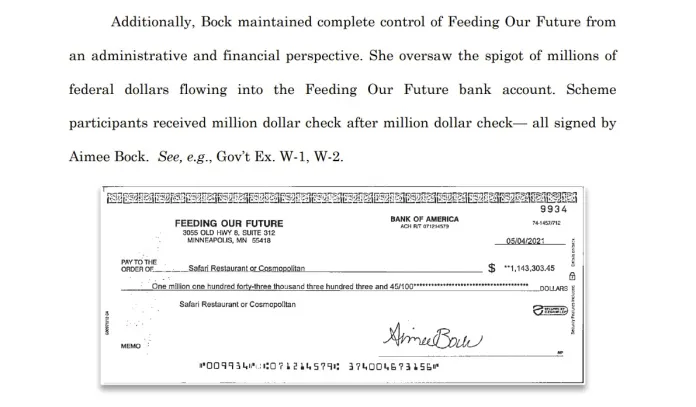
Prosecutors asserted that Bock maintained complete control of Feeding Our Future in an administrative and financial capacity. She appeared to manage the millions of federal dollars that flowed into the Feeding Our Future bank account. Scheme participants received million-dollar checks, all signed by Bock.
Bock also disputed a two-level offense enhancement for misrepresenting Feeding Our Future’s work as a 501(c)(3) charity.
“The organization’s charitable purpose was real — the fraud was in the claiming, not in the organizational identity,” Bock’s lawyers insisted. “This enhancement is designed for defendants who create fictitious charities. FOF was a real organization performing real charitable work.”
Meals were served at some point, Bock countered, citing the trial testimony of one investigator who acknowledged that “some food was distributed.”
Prosecutors say Feeding Our Future was a sham organization from its outset, lacked a legitimate board of directors, and acted as “a façade to carry out fraud.”
According to DOJ officials, Feeding Our Future was “designed to funnel money to fraudsters.” Ahmed said on the witness stand, “I think the best way to put that is Feeding Our Future was a bank. You come and you get money.”
In a text from Bock to Ahmed, which was entered as a government exhibit, Bock messaged, “We have become the mob.”