
The war between the United States, Israel, and Iran has yielded a significant amount of uncertainty, but it may also have produced an unalloyed and unprecedented good: peace between Israel and Lebanon, its neighbor to the north.
On Thursday, April 16, President Donald Trump announced that a 10-day ceasefire between Israel and Lebanon was to take effect later that day after representatives from both nations met in Washington, D.C. It followed what Trump described as “excellent conversations” between himself, Israeli Prime Minister Benjamin Netanyahu, and Lebanese President Joseph Aoun.
The ball got rolling on April 14, Secretary of State Marco Rubio spearheaded a meeting in Foggy Bottom between Yechiel Leiter, the Israeli ambassador to the United States, and Nada Hamadeh, his Lebanese counterpart. It was the most senior in-person meeting between the two countries, which have officially been at war since the Jewish state was established in 1948.
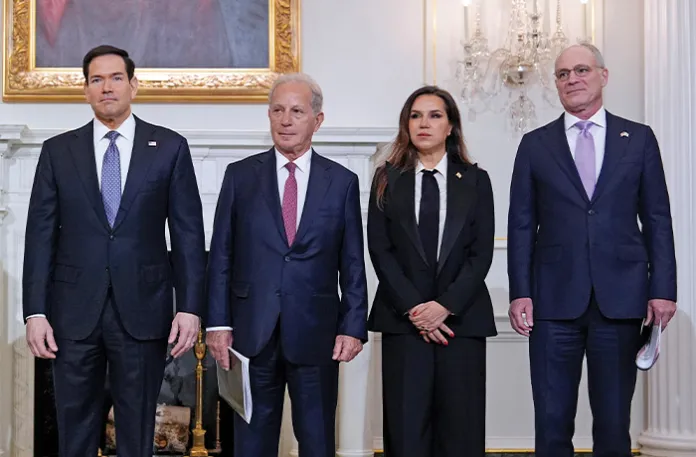
“We discovered today,” Leiter told a gaggle of reporters outside the State Department following the meeting, “that we’re on the same side of the equation, and that’s the most positive thing we could have come away with.”
By the “same side of the equation,” Leiter signaled that his government and Lebanese authorities are firmly opposed to a common enemy: Hezbollah, the Iranian-backed Shiite terrorist militia that for decades has exercised a stranglehold on the famously fractious Lebanese body politic.
Founded in the early 1980s, the so-called “Party of God” earned notoriety for in 1983 bombing of a Marines barracks in Beirut that claimed the lives of more than 240 American service members and an attack on the U.S. Embassy the same year that murdered more than 60 people, including the CIA station chief — his successor was later kidnapped and murdered by the jihadists as well.
Hezbollah has also targeted Israelis at home and across the globe, consistent with the mission of its Iranian patrons to slaughter Jews wherever they can be found. Awash in hundreds of millions of dollars in annual funding from the Islamic Republic, Hezbollah has fired tens of thousands of missiles, mortars, and other projectiles at Israeli population centers for more than three decades and has established a state-within-a-state in southern Lebanon — a hardened military base from which the terrorist group has launched no fewer than three separate wars resulting in widespread destruction.
For decades, the Lebanese government — a multiconfessional coalition comprising Shias, Sunnis, Christians, and Druze — and military found themselves essentially paralyzed by Hezbollah, unable to dislodge their control of key parts of the country and the government. The militia’s longtime charismatic leader, Hassan Nasrallah, gleefully mocked both the Israelis and his own government for their inability to stifle his cadres. Peace between Lebanon and the Jewish state seemed unattainable as long as the Iran-funded Islamists continued to menace both sides of the so-called Blue Line between the two countries.
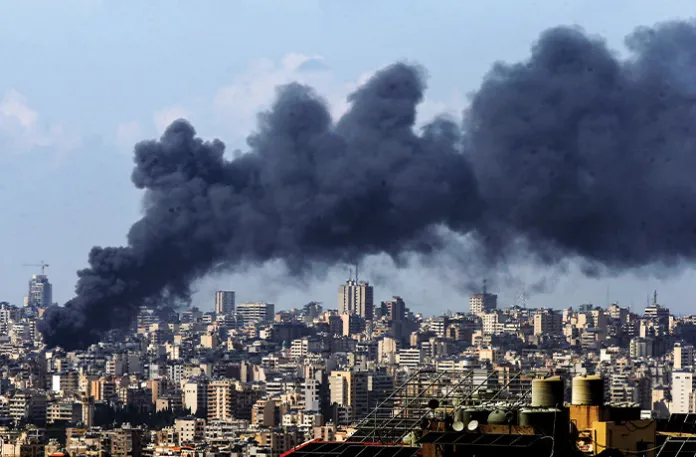
But all that changed after Oct. 7, 2023, when Hamas terrorists from the Gaza Strip invaded Israel and Nasrallah began firing missiles at Israel’s north. Flash forward a year later, and Israeli tactical surprise managed to incapacitate thousands of Hezbollah fighters through the ingenious “exploding pager” operation and eliminate Nasrallah himself in an attack on his compound near Beirut. In parallel, the Israel Defense Forces liquidated hundreds of hardened Hezbollah fighters and secured a tentative ceasefire in late 2024 that called for the Lebanese government to ensure that the group surrendered its weapons and its stranglehold on the south, seemingly opening the door to normalization.
But when the latest round of fighting in Iran erupted, Hezbollah resumed its attacks on the Israelis, firing over 6,500 rockets. In turn, Israel responded with a ferocious campaign that has further gravely weakened the Iranian proxy. The latest fighting has witnessed another IDF intelligence coup that resulted in the simultaneous targeting of more than a hundred jihadist sites across the country and the capture of Bint Jbeil, a key Hezbollah stronghold just a few miles north of the border. The terrorist group is now unquestionably at its lowest ebb in more than 40 years.
And so, when the parties announced their meeting in Washington, ordinary Israelis and Lebanese alike struggled to suppress their fervent hope that their leaders could at long last establish neighborly friendship and extirpate the malign presence of Hezbollah (and Iran) once and for all. Throughout the meeting, which lasted several hours, the participants exuded optimism.
“The United States congratulated the two countries on this historic milestone,” read a joint U.S.-Israeli-Lebanese statement, “and expressed its support for further talks, and for the government of Lebanon’s plans to restore the monopoly of force and to end Iran’s overbearing influence.”
For her part, Hamadeh, the Lebanese ambassador, noted that, during the meeting, “I emphasized the integrity of our territory and the full sovereignty of the state over all Lebanese land.” In parallel, a Lebanese news channel broadcast an image of Israeli and Lebanese flags side by side. A new organization called the Lebanon-Israel Peace Alliance was formed. And even Lebanese Shia appear to be warming to ties with Israel.
Leiter, the Israeli envoy, waxed exuberant. “We are both united in liberating Lebanon from an occupation power dominated by Iran called Hezbollah,” he told reporters.
When asked why things are any different now than 18 months ago, when the ceasefire seemed to augur a disarmament that never arrived, Leiter brushed aside the pessimism. “The Lebanese government made it very clear that they will no longer be occupied by Hezbollah,” he added. “They expressed a strong will to this time disarm Hezbollah.”
But the symbolism of the meeting surpassed the issue of the Iranian catspaw. Leiter discussed a “long term vision where there will be a clearly delineated border between our countries, and where the only reason we’ll need to cross each other’s territory will be in business suits to conduct business or in bathing suits to go on vacation.” Israelis strolling along the famed Corniche Beirut? Lebanese visiting the holy sites in Jerusalem? As a celebrated Zionist once said, “if you will it, it is no dream.”
The parties all expressed their gratitude to Rubio and the Trump administration for facilitating this extraordinary meeting, with Leiter praising the American approach over that of the French, who have tried and failed for decades to pacify their former colony.
“We’d like to keep the French as far away as possible from pretty much everything, but particularly when it comes to peace negotiations,” Leiter quipped. “They’re not needed. They’re not a positive influence, particularly not on Lebanon.”
Sure enough, on April 16, a ceasefire went into effect, midwifed by the Trump administration as a possible prelude to a face-to-face meeting at the White House between Israel’s prime minister and Lebanon’s president. Such an encounter would dwarf even the earlier confab in its significance as a marker on the road to peace.
HOW ISRAELIS ARE EXPERIENCING THE LATEST WAR WITH IRAN
To be sure, that road is very long, and there will surely be obstacles to overcome before an actual peace treaty can be signed. But April 14 marked a historic step forward.
As Leiter said in concluding his remarks, “Iran has been weakened, Hezbollah has been dramatically weakened, so this is an opportunity. This is the first time our two countries are sitting together in over three decades. Let’s enjoy the moment.”
Michael M. Rosen is an attorney and writer in Israel, a nonresident senior fellow at the American Enterprise Institute, and author of Like Silicon From Clay: What Ancient Jewish Wisdom Can Teach Us About AI.