
In the acknowledgements section of his latest novel, James Wolff shows his appreciation to those who helped him get his literary career off the ground and his fourth book out in the world. He saves the best until last, giving special thanks to his nearest and dearest — to his wife, for her continued love and support, and to his children, who, we are told, “are not satisfied in the slightest with my explanation for why their father’s name isn’t on the front.”
It would have been interesting to have eavesdropped on that conversation. For James Wolff — or rather “James Wolff” — is a pseudonym. Like David Cornwell, who was better known as John le Carre, the author of Spies and Other Gods, worked for British intelligence before switching professions and adopting a nom de plume. As a result of his past life, his previous three titles were a cut above the average spy story: They served up thrills alongside food for thought; they depicted murky worlds rich in moral complexity. And above all, they weren’t just compelling, they were also convincing.
Wolff’s new novel delivers more of the same. It opens with a woman on a London street looking at a government building. It transpires that it is no ordinary government building, but one from which, at present, 535 intelligence operations are being run, targeting Islamic terrorists and Kremlin apparatchiks, people smugglers and whistleblowers, a clutch of journalists and “one member of the royal family (not the one you think).” Inside the building is an organization “at the top of its game.” Does this watcher pose a threat to it?
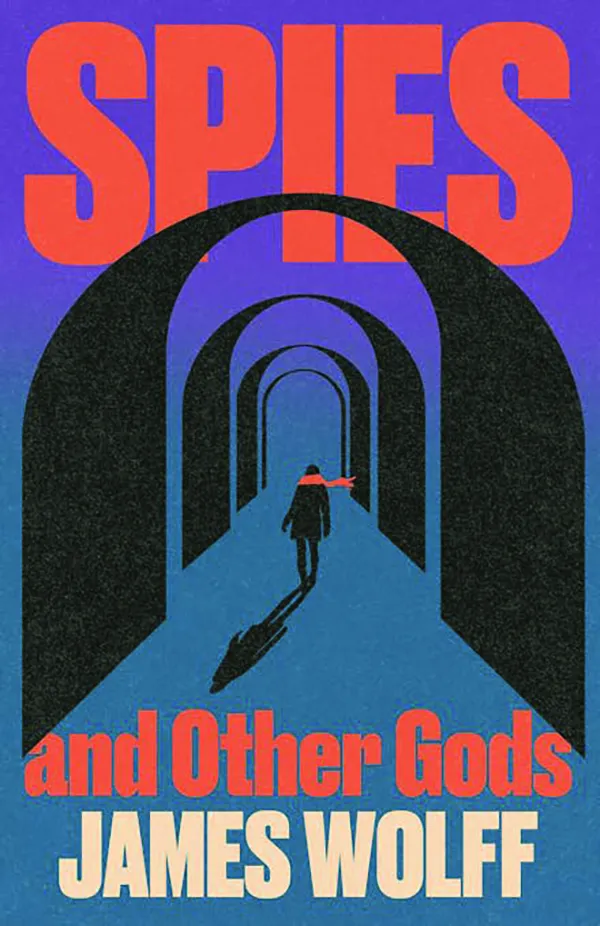
As the woman is admitted to the building and her status is made clear, the narrative’s precision-made cogs begin to turn, activating the plot and ratcheting up levels of intrigue. The enemy within this secret realm is Aphra McQueen, a parliamentary researcher with the Intelligence and Security Committee. The committee’s purpose is simple: “to catch the spies red-handed.” Aphra has been tasked with evaluating how British intelligence handled an operation. It all started when an exiled Iranian journalist was found murdered in the Netherlands in 2017. Eight more Iranians were killed across Europe. All victims were vocal critics of the Iranian regime. Pan-European intelligence services set up a working group to track down the Iranian assassin, a chemistry professor from Tehran, whom they codenamed CASPIAN. However, an anonymous individual has now accused the British of gross negligence. Enter Aphra to get to the root of the matter.
Unsurprisingly, not everyone is happy about an interloper poking their nose into what is both an internal affair and a live operation. The Head of British intelligence, Sir William Rentoul, who was hoping his last six months before retirement would be problem-free, patronizes Aphra. Susan, the “building escort” who chaperones Aphra as she interviews analysts, ethics counsellors, and agent handlers, assumes the role of kind and gracious host but can’t resist putting her unwelcome visitor in her place with the odd sharp tone or sly dig. Rentoul soon relaxes in the knowledge that he is at the helm of an organization with “decades upon decades of experience in frustrating outsiders intent on getting to the bottom of things.” Susan shows initiative and her true colors by planting a classified file in Aphra’s bag — an act that brings an abrupt end to the inquiry and to Aphra’s career.
Rather than slink away in disgrace, Aphra decides to go it alone and find out for herself why her country’s spies are resorting to desperate measures to cover up shady deeds and disastrous errors. Following the few leads she garnered from her short-lived investigation, and pretending to be working on His Majesty’s Secret Service, Aphra teams up with Zak, a British-Syrian dentist, and the pair head to Paris to meet his friend, the assassin’s nephew.
But when Rentoul discovers that Aphra is continuing her sleuth-work, he too travels to the French capital. “To remove Aphra McQueen from the board,” he tells his surveillance team, “we first need to know what game she is playing.” Once Rentoul realizes it is a zero-sum game and that Aphra is prepared to break the rules to come out on top, he devotes all his energies to apprehending her, preventing CASPIAN from striking again, and safeguarding his reputation.
Spies and Other Gods has echoes with Wolff’s earlier books. Its premise resembles that of his last novel, The Man in the Corduroy Suit (2023), which featured a “secret cadre of officers we refer to as Gatekeepers” who investigate malpractice within the intelligence community. Aphra and her audacious modus operandi of masquerading as a spy to enlist the help of the credulous Zak put us in mind of desk man Jonas and his duplicitous attempt to pass himself off as a field agent to rescue his kidnapped father in Wolff’s 2018 debut, Beside the Syrian Sea.
Fortunately, Wolff doesn’t lazily recycle these remits. Instead, he employs them as mere starting points from which to spin a fresh tale with a vividly rendered spyscape. What makes this novel completely original is his choice of narrator — not a flesh-and-blood character but a mysterious, amorphous all-seeing entity. “I’d rather you didn’t believe that I’m the spirit of spying, to be honest,” it tells us at one point. But it’s definitely the spirit of something, one whose roving eye and singular voice combine to create a commentary that is, by turn, witty, acerbic, and insightful.
Wolff further enriches his narrative by flitting between the perspectives of his characters, from wily operator Susan to unwitting dupe Zak — a man who believes there is something “godlike” about espionage: “You both work according to some sort of ethical yardstick that permits waterboarding and dead babies,” he remarks to Aphra. When the focus is on Rentoul, we follow a gripping fall from grace. Rentoul goes from a fierce figure of authority launching his own mole-hunt to snare the treacherous complainant to a hapless blunderer chasing Aphra on foreign soil. “His job is to steer the ship,” Wolff reminds us, “not scrape barnacles from the hull.”
But of all the characters — the elusive and the manipulative, the deniable and the expendable — the strongest and most credible is Aphra. Gutsy, resourceful, and single-minded, she endures hard knocks and powers on to get what she wants. Wolff shrouds her past in mystery, and when he thickens his plot to reveal a hidden personal agenda, we learn there is more to her than meets the eye. It is hard not to cheer her on as hostile forces close in, and she advances toward a high-stakes showdown in Switzerland.
There is a moment when Zak, an aficionado of spy fiction, spots a book written by a former intelligence officer. “Anyone who chooses writing spy novels over spying itself can’t have been much good in the first place,” he muses. We don’t know how good a spy James Wolff’s alter ego was, but on the strength of this book, we should be grateful he came out of the shadows to artfully blend spycraft and storytelling.
Malcolm Forbes has written for the Economist, the Wall Street Journal, and the Washington Post. He lives in Edinburgh.