
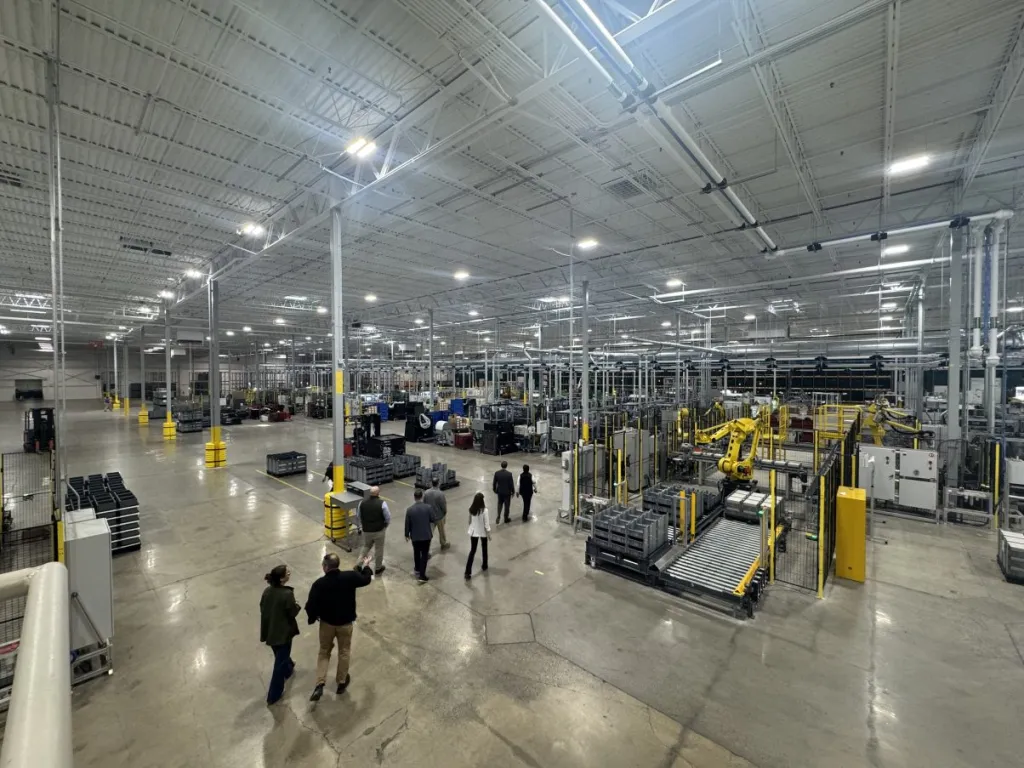
WARRENDALE, Pennsylvania — Joe Mastrangelo stood on the mezzanine overlooking the factory floor of Eos Energy Enterprises’ new plant, his eyes welling as he looked out over the rows of yellow-caged robotic cells, conveyors, and steel gantries stretching nearly the length of the building below.
“I come and stand here every morning, and I still can’t believe that this is where we are today,” the Eos CEO said. “I am both so humbled and also proud of what we are building.”
It is a long way from where the company began. In 2019, Eos had about 20 employees working inside a former Westinghouse building in Turtle Creek, a Western Pennsylvania borough that once helped light the world. Today, the zinc-battery maker employs more than 800 people in the Pittsburgh region; its second plant is humming here in the northern suburbs of Allegheny County, and its corporate headquarters moved from New Jersey to Pittsburgh’s North Side.
Every worker on the production floor is a member of the United Steelworkers, a choice management says was deliberate. It is a traditional union shop that reflects the manufacturing legacy of the place it calls home.
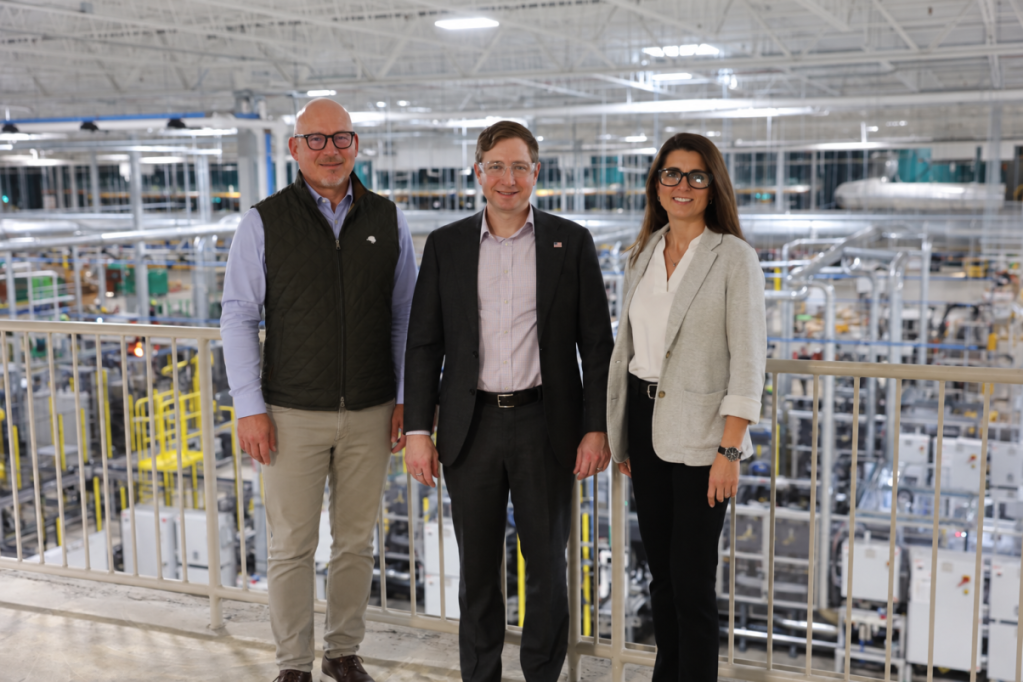
On Thursday, Alex Fitzsimmons, associate deputy secretary of energy and senior adviser to Energy Secretary Chris Wright, toured the 432,000-square-foot facility alongside Mastrangelo and Chief Administrative Officer Michelle Buczkowski to see what an American-made alternative to the lithium-ion battery looks like at scale.
“With Eos, you have a company that left the United States for China in 2016 under the Obama administration, and then returned to America in 2018 in President Donald Trump’s first term,” Fitzsimmons said. “Now, in President Trump’s second term, Eos is rapidly expanding manufacturing capacity for advanced battery technologies, spurring economic growth and employment opportunities in the Pittsburgh region.”
What Eos does here is almost impossible in the lithium-ion world: It turns raw materials into complete battery systems under one roof, with a predominantly domestic supply chain.
At the heart of the product is a gray battery module about half the size of a carry-on suitcase. Each module contains 20 cells, with a design that borrows from the familiar lead-acid battery: Plastic plates called bipolars sit in a row, with a zinc-and-bromine electrolyte flowing between them. As the battery charges, zinc coats the plates and bromine settles into carbon felt. As it discharges, the two recombine, releasing a whisper of heat and a great deal of electricity.
“It’s more of a chemical reaction than it is what you would see in lithium,” Buczkowski explained.
That chemistry is the point. The batteries are nonflammable. Mastrangelo said engineers in Alabama overcharged them by roughly 300% to try to provoke a thermal event, then put a live flame to them. They would not ignite. The plastic smoked, then melted, and the electrolyte that spilled out extinguished anything that might have caught fire.
“So it’s like self-extinguishing,” Fitzsimmons said.
Because the modules will not burn, they can be safely stacked in ways competitors’ batteries cannot. Stacked three high, they match lithium-ion’s energy storage per acre. Six high doubles that capacity; 12 high quadruples it. Eos is also working with the Department of War to develop a new design: A stackable cube about six feet on each side that stores 133 kilowatt-hours and can be moved by forklift. Each cube is about one-sixth the size of a shipping container.
The batteries also do not wear out the way lithium-ion batteries do. After a small amount of degradation as the battery “settles into itself,” Buczkowski said, the performance curve stays flat for 20 years. They can discharge over milliseconds or for as long as 16 hours, with a sweet spot of four to 16 hours, and they actually perform better the more they are cycled.
That flexibility matters in the age of artificial intelligence. Data centers need power systems that can handle both millisecond spikes from AI inference and hours of steady demand. Eos’s own software, DawnOS, controls each module individually. If one charges faster than the others, the system pauses its charging to let the rest catch up, bringing all modules to full charge together.
Mastrangelo calls one of the biggest emerging uses an “electron parking lot” — batteries near a grid connection that store incoming power, whether generated by gas, nuclear, or solar, and help utilities avoid costly new transmission lines.
The company focused on research and development from 2008 to about 2016, then tried building dry batteries in China to be filled and shipped to customers. When Mastrangelo arrived in 2018, he reversed course.
“We came back from China in the first Trump administration because we couldn’t afford to do it, and I was worried about the IP getting stolen,” he said. He brought the equipment back to the Turtle Creek building where it all started.
When the company brought its supply chain home, it gave engineers a strict rule: No custom materials. Everything had to be an off-the-shelf commodity. The electrolyte is similar to the fluid used in horizontal drilling for oil and gas, while the felt is the same kind used to insulate nuclear warheads. Working with those common materials, the company has developed technology it owns from the ground up, backed by more than 200 patents.
Eos applied for its Department of Energy loan during Trump’s first term. The $303.5 million loan guarantee from the department’s Loan Programs Office closed in the final days of the Biden administration, and the money has flowed since Trump returned to office. Eos has drawn about $178 million so far, including an $87 million advance to build the second production line here in Warrendale.
“We’re moving much faster,” Fitzsimmons said.
State and local governments have bet on the company, too. Pennsylvania committed $22 million through a $10 million Pennsylvania First grant and $12 million from the Redevelopment Assistance Capital Program, including $3 million awarded in 2022. Allegheny County added $2 million, which County Executive Sara Innamorato called the county’s largest contribution of its kind. Eos is investing $352.9 million of its own in the expansion.
The only major component not yet sourced domestically is that carbon felt, which Eos buys from South Korea. It accounts for about 12% of the system’s cost and carries a 12.5% tariff. Mastrangelo said the tariff puts the company’s goal of becoming gross-margin positive by the end of the year at risk.
Eos is working with Sen. Dave McCormick (R-PA) and members of Congress from Pennsylvania, Ohio, and New Jersey to press the U.S. trade representative for relief. It is also pursuing a project at a long-shuttered Ohio facility to make the felt from recycled carbon fiber taken from retired wind turbine blades.
Fitzsimmons said the department still has money available for those kinds of supply-chain efforts and intends to put all of it to work.
Defense is a growing part of the story. Under a Department of War contract, Eos is developing long-duration energy storage for the proposed Golden Dome for America missile-defense shield. The prototype sits on the factory floor here. The company is also involved in an Army project to strengthen energy resilience at Tobyhanna Army Depot in northeastern Pennsylvania.
Fitzsimmons, who previously ran the department’s grid-security office, said the administration is balancing speed and security as it writes new rules for equipment on the power grid. “If we don’t build this stuff here, China will build it,” he said.
Eos has done something rare in Pennsylvania politics: it has drawn enthusiastic support from both sides of the aisle.
Gov. Josh Shapiro came to Turtle Creek last October to announce the expansion, the headquarters move, and this plant, which is expected to help create 735 new jobs. McCormick has championed the company and is helping it fight the felt tariff. And Trump singled out Eos and its Golden Dome contract during a manufacturing announcement in Pennsylvania with McCormick.
All three men recognize what is taking shape here: part of the region’s future is being built by Steelworkers on a factory floor, making a product invented and engineered at home.
THE CONSERVATIVE WHO SAID YES TO BUCKS COUNTY, USA
Fitzsimmons put it in national terms. “Eos moved into a shuttered Westinghouse plant, revitalized it, and is now producing some of the most advanced batteries in the world to meet rising energy demand,” he said. “With common-sense energy policies and a focus on reindustrializing America, President Trump is bringing historic levels of investment and jobs to parts of the country, including Pennsylvania, that haven’t seen these levels of investment in decades.”
Back on the mezzanine, Mastrangelo looked down at the line once more. Seven years ago, he had a handful of workers and equipment shipped back from China. Now he has two plants and a union workforce doing what many said America could no longer do.