
The American artist Edward Hopper (1882-1967) was the strong, silent type. He considered himself a hermit and a loner. But he had a strong, not-so-silent wife who called him a blue-eyed Viking and sometimes a monster.
His wife, the former Josephine Nivison (known as “Jo”), kept a diary for more than 35 years, recording most every detail of their daily lives: the books they read; the poets, artists, and friends they associated with; the places they lived and traveled to; the films they saw; the plays they attended; their progress as artists; their awards, exhibitions, and sales — to say nothing of the arguments between them, which sometimes became violent.
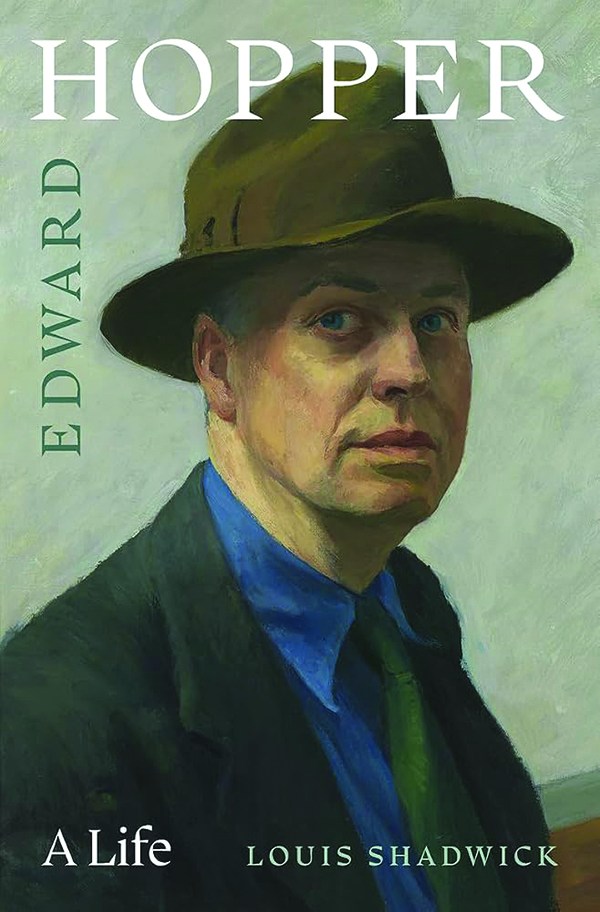
Their relationship, as seen from Jo’s diaries, brings alive Louis Shadwick’s somewhat dry rendition of the artist, Edward Hopper: A Life. Shadwick based his book on Jo’s diaries as well as his own doctoral thesis, “Memory and Myth: Edward Hopper and American Identity, 1882-1940.”
As Shadwick portrays him, Hopper was neither the individualist nor the loner he claimed to be. His work revolved around his own interior life, but it also focused on architecture, geometry, and the position of sunlight.
Shadwick believes that Hopper was a Realist painter but was influenced by other styles, including Impressionism and the Hudson River School. From his earliest days, he was obsessed with the light that had inspired both styles of art.
Shadwick brings in authors, poets, and artists whose work influenced Hopper. Unfortunately, Shadwick frequently writes with a broad brush, often just mentioning a name or a story title. One exception is Robert Frost. Shadwick notes that Frost and Hopper had high regard for each other’s work. Shadwick briefly quotes from a few of Frost’s poems, including “Stopping By Woods on a Snowy Evening,” which, according to Shadwick, nods to Hopper’s sense of impending mortality. But who knows?
Hopper traveled to Europe several times, visiting France, England, and the Netherlands. In the process, he fell under the influence of work by Edgar Degas, Edouard Manet, and Johannes Vermeer, whose use of light streaming through windows inspired him. It may have reminded him of the light coming into his childhood bedroom from the Hudson River. This style stayed with him and influenced his art until his final paintings, such as Sun in an Empty Room (1963), which shows rectangles of light and shadow.
Even though Hopper described himself as an individualist, Shadwick contends he was inspired by cultural, social, and aesthetic movements of his era. He borrowed themes prevalent in art, literature, and society, blending them with his own feelings and aspects of his interior life. Shadwick believes that he was deeply influenced by an atmosphere of “Americanness” prevalent.
Shadwick suggests that Hopper’s most famous painting, Nighthawks (1942), though conceived prior to Pearl Harbor, was informed by the state of the country as it dealt with World War II-era shortages and blackouts. The atmosphere, he argues, enveloped the painting.
Shadwick also reads much into other paintings. He connects Hopper’s High Noon (1949) to the Annunciation. But considering that the robe of the woman in the picture is half-open, this seems far-fetched. A more reasonable interpretation is that High Noon reflects Hopper’s preoccupation with light coming through windows and doorways.
In Shadwick’s account, Hopper used his wife as a stepping stone to his towering success. Today, his work is included in major art galleries, including the Art Institute of Chicago and the Whitney Museum of American Art, which is home to the largest collection of Hopper’s art.
The story of their marriage is the backdrop to his rise to fame. Without her, he would probably have been a struggling artist like his friend, Martin Lewis, an Australian artist, printmaker, and etcher, whose cityscapes inspired Hopper’s own New York City paintings. (I wish Shadwick had said more about the relationship between Hopper and Lewis, and their works’ common points.)
Hopper married Jo in 1924. At the time, they were both in their 40s, and their marriage produced no children. They lived a frugal life in their Washington Square apartment and studio, in which there was no bathroom or central heating for much of their time there. For warmth, they relied on a pot-bellied stove, requiring Hopper to go down to a subcellar for coal and carry it up 74 steps.
The couple shared the studio until a room next to their apartment became vacant and was used for Jo’s studio. It was unheated, and Jo noted posing in a cold room so Hopper could capture aspects of light he felt he needed for a painting. Jo said that her husband didn’t care that she was freezing, “with scarcely a stitch on … to see how light falls on your shivering flesh.”
Jo’s diaries show Hopper to be misogynistic, selfish, and temperamental. He was difficult to live with and disapproved of her driving, once pulling her out of the car. He said her art had no magic. He did almost nothing to help her achieve recognition, although she helped him. He sometimes slapped her, and she scratched him.
REVIEW: ‘HOTEL EXILE’ OFFERS WARTIME A MICROCOSM
Hopper’s final painting, Two Comedians (1966), shows two figures onstage under the floodlights, dressed in white and holding hands. Behind them is darkness. In front of them is a well-lit auditorium. They are intended to be Hopper and Jo, and the couple is suggestive of the lovers Pierrot and Pierrette from the commedia dell’arte.
Considering Hopper’s sense of himself as a loner, and his fraught relationship with his wife, it seems ironic that this final picture would depict Jo next to him and would allude to the French poetry they had both appreciated. Such ironies are part of this thought-provoking biography of a difficult man whose art most Americans find easy to love.
Diane Scharper is a frequent contributor to the Washington Examiner. She teaches the Memoir Seminar for the Johns Hopkins University Osher Institute.