
PITTSBURGH — In March, Jake Loosararian stood in the middle of what was once a bustling Sears department store, now his company’s headquarters, and talked about what a $71 million Navy contract could mean for a robotics company that had chosen to stay in western Pennsylvania, as the Washington Examiner reported at the time.
Seven months later, that contract has quadrupled.
Gecko Robotics, the Pittsburgh company that builds robots to inspect and maintain critical infrastructure, is announcing that the ceiling on its Navy contract has grown to $300 million. Its robots climb, crawl, swim, and fly. The original five-year deal started with 18 ships in the Pacific fleet. Loosararian said the expansion takes in much of the Atlantic fleet as well.
“From April ’til now, the expansion quadrupling the size of this contract vehicle is insane,” Loosararian said. “Speaks to how much success we’re having, but also how important this is for the U.S. Navy.”
The problem Gecko is trying to solve is plain: Loosararian said roughly 60% of the fleet is ready to deploy at any given time, but the chief of naval operations has set a target of 80% fleet readiness. In Loosararian’s view, a ship stuck in dry dock is a ship that isn’t doing its job.
“You have a war with the military you have,” he said. “I want to see a Navy that’s spending all of its time patrolling and as few days as possible in the dry dock somewhere.”
Gecko’s robots crawl over flight decks, ballast tanks, hulls, and rudders and collect data that, Loosararian said, “no one ever had before.” He compared it to being “Superman with X-ray vision.” Artificial intelligence built in the United States then reads that data to find exactly what is broken and what to fix first.
The result is what he calls “a living, breathing model” of each ship’s condition. Over time, it can predict where a part will fail before it does.
Loosararian said the system has cut turnaround time on inspection and repair plans by 83% and saves “tens of millions of dollars per vessel.”
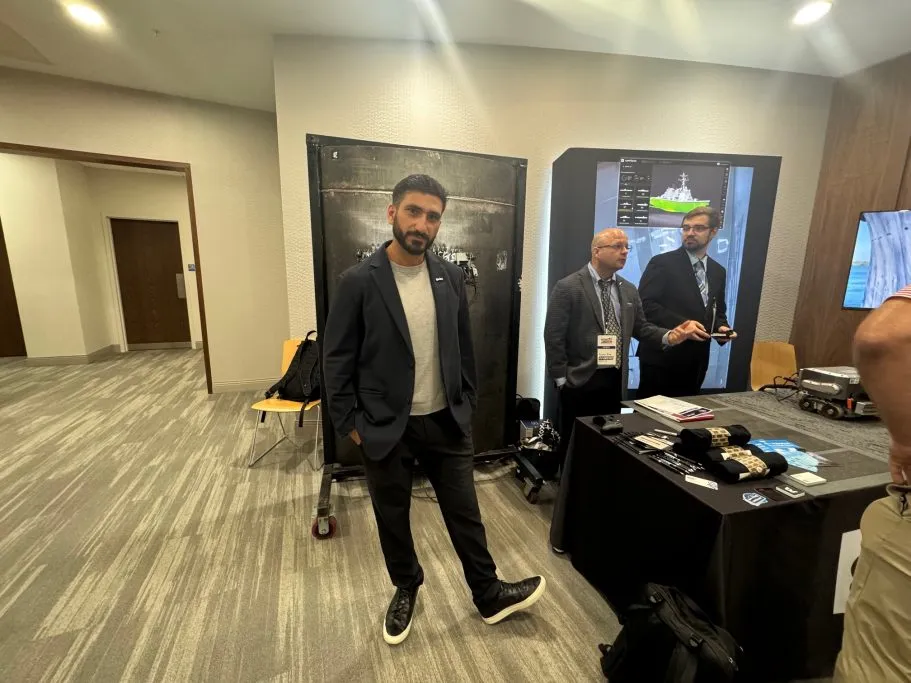
“China does not have this technology,” he said, “but they’re desperate for it.”
The company started working with the Navy only three or four years ago. Loosararian began building his first wall-climbing robot in his dorm room in 2012 as an engineering student at Grove City College. He had just seen a local power plant losing millions of dollars a month to downtime. A year later, he co-founded Gecko with his college roommate, Troy Demmer, according to Gecko’s company history.
Loosararian talks less about admirals than about the people who keep ships running.
“The port engineers, the ship welders, the folks who are doing the actual behind-the-scenes to ensure our Navy’s ready for the fight, everyone of these sailors, all they want to do is spend the least amount of time waiting around for things to get done and the most amount of time doing their job,” he said. “It gives me goosebumps.”
Where Gecko works fits the story it tells.
The headquarters sits in Nova Place on the North Side, the former Allegheny Center Mall. The mall opened in 1965 with Sears as an anchor on land cleared by urban renewal that wiped out the old downtown of Allegheny City. Its stores began closing after Sears left for the suburban Ross Park Mall in 1986. In 2015, a developer unveiled plans to turn it into a tech hub called Nova Place.
Just beyond it runs the route of the old Pennsylvania Canal, which tied Pittsburgh to Philadelphia in the 1830s. It carried the people and goods that helped start the city’s industrial boom, including a young Andrew Carnegie. The canal’s North Side locks stood where the railroad tracks run today. Those tracks were first laid by the Pennsylvania Railroad and are now used by Norfolk Southern to carry freight through a region built on iron, steel, and coal.
The canal, the railroad, and the mall are all still there, and so is a company building the tools for the next industrial age.
Asked what the expansion means for the region economically and emotionally, Loosararian pointed to the gap between the coasts and the country’s interior.
“When you see technology companies having all this success, they’re typically happening in all the same places on the coasts,” he said. “It just seems as though technology has worked for a few cities on the coast, but never seemed to work for folks in Appalachia or folks inland in the U.S., where the industrial supply chain economy was the backbone for the U.S. in World War II.”
Pittsburgh, he said, “was one of the most important places” for the arsenal that won that war.
“I think what you’re seeing is a resurgence of that,” Loosararian said.
He sees Gecko as a new kind of defense contractor.
“When you see companies like Anduril becoming these neo-primes for weapon systems, you’re seeing Gecko become the neo-prime for maintenance and operations,” Loosararian said.
Earlier this month, Gecko announced a partnership with Anduril to bring its robotic inspection technology to Anduril’s submarine-component manufacturing. That work covers a California factory and Anduril’s planned Arsenal-2 shipyard in Baltimore County, Maryland.
That also means taking technology into places that have rarely gotten it, such as a forge in Lehigh, Pennsylvania.
“This technology is built specifically for the worker,” Loosararian said, “for the people who have been doing these jobs for 30, 40 years, but have never had technology built for them.”
The timing is urgent. He said 25% of the shipbuilding supply-chain workforce will retire in the next five years, “at a time when we needed to build more than ever before or maintain more than ever before.”
Asked whether the contract will create jobs, Loosararian talked about the work itself. In shipyards, he said, the average worker may get only one or two hours of real work done in a day. The rest goes to waiting for another trade to finish or for a part to arrive from across the country.
“It’s all about less waiting around, which is the killer for the U.S. ability to outmaneuver China,” he said. “This technology helps people get to work.”
At a time when many people are skeptical of artificial intelligence, Loosararian argues that robots, AI, and workers should not be thought of separately.
“Gecko represents the integration of all these three things but puts humans at the forefront,” he said. “Robotics and AI need to serve humans and give them better judgment, because we can capture information and data that never existed before that actually makes AI useful and puts the power in the hands of the skilled worker to be able to make better decisions and do so safer.”
He said what cities such as Pittsburgh still have is an understanding of how to actually build things. Gecko is trying to turn that into technology.
WHAT PITTSBURGH CAN TEACH THE NEXT HOUSE MAJORITY
“A company that cares deeply and believes deeply that the dignity of the work is one of the most important parts of the IP to be building into the tech stack,” Loosararian said. “That’s going to create better jobs. It’s going to create safer environments.”
He called it “a bright light” at a dim time in the country.