
The news that Tony Romo would not be returning to CBS was a stunning turn in contemporary sports media.
Only a few years ago, Romo vaulted to the top of the broadcasting world with his infectious enthusiasm, winning bonhomie, and uncanny knack for predicting plays before they happened. Partnered with Jim Nantz, he was redefining the role of lead NFL color analyst. It was refreshing, even exhilarating, to have someone in the booth who sounded as excited as you were for big games and big plays, and who could also speak with real NFL quarterbacking experience about those plays.
But over the past few seasons, the initial delight of the Romo TV experience had begun to wane. There were stretches when he’d go on rambling tangents, and other moments when, like a quarterback coasting on his natural talent instead of studying game film, he appeared to reveal a lack of preparation. Finally, in July, when video surfaced of Romo’s arrest in Wisconsin for operating a vehicle while intoxicated, his position as the network’s No. 1 color analyst became untenable. CBS, which may have been looking for an out from the Romo business anyway, seized the opportunity and cut ties with him earlier in October.
How did CBS’s top NFL analyst — someone who, just a few years ago, many of us thought could become this generation’s best analyst — fall so steeply, so quickly?
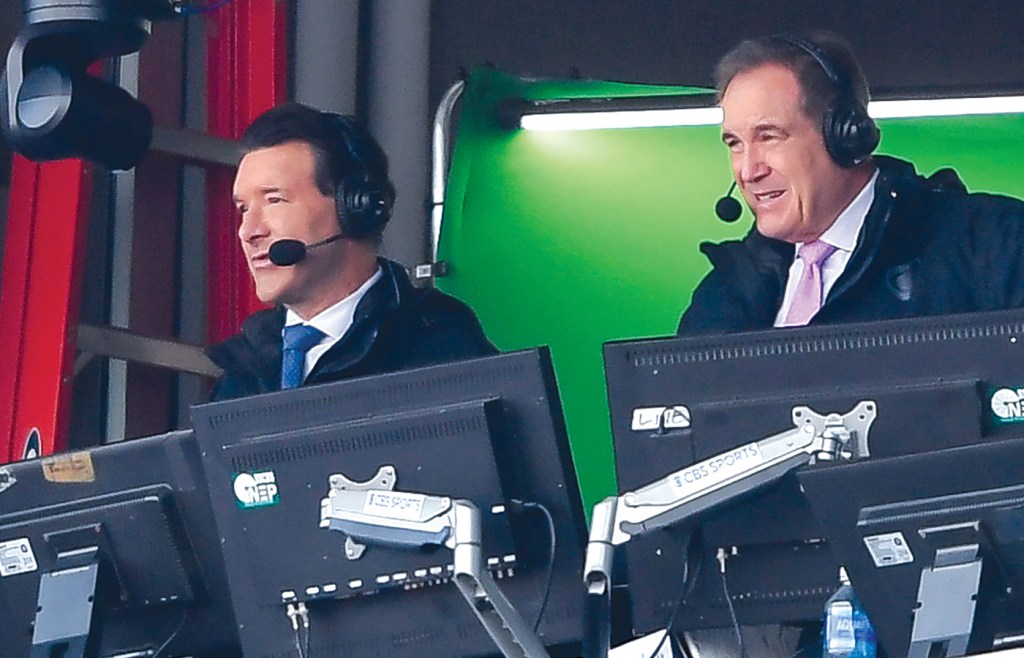
I put the question to Underscore Media’s Jimmy Traina, a longtime sports media reporter. “I think there are a few factors here,” Traina said. “CBS doesn’t like the public embarrassment caused by the Romo situation. Once the video came out of Romo from his arrest, I think he was done right then and there.” Traina also highlighted how corporate pressures were a vital catalyst that motivated the network’s decision: “Another huge factor in this is the Paramount/Warner Bros. merger. I think CBS wanted to go into the merger with a clean slate and not have the Romo thing lingering, especially since CBS airs the Super Bowl next season.” (CBS is part of Skydance Corporation, which now owns both Paramount and Warner Bros.) With the capable J.J. Watt stepping into the lead analyst role alongside Nantz, Romo’s departure solves a major problem for CBS and also allows it to let Watt develop for another full season so that he’ll be even more polished (and develop more chemistry with Nantz) by the time the network has its next turn hosting American television’s biggest annual event.
Still, some fans may not have gotten over Romo’s departure just yet, which speaks not only to how popular Romo had been but to the uniqueness of NFL broadcasting itself. Major upheavals in top NFL broadcasting booths are so significant in part because the voices that we hear calling the games each Sunday are the only NFL voices on TV we hear. As Traina notes, in the NFL, “you only have national announcers. There are no local broadcasts like in other sports. So, you don’t have the chance to bond with a broadcast team like in MLB or NBA. However, the best games each week are broadcast by the best broadcast crews. This gives NFL games a big feel every single week.” And that makes sudden changes to networks’ No. 1 broadcast crews feel like a very big deal.
The other reason that these voices are important is because, like John Williams scoring Star Wars and E.T. or Howard Shore scoring The Lord of the Rings, the top announcers provide the emotional soundtrack to our collective sports experiences. The finest NFL broadcasters, from Pat Summerall and John Madden to Mike Tirico and Cris Collinsworth, can elevate an ordinary athletic competition into an extraordinary event of high drama. Like those great movie composers, they provide authority, rhythm, and a sense of occasion that binds millions of viewers together on a Sunday afternoon.
At their best, they can make your sports-viewing experience feel genuinely sublime. Does anything get better than Joe Buck’s call of the so-called “Minneapolis miracle,” in which the Vikings beat the Saints in the 2017-18 NFC Divisional Playoff game? “Keenum steps into it … Pass is … cauuught! … Diggs! … Sideline! … TOUCHDOWN! … UNBELIEVABLE! … Vikings win it!” I still get goosebumps when I listen to that call. Just as important was color analyst Troy Aikman setting up what we were going to see just moments before the play happened: “To save time … that’s where Keenum’s gonna try to work the ball to the boundary.” That Aikman-and-Buck call, to me, embodies everything we want in NFL broadcasting, and also illustrates why the Aikman-Buck team has been the best in the business for decades now — and why it would be a travesty and a colossal mistake for it to get broken up, if it ever comes to that.
Alas, Romo’s departure is part of a broader wave of transition sweeping across the NFL broadcast landscape. This year may come with significant upheaval, driven by the looming free agencies for several of our highest-profile broadcasters: the aforementioned Aikman (probably the best of all the No. 1 color analysts), Romo (the former No. 1 guy who may never be a No. 1 guy again but who could be the beneficiary of a redemption arc if he latches on with the right network), as well as Greg Olsen, a once and (likely) future No. 1 color analyst. Overall, I agree with Traina that “the current state of broadcasting is very strong in the NFL, especially from a play-by-play standpoint,” with Buck and Tirico still at the top of their games, and with solid color analysts such as Watt and the much-improved Tom Brady.
But I am concerned with what a possible game of musical chairs in the networks’ top broadcasting booths could do to our weekly football viewing experience. We invite these announcers into our living rooms every week, forging parasocial relationships with them that can make broadcasters feel almost like family members. When a top-tier broadcaster leaves your TV for whatever reason, watching a game without them can be like having Thanksgiving dinner without your favorite uncle at the table. Yes, you might still have turkey with all the fixings, but you’re missing something essential.
BILL BELICHICK AT NORTH CAROLINA — WHAT (AND HOW) IS HE DOING?
We want our NFL broadcasts to match the level of professionalism, commitment, and dynamism that we see on the field. Whether the industry moves toward freewheeling Manningcast-style alternative broadcasts or stays anchored to traditional booths, the core mission of the broadcaster remains unchanged: to be for football fans what John Williams and Howard Shore are for movie lovers. (For the record, I’m not a fan of ESPN putting the Manningcast, with brothers Peyton and Eli, against Buck and Aikman on Monday Night Football, although Peyton Manning would be a slam-dunk top-tier No. 1 color analyst if he ever wanted to do it.)
As the dust settles on the Romo era at CBS, and as the networks prepare for more possible changes, the voices filtering America’s favorite sport will continue to shape how we experience the great plays, mind-numbing blowouts, and occasional on-field miracles.
Daniel Ross Goodman (@DanRossGoodman) is a Washington Examiner contributing writer and teaches theology and religious studies at St. John’s University. His next book, Dante’s Guide to Life: How The Divine Comedy Can Change Our Fortunes, Our World, and Ourselves, will be published this fall by Angelico Press.