
WYTHEVILLE, Virginia — Most people meet this town zooming past it at 70 miles an hour.
Interstate 77 comes up out of North Carolina. Interstate 81 runs down the Great Valley toward Bristol. They cross here, share a few miles of pavement, and then split again. Truckers stop for diesel. Families stop for a bathroom. Then they are gone.
They miss the better road.
U.S. 11 runs right through downtown as Main Street. In this part of Virginia it is also called the Lee Highway. Before that it was the Great Road, the wagon road that carried settlers south out of Pennsylvania and Maryland and down the valley toward Cumberland Gap. Virginia now signs the corridor as the Wilderness Road: Virginia’s Heritage Migration Route. About 10 miles east, at Fort Chiswell, long hunters set out in 1761 for the country beyond the mountains.
On March 10, 1775, Daniel Boone and some 30 axmen set out from the Long Island of the Holston, near present-day Kingsport, Tennessee, to cut a path through Cumberland Gap into Kentucky. The crown had banned settlement beyond the mountains. They went anyway. Hundreds of thousands of settlers followed, and many of them came down this valley to get there.
That was 250 years ago. Virginia and Kentucky spent last year marking the anniversary with reenactors, relay hikes, and a ceremonial ax carried from Kingsport to Fort Boonesborough. This year the country marks its own 250th.
The two anniversaries belong together. The road came first. It carried the push west before there was a United States to push. And the people who stopped along the way, who decided the next valley was far enough, built Appalachia.
They are still building it. That part of the story did not end in 1775, or in 1872, or in 1960. It is happening on Main Street right now.
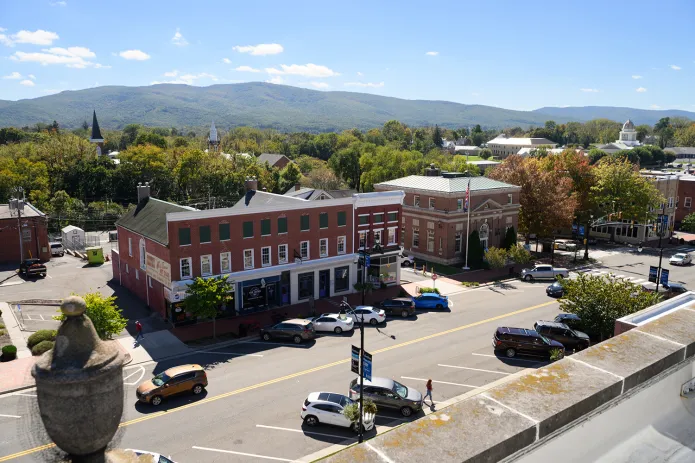
A dozen years ago, nearly half the storefronts on Main Street were empty. Now an empty one is hard to find.
Two breweries opened. So did a Vietnamese bakery. The Millwald Theatre, dark since 2006, reopened in December 2022 with a hometown flat-picker on the bill. Apartments are coming back to the floors above the shops, the way the Bollings once lived over theirs. This spring, a town of about 8,000 people won one of three Great American Main Street Awards, beating out places up to 50 times its size.
Not every promise was kept. Out by the interstate, a glove factory that was supposed to bring nearly 2,500 jobs went partway up and never opened. The county has fewer people than it did five years ago.
This is not a boom. It is people deciding to stay, and building where they are.
That is how it has always worked on this road.
Downtown, music plays from speakers set along the brick sidewalks. A 30-foot yellow pencil has hung over Main Street since the early 1960s. On East Main, Skeeter’s has been selling hot dogs with mustard, onion, and chili since 1925.
Sit at the counter at Skeeter’s, and you are in the same building where a future first lady was born.
Farron Smith owns that building. She and her husband, Bill, bought it in 1989. It came with the hot dog shop. It also came with the second floor, where Edith Bolling was born on Oct. 15, 1872, the seventh of 11 children.
Smith did not need anyone to tell her what she had.
“We always knew it was the birthplace and knew its history, its place in history,” she said.
She had rented the space first. She ran a dance school on the ground floor. When the couple bought the building, they made a deal with themselves. Raise the children. Pay for college. Then turn to the house.
“This would be our way of giving back to a community that we love,” she said.
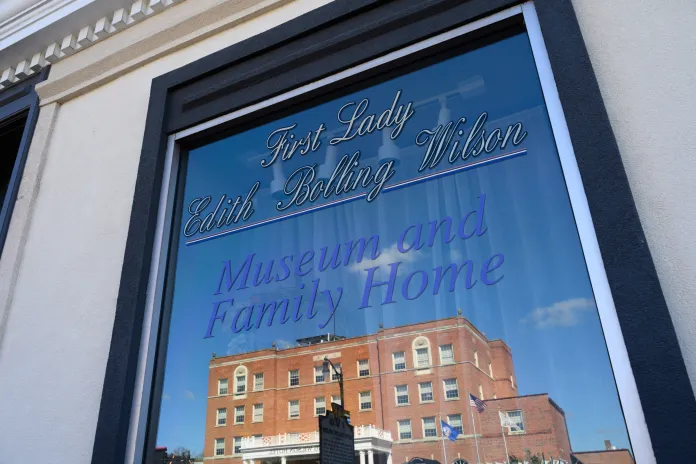
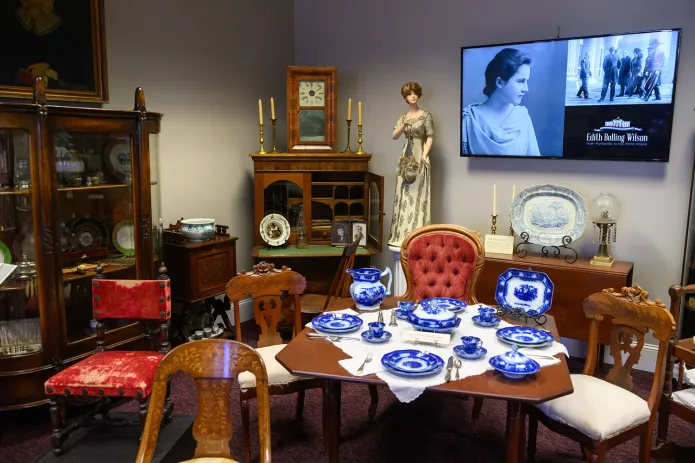
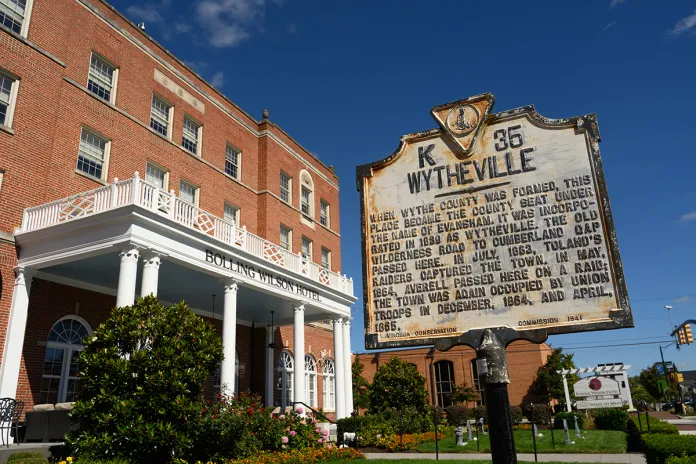
The Smiths formed a foundation in 2006. The Edith Bolling Wilson Birthplace Museum opened on Oct. 15, 2008, Edith’s birthday. In 2010 they bought the old George Wythe Hotel across the street, where Edith had stayed on her last trip home, and reopened it as the Bolling Wilson Hotel.
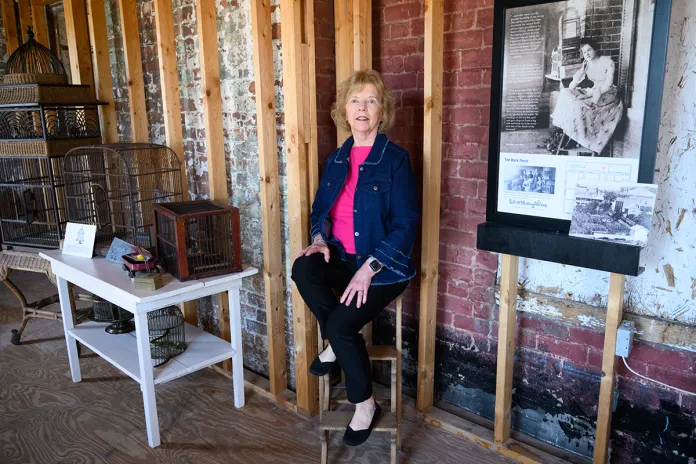
“We really didn’t know what we were getting into,” Smith said.
What they got into is a rare thing. No other first lady’s birthplace in Virginia is a museum, and only eight sites nationwide are devoted to the life of a first lady.
“We feel like it’s worthy of preservation,” she said.
The upstairs was never grand. It was crowded.
As many as 20 family members lived over the shops at a time. Grandmother Bolling kept a couple dozen canaries on the back porch. Edith cleaned the cages.
The family was prominent and broke. Before the Civil War, the Bollings had a plantation in Bedford County and enslaved people to work it. After the war, the plantation was gone. The family took the upstairs of a brick commercial building on Main Street that Edith’s grandfather owned. Her father, William Holcombe Bolling, became a circuit judge. Rent from the businesses downstairs brought the family about $1,200 a year.
Edith did not leave Wytheville until she was 12. She had less than two years of formal schooling in her life. At 15 she was sent to Martha Washington College in Abingdon, a girls’ school whose building is now the Martha Washington Inn. She lasted one semester. Two years later she enrolled at Powell’s School in Richmond. It closed that spring after its founder was hurt in a streetcar accident. Her parents spent what they had left on her brothers’ schooling.
That was the end of school for Edith. Most of what she learned, she learned upstairs.
Smith tells the story of Edith’s character as a story of two grandmothers.
The first was Grandmother Bolling. She ruled the household from a rocking chair. She taught Edith to read and write and to speak a little French. She had no patience for the word “can’t.”
“I hate a can’t,” she used to say. “Anyone can do anything they try to.”
Edith wrote that line down decades later in her memoir. Smith said the grandmother was “very outspoken, opinionated, very much like Edith was as an adult.”
The second was Grandmother Logwood, her mother’s mother. She was the Southern lady.
“Her back would not touch the back of the chair,” Smith said. “Very ladylike.”
“So she was a mixture of those two,” she said.
Add church. The Bollings were pillars of St. John’s Episcopal Church, a short walk from the house. Edith was baptized there, confirmed there, and she married her first husband, Norman Galt, a Washington jeweler, there.
Add family, which mattered to her more than anything.
That is the Appalachian part of the story, as Smith sees it. Not the mountains as backdrop. The mountains as the place where a girl with almost no schooling learned that she could do what she set her mind to, learned how a lady was supposed to sit, and learned that you take care of your own.
Ask anyone in Wytheville about Edith’s ancestry, and you will hear about Pocahontas.
It is true; Edith was a direct descendant.
The line runs through Pocahontas’s son, Thomas Rolfe, and his daughter, Jane Rolfe. Jane married Col. Robert Bolling in the 1670s. She bore him one son and died young. Bolling remarried, to Anne Stith, and had more children.
Generations of Virginians have sorted the family this way. Descendants of Jane Rolfe are the “Red Bollings.” Descendants of the second marriage are the “White Bollings.” Edith was a Red Bolling. When the lines crossed again, Smith said, the children got called “Pink Bollings.”
Then there are the Blue Bollings.
“They tell me there are blue Bollings, and I fell for it,” Smith said. “Who are the Blue bollings? Those are just people out of the blue who want to be a Bolling.”
She laughed. “So I’m a blue Bolling.”
Genealogists use the term a little differently. To them, the Blue Bollings are a set of families who claimed descent through one branch of the Red line without the paper to prove it. DNA testing has since backed some of those claims and knocked down others.
Either way, Smith’s version gets at the truth of the thing. People want in.
The family tree reached into other famous names, too. Edith’s great-great-grandmother, Mary Jefferson Bolling, was Thomas Jefferson’s sister. The family tree also branched toward Martha Washington and Robert E. Lee.
None of it paid the bills. “They were a very prominent family, but they were not wealthy,” Smith said.
However, most Americans who know Edith Wilson’s name know it for one stretch of time. On Oct. 2, 1919, President Woodrow Wilson suffered a massive stroke. It paralyzed his left side. For the 17 months that remained of his term, Edith decided who saw him and what papers reached his bed. She called it her “stewardship.” Critics then and since have called it something else. Some have gone so far as to call her the “secret president,” or the country’s first woman president.
Smith knows how the story is usually told.
“She is criticized often for the role, maybe seen as overstepping her boundaries when the president suffered a stroke,” she said, asking people to remember what was missing.
“There was no legislation in place as to what would happen if a president was incapacitated,” she said.
She is right about that. The Constitution in 1919 had one convoluted sentence about presidential “inability” and no process for using it. The 25th Amendment, which spells out how power passes when a president is disabled, was not ratified until 1967, after the assassination of John F. Kennedy.
Vice President Thomas R. Marshall wanted no part of it. Days after the stroke, Secretary of State Robert Lansing raised the question with the Cabinet. Marshall would not act unless Congress declared the office vacant and Edith and the president’s physician certified in writing that Wilson could not serve. Neither happened.
“Maybe he felt it was too much of a responsibility, and maybe he may have had personal reasons for that,” Smith said. “We don’t know.”
Then, in Smith’s telling, the doctors came to Edith.
“You must protect him from Congress and the public so he can recover,” she said, paraphrasing the advice. “And that she did. She first thought of him as her husband, secondly as the president, and she was trying to save his life.”
That account comes largely from Edith’s own memoir. In it, she wrote that the neurologist Francis Dercum told her a resignation would hurt the country and hurt the patient, and that official business should flow through her.
Not every historian buys it. Some have pointed out that the doctor’s words appeared only after he was dead, and that it is odd medical advice to keep a stroke patient in the most stressful job in the world. Others note that Edith overruled Dr. Cary Grayson when he wanted to tell the public more, and that she pushed back on resignation even when Wilson himself raised it. The Wilsons’ coldness toward Marshall, they argue, did not help.
Rebecca Boggs Roberts, the daughter of the journalist Cokie Roberts, took a fresh look in her 2023 biography, Untold Power. Roberts felt Edith had been treated unfairly, Smith said, and set out to understand why she made the choices she did. Roberts has also said plainly that there were times Edith “could not or would not consult him.” The book traces both instincts, the confidence and the control, back to the two grandmothers upstairs in Wytheville.
That is the fair version. Edith Wilson was a wife trying to keep her husband alive, in a system that had no rules for what she was facing. She was also a woman who liked power and guarded her own reputation fiercely, and who kept the country in the dark about its president. She was a product of her time and place in other ways, too. She opposed women’s suffrage. She grew up hearing the Lost Cause preached at her grandmother’s knee.
Smith does not want those 17 months to be the whole story. She wants them to be one chapter in a long life that started upstairs on Main Street.
There is another chapter Smith likes to tell, and she wrote a book about it.
During World War I, the Wilsons put a flock of sheep on the White House lawn. The sheep kept the grass down and freed groundskeepers for war work. Their wool was auctioned off for the Red Cross. Estimates of the take run from about $50,000 to nearly $100,000, depending on what is counted.
A local preschool once asked the museum for a program. Smith wondered what to do with 4- and 5-year-olds. Her sister, a teacher, helped her build the story of how the sheep helped win the war. They made a PowerPoint. The sister, worried the power might go out, ran off a paper copy.
“Everybody loved it,” Smith said.
So they made a paperback. Then a hardback. How the Sheep Helped Win the War now sells at the museum and at the hotel across the street. Smith said the first 2,000 copies are gone.
“It’s authentic photographs,” she said. “It’s a true story.”
Edith left Wytheville. However, she did not forget it. When she came back she did not make a show of it, said Smith.
“Edith came home for her mother’s funeral and for her sister Bertha’s. Her last visit came in April 1960, when she was 88. She returned to dedicate a stained-glass window at St. John’s in memory of her parents.” The window, “The Blessing of the Children,” is still there, she explained.
She stayed at the George Wythe Hotel and for supper she walked over to Durham’s Restaurant, which then occupied the ground floor of her birthplace, in the room that is now the museum.
Then she asked to climb the stairs one last time.
“That’s the home that shaped her and prepared her for life,” Smith said, “the challenges she would face as first lady.”
Edith Bolling Wilson died 20 months later, on Dec. 28, 1961.
Many of her people are still here; the Bolling family plot is in East End Cemetery, right behind the museum. Both of her grandparents are buried there, Smith said, along with a sister and many others.
That is what Farron Smith has spent nearly 40 years on. Not a defense brief. Not a shrine. A house, saved. A complex woman who fled Appalachia and would find herself in the highest echelons of American power.
Two hundred and fifty years ago, the people coming down this valley were looking for a place to stop. Some of them stopped here. The Bollings came to Main Street after the Civil War with a famous name and not much else. A dance teacher bought their building with a hot dog shop in it, raised her children, and went upstairs to save what she found.
The interstates still carry most people past at 70 miles an hour.
The Wilderness Road still runs down Main Street.
STEVE WITKOFF KEEPS THE LIGHT ON
Along it, a museum dedicated to a first lady is about to open its second floor. On Oct. 17, two days after what would have been Edith’s 154th birthday, the museum will unveil the first phase of its restoration of the Bolling home. Locals, tourists, and history buffs will climb the same stairs Edith climbed in 1960, into rooms stripped back to the era when her family lived there and brought back to life.
The work turned up pieces of that life, buried in the rafters and hidden behind the walls. They are the things an Appalachian family left behind, a family whose daughter would find herself living a very different life in the White House.