
Every spring, Peter Santenello’s parents would have a dump truck come down their long driveway, deep in the Vermont countryside, to unload a fresh pile of sand for their young son’s enjoyment. Santenello would spend hours creating sand roads for his toy trucks, his vast network of roadways weaving through the forest and fields surrounding his home and eventually meandering onto a neighbor’s property far away.
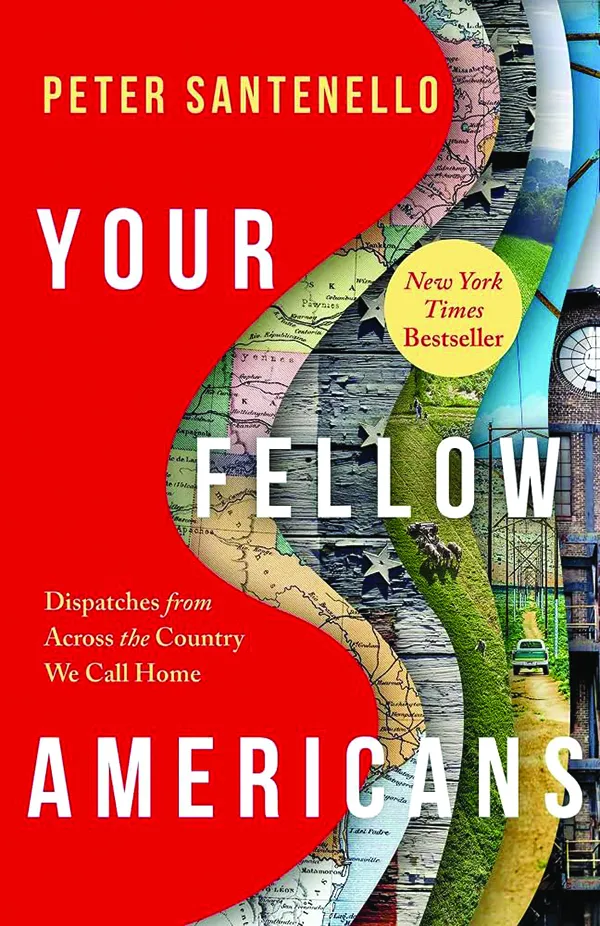
The annual sandpile delivery is more than a core childhood memory for Santenello. “I think sometimes about how that small detail — it being a loose pile and not sand in a contained box — became a metaphor for the direction my life would take,” he writes in his debut book, Your Fellow Americans: Dispatches from Across the Country We Call Home, published to coincide with America’s 250th birthday. Indeed, this world traveler, independent journalist, filmmaker, and popular YouTube documentarian is living a life outside the box.
Santenello has traveled to 85 countries and lived in five. Even spots such as Tajikistan, Iran, and Syria haven’t been off-limits. But for the last six years, Santenello has focused his travels solely on these United States, which, as he shows in Your Fellow Americans, can be just as extraordinary as some of the far-flung lands he’s traversed. Santenello now has more than 4 million subscribers to his YouTube channel, founded in 2009, where he documents these travels and shares videos of his authentic conversations with the locals. His book is a compilation of many of these interactions.
Santenello is on the road about four months out of the year and is intentional in his wandering, preferring to visit the U.S. places that you wouldn’t normally see at the top of an avid sightseer’s bucket list. These communities are often unfamiliar, misunderstood, stereotyped, overlooked, or stand out for their resilience, unique culture, or “pioneering spirit.” “We’d be missing the whole truth of the United States if we only talked about the places with fairy-tale making-it stories,” he explains.
His book features trips to Amish country, including a little-known Amish snowbird enclave in Pinecraft, Florida; the gritty streets of East Los Angeles, where Latinos literally spin their wheels; St. Lawrence Island in Alaska’s Bering Sea, where a hunted whale can feed the entire Siberian Yupik community; the hollers of deep Appalachia, which is “more than just drugs and coal mining”; the Mississippi Delta, most notably the tiny town of Alligator; northern California’s redwood country, which keeps getting back up after Mother Nature’s wallops; Smith Island in the Chesapeake Bay, where some locals’ accents are still reminiscent of Elizabethan English; the surprisingly soulful and history-rich Hamptons; and the swamps of the Louisiana Bayou.
“My aim has always been to get out of my bubble,” he writes. “And I’ve been amazed over the years at how many people have welcomed me into theirs.” Santenello is living proof that genuine curiosity about the lives of other people goes a long way. He learned very early in his travels that when he “showed strangers honest interest, they showed it back in volumes.” And so, with a GoPro in hand and a friendly smile on his face, Santenello earnestly sets out to make everyday Americans feel comfortable enough to tell their stories on camera, so viewers can learn what life is really like for them. Along the way, he earns trust, invites to family dinners, and a few cool souvenirs, too.
Santenello avoids political and social commentary altogether, letting his viewers (and here, his readers) draw their own conclusions — a refreshing approach in an age of keyboard warriors prone to partisanship. I admit I had never seen Santenello’s YouTube videos before reading this book, and not wanting to spoil the experience, I didn’t check out his channel until after I finished it. At the very least, I wanted to view his most-watched video — “Poorest Region in America — What It Really Looks Like” — which takes you on a tour of West Virginia coal country, a region that “had such a huge role in building America and yet in recent decades has seen the worst decline.” I was hooked.
While exploring the channel, I was astonished by how much the videos mirrored what I had imagined as I read the book. I credit this uncanny experience to Santenello’s superb ability to appeal to the reader’s senses. He uses such vivid descriptions and writes with such precision and poetic flair that one doesn’t need to watch his videos, though fantastic, to gain a full understanding of the settings and the people he meets in Your Fellow Americans. You feel like you’re there with him, whether smelling the pine sap and sweetgrass in his childhood backyard in summertime, seeing massive whalebones on the shores of Alaska and the majestic redwoods of California, hearing a cacophony of street music and hissing hydraulics at a Chicano car show in East L.A., or tasting the nutria — an invasive rodent found in Louisiana’s swamps — that a Cajun couple catch and cook up in a stew for supper.
I was particularly curious to see how the Hamptons, a collection of glamorous beach communities known for catering to wealthy New Yorkers, made its way into the book. It’s here that we meet Jimmy, a lifelong resident, senior citizen, and surfboard repairman, better known as the “ding repair guy.” After meeting Santenello, he takes him on a “real local dive.” I thought I detected a typo (surely he means “drive”), but no, they go dumpster-diving in Montauk, where rich people’s trash is regular people’s treasure. Later, they check out the first cattle ranch in America and visit the working waterfront side of town.
TAKE ‘A ROAD TRIP THROUGH U.S. HISTORY’ WITH PULITZER AUTHOR BEVERLY GAGE
Even a remote part of my home state makes an appearance: Smith Island, one of Maryland’s last inhabited islands. I suddenly started to understand what Santenello means when he says “You can learn more about yourself in a week of looking at your community as a spectator than in a decade of living in it as a participant.” Having never visited Smith Island, I learned that I knew nothing about it (other than that it boasts a famous chocolate cake) until now.
In the book’s acknowledgments, Santenello, who now makes Florida his home base, expresses gratitude to his YouTube audience: “Your curiosity about this country made this all possible.” After all, his fans often suggest the places he should go next and connect him with the people he should meet when he arrives. Let’s see what they come up with next.
Erin Montgomery is a writer living in Maryland.