
Ever since the age of the pharaohs, great leaders have always understood the importance of architecture in the civic life of their nations. Augustus found Rome a city of brick and left it a city of marble. Louis XIV turned a modest hunting lodge into Versailles, a stage on which the Sun King could display the order of his realm. Napoleon commissioned the Arc de Triomphe to proclaim the glory of France in the language of imperial Rome. Thomas Jefferson, writing to Pierre Charles L’Enfant as the federal city was being planned, urged that the Capitol be based on “the models of antiquity, which have had the approbation of thousands of years.” Even Herod, a ruler the sages of the Talmud regarded with deep suspicion, expanded the Temple in Jerusalem so magnificently that they proclaimed that “One who has not seen Herod’s building has never seen a beautiful building in his life.”
President Donald Trump has taken up that ancient vocation with characteristic energy. In the second year of his second term, cranes are swinging over the former East Wing of the White House, concrete is pouring 20 hours a day, and plans are advancing for a 250-foot triumphal arch, a Garden of American Heroes along the Potomac, and a colossal statue of George Washington. The program is patriotic, unapologetically classical, and tied to the nation’s 250th anniversary. If executed with the quality its advocates promise, it could return inspiring, civic-minded art and architecture to the heart of the republic at a moment when many Americans have grown weary of public buildings that look like parking garages, abstract sculptures that explain themselves only to specialists, and presidential libraries such as the recent one erected in Chicago that really put the “brutal” in the term “brutalist architecture.”
A ballroom worthy of the People’s House
For more than a century, presidents have hosted state dinners and large gatherings in tents on the South Lawn or in the East Room, which seats roughly 200 people. Trump, a builder by trade long before he was a politician, decided that the arrangement no longer suited a country that regularly entertains heads of state. In July 2025, the White House announced a new State Ballroom of approximately 90,000 square feet, designed in the neoclassical idiom of the existing mansion.
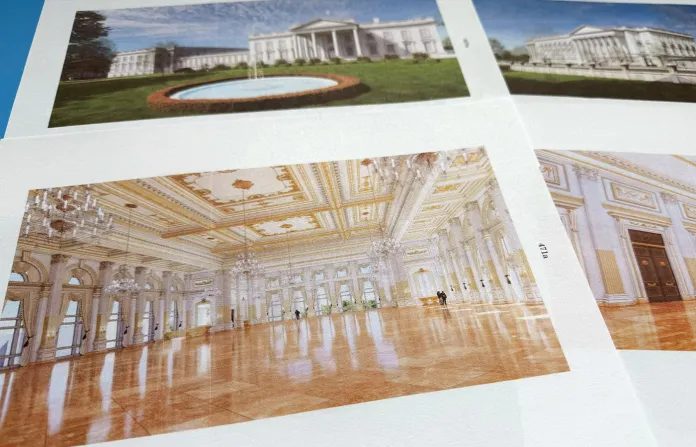
The East Wing, added in 1902 and given a second story in 1942, came down in October 2025. Construction has proceeded at a pace unusual for Washington: hundreds of workers, seven days a week, with the administration reporting substantial progress on foundations, steel, and a below-grade complex that officials say will modernize aging secure infrastructure. Trump has repeatedly called the project “the GREATEST of its kind anywhere in the World” and “a Gift to the U.S.A. from me and other American Patriots.” He has also said presidents have wanted such a space “for 150 years.” After a trip to Beijing this spring, he posted, “China has a Ballroom, and so should the U.S.A.!”
Renderings released on Truth Social in mid-September show a cavernous hall of golden-brown marble floors, gilded columns and moldings, crystal chandeliers, and tall draped windows. Earlier descriptions circulating with court filings and administration materials speak of Corinthian columns, coffered ceilings, and a portico of unusual depth. Capacity figures have grown in public statements from 650 seated guests toward as many as 999. The original design team included James McCrery, a Washington classicist known for churches and a former member of the Commission of Fine Arts. Shalom Baranes Associates later assumed the lead, with McCrery remaining as a consultant. Cost estimates have risen from the initial $200 million as the scope expanded. President Trump and private donors have pledged the bulk of the construction funds, while security-related elements have drawn separate federal attention. (The administration continues to describe the ballroom itself as privately funded.) The target opening remains September 2028.
Critics have objected to the demolition, the scale relative to the historic mansion, and the legal path the project has taken. Preservation groups sued. A district court briefly halted above-ground work; the Supreme Court allowed construction to continue. The administration has framed the ballroom as both a practical necessity for future presidents and a declaration that the White House should look and feel like the seat of a confident nation rather than a compound that must erect tents whenever the guest list exceeds a few hundred.
An arch for the semiquincentennial
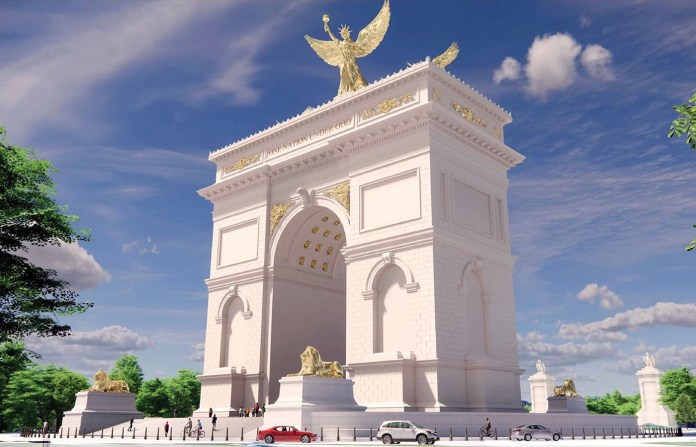
Across the Potomac, at Memorial Circle adjoining Arlington Memorial Bridge, another project is taking shape. The planned 250-foot granite arch, designed by Atlanta-based Harrison Design, would stand nearly 100 feet taller than Paris’s Arc de Triomphe and more than twice as tall as the Lincoln Memorial. It is intended to mark the nation’s 250th birthday, with gold-lettered inscriptions such as “One Nation Under God” and “Liberty and Justice for All,” flanking eagles, and a gilded figure evoking Liberty at its summit. An observation deck would offer 360-degree views of the capital.
The Commission of Fine Arts approved the design in May 2026; the National Capital Planning Commission followed in July. Trump has observed that among the world’s major capitals, “Washington, D.C., IS THE ONLY ONE IN THE WORLD THAT DOES NOT HAVE A TRIUMPHAL ARCH,” and promised, “by far, the greatest of them all.” This month, he announced that, at what he described as the military’s strong request and for national-security purposes, the structure would also serve as a facility able to house drones and snipers and store ammunition. Construction is slated to begin after remaining reviews — including the National Park Service’s still-pending Section 106 consultation and a later National Capital Planning Commission final vote — with the administration aiming to finish the work during the current presidency.
If this arch can be completed successfully, it will stand as a long-overdue civic monument in the classical tradition that L’Enfant, Washington, and Jefferson themselves favored when they laid out a capital of radiating avenues, reciprocal views, and buildings meant to instruct as well as house government.
Heroes in Stone and a Colossus of Washington
West Potomac Park, a stretch of athletic fields and memorials along the Potomac near the Jefferson Memorial, is the chosen site for the National Garden of American Heroes. President Trump first proposed the garden in a July 2020 executive order issued after a summer of statue topplings, describing it as an answer to what he called an attempt to erase the nation’s heroes. A January 2021 order listed 244 names; a 2025 revival brought the total to 250 and directed that work proceed as expeditiously as possible. Congress later appropriated $40 million for it. Trump has called the current site “a totally BARREN field of Prime Waterfront Real Estate” that will become “one of the World’s most beautiful public spaces.”
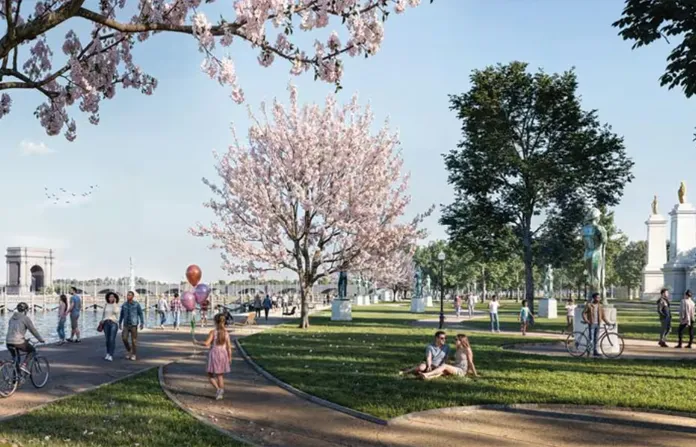
$40 million for the garden that will honor 250 Americans. (National Garden of American Heroes)
The roster of figures that will be honored in this garden is eclectic — a kind of National Hall of Fame. It includes the founders and presidents: Washington, Jefferson, Adams, Lincoln, Reagan; alongside Harriet Tubman, Frederick Douglass, Martin Luther King Jr., Clara Barton, Amelia Earhart, Jackie Robinson, Muhammad Ali, Neil Armstrong, Louis Armstrong, Billy Graham, Antonin Scalia; and figures from science, letters, and the battlefield, such as George S. Patton Jr. and Roy Benavidez. Later renderings have added reflecting pools, dining facilities, an amphitheater, and themed walks connecting politicians, soldiers, scientists, artists, and athletes. Officials hope a first group of statues can appear in time for the remaining 250th-anniversary events — the rest would follow through the end of the term.
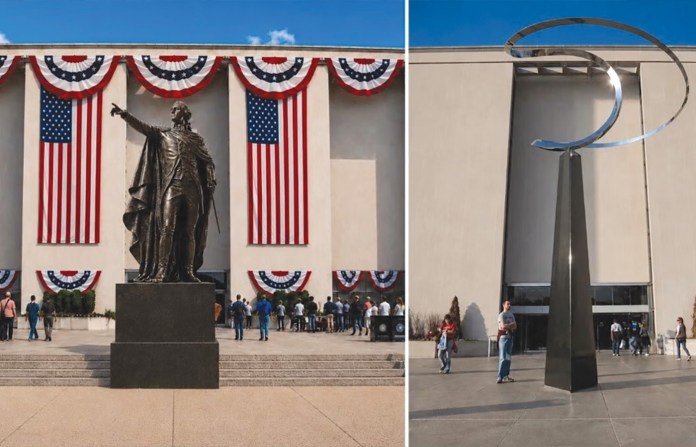
On Sept. 12, Trump separately called on the Smithsonian Institution to replace Infinity, Jose de Rivera’s abstract 1967 sculpture outside the National Museum of American History, with a 30-foot “Washington Colossus.” He also asked that an 11-foot bronze of Washington displayed at August’s Freedom 250 Grand Prix be installed in the museum’s Flag Hall for Constitution Day, and that a five-year exhibition on the first president begin at once, looking toward Washington’s 300th birthday in 2032.
“That strange modernist sculpture tells visitors nothing about America, inspires no one, and honors none of our Great American Heroes,” he wrote. “George Washington does. He is easily America’s Greatest Hero. Without him, our Country and our Freedoms wouldn’t exist.”
It’s hard to argue with any of that.
These projects sit inside a larger policy. On Aug. 28, 2025, Trump signed Executive Order 14344, “Making Federal Architecture Beautiful Again,” directing that classical and traditional styles be preferred for federal public buildings, especially in the District of Columbia. The order states that such buildings should “uplift and beautify public spaces, ennoble our Nation, and command respect from the general public.” It treats classical architecture as the default in Washington absent exceptional circumstances, and it requires justification when a design embraces brutalist, deconstructivist, or other modernist (and, let’s be honest, frankly ugly) styles. The directive revives a similar order from the close of his first term that President Joe Biden had rescinded.
Justin Shubow, president of the National Civic Art Society and a principal advocate for the policy, has argued for years that public buildings should be visually identifiable as civic buildings and that the postwar federal landscape too often intimidated rather than inspired. He frequently cites Winston Churchill: “We shape our buildings, and afterwards our buildings shape us.” The founders, in this telling, chose the language of Athens and Rome because they wanted citizens to remember both their rights and their duties. A courthouse or a White House addition that looks like a warehouse does not perform that work.
Beauty as civic duty
The administration’s architectural turn is a conscious break with the brutalist and late-modernist federal buildings that proliferated after the 1960s Guiding Principles for Federal Architecture. Those structures convey bureaucracy and abstraction. Classical architecture was the language chosen for the Capitol, the White House, and the early federal city because it linked the American experiment to the republics of antiquity and to the Renaissance and Enlightenment architects who recovered those forms.
President Trump’s own tastes — gold, marble, deep colonnades, grandeur — align with that tradition even when it exceeds it in ornament. He has said he is “a great builder,” that “the thing I do best in life is build,” and that “there will never be anything like this.” He has compared the ballroom’s portico to the Supreme Court and found the court’s three ranks of columns insufficient. The projects are tied to the America 250 celebrations I’ve covered in this space, such as the UFC card on the South Lawn and the IndyCar race down Pennsylvania Avenue. Sports and stone, in this vision, are both ways of staging national confidence on the most symbolically loaded ground in the country.
These structures will allow us to celebrate America 250 further and take pride in what we’re capable of, that we can still build works of grandeur and beauty. It’s about time that we’ve had a president who’s been willing to treat the capital’s appearance as a matter of national pride rather than an afterthought left to design committees that, for half a century, preferred concrete bunkers to neoclassical columns.
SIGNIFICANT WHITE HOUSE RENOVATIONS WERE PLANNED LONG BEFORE TRUMP
Herod’s Temple was so magnificent that it even surpassed Solomon’s in the sages’ assessment. Augustus’s marble Rome outlasted his dynasty and became the visual standard for every later capital that wished to look like a republic with an empire’s poise. Versailles still draws millions who come to see what one king made of stone, water, and axial perspective. Jefferson’s Virginia State Capitol, modeled on the Maison Carree at Nimes, announced that a new people would house its legislature in a temple. The test of Trump’s program will be whether the ballroom, the arch, the garden, and the Washington statue possess the proportion, craftsmanship, and dignity that make buildings endure in the public mind rather than merely dominate a news cycle.
If they do, future visitors walking past a completed White House ballroom or standing beneath a finished arch may one day speak of them the way the Talmud spoke of Herod’s work: that anyone who has not seen them has not seen a beautiful building. That would be a legacy measured not in election cycles but in centuries, the proper measure for a republic that still believes its story should continue for at least another 250 years.
Daniel Ross Goodman (@DanRossGoodman) is a Washington Examiner contributing writer and teaches theology and religious studies at St. John’s University. His next book, Dante’s Guide to Life: How The Divine Comedy Can Change Our Fortunes, Our World, and Ourselves, will be published this fall by Angelico Press.