
In a lengthy piece published this past spring, we highlighted anecdotal and data-based evidence of a growing political violence problem, which currently exists disproportionately on the Left.
One piece of evidence was a YouGov survey published in September 2025, shortly after Charlie Kirk’s assassination, which found that “fully one-quarter (25 percent) of self-identified ‘very liberal’ Americans believed citizens can be justified in ‘resort[ing] to violence in order to achieve political goals.’ Seventeen percent of ‘liberals’ said the same.” This stance was shared by just 3% of self-identified “very conservative” respondents and 6% of “conservative” respondents. This was, unfortunately, not an isolated data point.
A study out of Rutgers University, chronicled by City Journal, revealed that so-called “assassination culture” has been “incubated on social media” and has “migrated from the margins of public life into the mainstream.” It found that “nearly one-third of Americans surveyed — and around half of those identifying as left-of-center — believe that the murder of certain public figures is at least somewhat justified.”
The figures included “38 percent of respondents, and 55 percent of those left of center, [who] said assassinating President Trump would be at least somewhat justified.” That is a shockingly wide embrace of, or flirtation with, the politics of murder. On the prospect of “merely” burning down a Tesla dealership as an act of protest against Elon Musk, support among lefties surged to nearly 6 in 10.
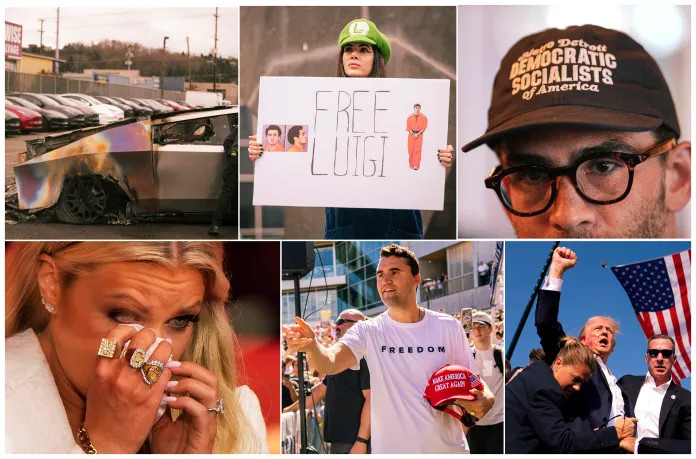
This apparent bloodlust, or at least the degree of comfort with criminal violence directed at disfavored political targets, does not exist exclusively in hypothetical realms. As we also showcased in a previous column, after a radicalized leftist allegedly shot and killed Kirk during his political speech, a shocking number of people publicly celebrated.
Weeks ago, prominent left-wing influencer Hasan Piker mocked Kirk’s grisly murder, delighting the large crowd of socialists he was addressing. In a karaoke-style performance, Piker hammed it up for the audience as he sarcastically performed a tribute song written for Kirk after he was shot to death for his beliefs. They jeered a line extolling the victim’s faith in Jesus. Piker then dramatically delivered the lyric “unafraid to die,” drawing loud, gleeful cheers from the assembled leftists. A revolting but illustrative spectacle.
We now have a new set of data that further underscores the breadth of extreme derangement that exists in center-left circles today. An outfit called the Center for Strategic Politics asked self-described Democratic voters how they would feel about five scenarios in which President Donald Trump left office before his second term expired in January 2029.
The most popular options were impeachment and conviction (87% reporting “very positive” or “somewhat positive” feelings) and removal under the 25th Amendment by the president’s Cabinet on fitness grounds (84%). Asked about the notion of Trump passing away in his sleep, a 55% majority of these Democratic respondents said they would receive the news positively, with an additional 28% feeling neither “positive nor negative” about it. That’s a supermajority who said they would feel good or neutral about the death of a sitting American president.
Then come the two most disturbing results. The prospect of a military coup ousting Trump, the duly elected chief executive of the federal government, was quite popular among these voters. Fifty-nine percent of respondents said they would react very or somewhat positively to “a group of US military leaders” removing Trump from office and “assum[ing] control of the country” in order to “safeguard the constitution.”
This is broad support for a literal coup, for democracy, from the self-appointed Party of Democracy, which has started to make a habit of nullifying election results (Joe Biden, Graham Platner) that are deemed to conflict with its designs on power.
As for the Trump assassination scenario, approximately one-third of Democratic-leaning respondents said they would have a positive reaction to the president of the United States being murdered. This 32% cohort matched the “very negative” group, which also accounted for 32%. An additional one-quarter told the pollster that this outcome would engender a “neither positive nor negative” sentiment. That’s a substantial majority who would feel good, conflicted, or neutral about this president being intentionally killed.
REPUBLICANS ARE STARING DOWN A MIDTERM ELECTION RECKONING
If this poll were a clear outlier, notably divorced from any other data or discernible cultural phenomena, this column would not exist. It’s the developing and haunting consistency with which very large numbers of Americans, clustered heavily on the left side of the ideological spectrum, are willing to share their tolerance or endorsement of political violence with pollsters that makes this an urgent issue.
How does a republic like ours endure under such conditions? What happens if these destructive feelings and actions start to be reciprocated? How can we collectively pull back from this dangerous Rubicon? Those are not easy questions to answer, but step one has to be the uncomfortable recognition that the problem very much exists and may be approaching crisis levels.