
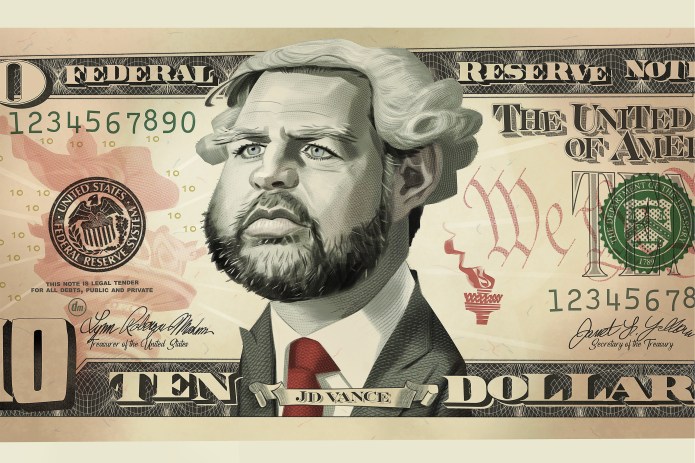
Vice President JD Vance has said American right-of-center economic policy is now “much more Alexander Hamilton than it is Milton Friedman,” and he has called that shift “obviously a good thing.” Friedman’s tradition treated markets as the default and government intervention as the exception requiring justification. Hamilton’s tradition treated a strong central government as the engine of economic development, from national banks to tariffs to direct subsidies. Vance is naming his preference and endorsing it.
The break is not without precedent throughout Republican history. Skepticism of unregulated markets ran through the party well before President Donald Trump, from the trust-busting Republicanism of President Theodore Roosevelt through pockets of Rockefeller-era Northeastern centrists who dismissed Sen. Barry Goldwater’s free-market ideology. What makes Vance’s version different is not that a Republican is skeptical of markets. It is how he oddly grounds that skepticism in religious terms rather than economic ones and how far he is willing to take it inside a sitting administration.
During the 1992 Republican National Convention, Pat Buchanan warned of a “religious war” and “culture war” for “the soul of America” and described the party establishment’s anxiety in his own words: “They hear the shouts of the peasants from over the hill. All the knights and barons will be riding into the castle, pulling up the drawbridge in a minute. All the peasants are coming with pitchforks.” Buchanan’s challenge to President George H.W. Bush, and GOP nominee Bob Dole in 1996, ran on economic nationalism and trade protectionism, warning that free trade was hollowing out domestic manufacturing and that the GOP had abandoned its own working-class base. He never came close to winning the nomination and spent the following decades as a fringe figure in his own party.
It took a populist billionaire to make Buchanan’s argument the strongest single element of the GOP’s voting base. Trump steamrolled the primary competition in 2016, beat Democratic nominee Hillary Clinton, and in his 2017 inaugural address, Trump described “mothers and children trapped in poverty,” “rusted-out factories scattered like tombstones across the landscape of our nation,” and a country of “American carnage,” blaming a political and economic establishment that had enriched itself while working-class people were left behind. Millions of voters who didn’t buy Buchanan’s argument believed Trump. Vance managed to adopt it, and whether he believes it or is simply chasing the voters who do is a question he will have to answer for himself.
The reason is that Vance’s new view also reverses what he said previously. When weighing a Senate candidacy in 2017, he wrote that manufacturing job losses “haven’t disappeared so much from globalization or from shipping them overseas. They’ve largely disappeared because of automation and because of new technological change.” On Twitter that year, he wrote, “Can’t be repeated enough: if you’re worried about America’s economic interest, focus more on automation/education than trade protectionism.” He now defends the same tariffs he once argued would not work, and he does so with the fervor of a convert.
He continues in that vein in his book Communion. In a chapter titled “A Dismal Science,” Vance writes that “as the decline of Christianity has left us without a shared moral language, economics has stepped into the vacuum. We pretend there are scientific answers to questions of values.” Government intervention in private life follows from that premise, argued in religious terms rather than economic ones.
He is candid about the trade-off this requires. Discussing the industrial decline of the 1990s and 2000s, Vance concedes that GDP growth was “robust” throughout that period. He calls the decline “apparently a trade-off worth accepting” for “the previous generation’s policymakers” and rejects the trade anyway.
Elsewhere, he has argued that Prime Minister Margaret Thatcher’s policies took Britain “further away” from what actually matters and that meritocracy itself “can steal from us” a sense of what matters, with prosperity treated as a potential “idol.” Vance closes the Communion chapter by arguing that “an economy geared toward creation and dignity may very well produce more real prosperity than one geared toward finance and accumulation” and calls it “undoubtedly … a more Christian economy.”
On tariffs specifically, Vance relies on more than 100 years of history rather than economic theory. Pressed by Fox News’s Shannon Bream on whether tariffs would raise prices for consumers, Vance answered, saying, “William McKinley and Teddy Roosevelt built the American industrial powerhouse we know today using tariffs to ensure that American workers got a fair deal and foreign competitors weren’t able to undercut the wages of our workers.” At a rally in Maine this year, defending tariffs against Canada, Vance said, “Stop taking advantage of the people of Maine. Stop taking advantage of America. It’s over. We expect fairness in our trade policy.” Fairness, not efficiency or price, is the standard he is applying.
The problem for Vance is that economists across the ideological spectrum have made the case against him with much more clarity. Friedman said government intervention must clear a cost-benefit test, not simply serve a desired outcome, and that “the government solution to a problem is usually as bad as the problem.” The record on tariffs since Vance took office is proof of that.
The Cato Institute has tracked how the on-again, off-again nature of Trump’s tariff regime pushed firms to “postpone or scuttle major decisions on hiring, investment, purchases” because they could not plan around a tax liability that changed by the month.
The American Enterprise Institute reached the same conclusion, noting that the share of manufacturers planning to increase investment fell from 51% to 23% in a matter of months, and that tariffs on capital goods, unlike a simple consumption tax, directly penalize the equipment and machinery businesses need to expand. The International Chamber of Commerce estimated that policy uncertainty reduced business investment across 10 major economies by $202 billion in 2025, with the United States absorbing the largest share.
Vance has applied the same logic to antitrust. At a Bloomberg conference in February 2024, he said, “A lot of my Republican colleagues look at [then-Federal Trade Commission Chairwoman] Lina Khan … and they say, ‘Well, Lina Khan is sort of engaged in some sort of fundamental evil thing.’ And I guess I look at Lina Khan as one of the few people in the Biden administration that I think is doing a pretty good job.” He said he wants antitrust policy that builds “a competitive marketplace” rather than one “obsessed on pricing power” for consumers. Vance, along with Sen. Josh Hawley (R-MO) and then-Rep. Matt Gaetz, earned the nickname “Khanservative” for it. It was an odd flex considering Trump’s transition policy document promised to “reverse Lina Khan’s anti-business agenda” and end “Lina Khan’s war on mergers.” Khan herself is now the chairwoman of the Economic Development Corporation in New York Mayor Zohran Mamdani’s administration, having co-chaired his transition team.
On trade, the song remains the same. During a recent interview with Fox’s Laura Ingraham, Vance framed the Michigan Senate race as a choice between “redistribution” and building “the foundation of the economy,” crediting the Trump administration’s trade policy for “sustaining” that foundation over the past 18 months. Tariffs were “heresy” in the GOP as recently as 2016. They are now “the baseline position.”
The clearest test case is the policy Vance is pushing inside the White House. The administration is drafting a rule that would allow married couples to collect roughly $9,000 a year in federal childcare subsidies without any outside childcare expenses incurred, so long as one parent stays home. The money currently goes to providers, but under the new rule, it would go directly to a parent who isn’t working. It draws on the Child Care and Development Fund, a program established during the Clinton years to help working parents afford childcare so they could stay employed. It amounts to a direct payment from the federal government that is funded by taxpayer dollars, something Republicans have opposed for decades.
Free-market conservatives have rightly called it “Republican socialism.” Rachel Bovard of the Conservative Partnership Institute dismissed the objection on X, noting a similar cash-benefit idea was introduced by then-Sen. Marco Rubio in 2024 and suggesting that the establishment critics were only now noticing a problem they had ignored for decades.
The exchange shines a light on the “New Right” and what it actually believes: Government intervention is good so long as it helps the right people. That’s the same instinct behind Hawley teaming up with Sen. Bernie Sanders (I-VT) to cap credit card interest rates, a bill built on the idea that Republicans can win working- and middle-class voters by borrowing the Left’s tools rather than rejecting them. Decades of history show that this kind of intervention sounds appealing but doesn’t work. Price controls produce shortages. Interest rate caps push risky borrowers out of legal credit markets and into worse alternatives. The cost of tariffs, like corporate taxes, is passed on to consumers. Someone else always ends up picking up the tab.
Vance wrote in Communion that GDP and market efficiency are subordinate to outcomes he considers morally correct and that government needs to step in at times. The direct payment for a mother staying at home is drawn from that, and it takes a conversation about what is moral into government rulemaking.
Concern about family formation and fertility decline is a legitimate question across the political spectrum. But Vance wants to argue that free-market capitalism cannot operate outside some moral boundary.
VANCE’S MOST IMPORTANT JOB IN THE MIDTERM ELECTIONS
It is the abandonment of the economic tradition the Republican Party spent four decades building, in favor of a philosophy that treats GDP, market efficiency, and consumer welfare as secondary to outcomes the government will now use its power to achieve.
Vance has said directly, in interviews and in his own book, that Friedman had it wrong and the older, more interventionist tradition in American conservatism had it right.
Jay Caruso (@JayCaruso) is a writer living in Florida.