
Here’s an interesting piece of trivia: One of the world’s oldest comic strip characters is an 8-year-old girl who hasn’t aged a day in nearly a century.
I refer to the self-assured, audacious, and somewhat mischievous Nancy. Created by the brilliant cartoonist Ernie Bushmiller (1905-1982), she first appeared in the newspaper funnies on Jan. 2, 1933. The young rapscallion went from being a bit player in the comic strip Fritzi Ritz — Bushmiller once said in an interview he “planned to keep her for about a week and then dump her” — to taking it over five years later and becoming the star of her own black-and-white fantasy world. Nancy, along with her best friend Sluggo and pals such as Irma, Spike, Rollo, and Pee Wee, always seemed to find their way into hilarious bouts of trouble — and, in some cases, trouble found its way to them.
The comics publisher Fantagraphics recently launched a book series that will republish a multitude of classic Nancy strips. The superb first collection, Nancy Wears Hats, which focused on dailies that ran between 1949 and 1950, was published last year to much fanfare. The newest volume is Nancy For All Seasons, a collection of dailies from 1951 to 1952. It’s even more uproarious, intriguing, and avant-garde.
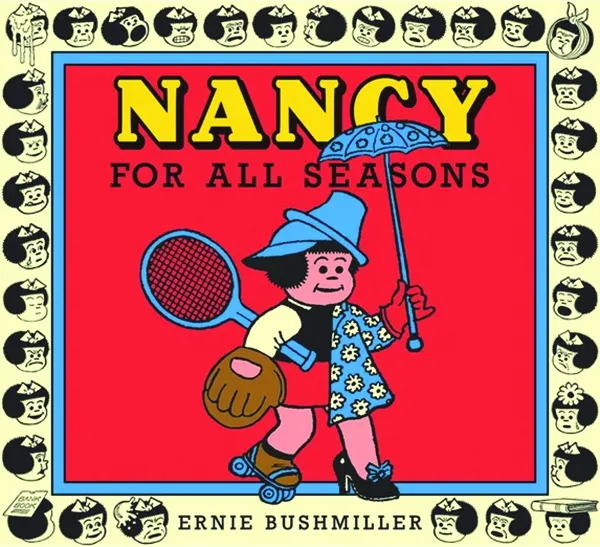
Nancy For All Seasons, like the earlier collection, is a paperback edition with lavishly designed front and back covers, crisp pages, beautifully reproduced strips (over 300 in total), and a short, one-page summary titled “Ernie and Nancy.” There are no essays, notations, or historical research to be found. Sluggo (ahem) does recommend three books for those who want to enhance their knowledge: Paul Karasik and Mark Newgarden’s How To Read Nancy: The Elements of Comics in Three Easy Panels, editors Peter Maresca and Brian Walker’s The Nancy Show: Celebrating the Art of Ernie Bushmiller, and the first volume in this series.
While it would have been nice to have some additional analysis, a collection largely focused on Bushmiller’s exceptional artwork, gags, and storytelling is still perhaps the best way to acquire a deeper understanding of this important, long-running strip.
Nancy For All Seasons covers a period when the main character had been firmly in control of the daily for well over a decade. Her ex-flapper aunt Fritzi Ritz, who was created by Larry Whittington and first appeared in the New York World on Oct. 9, 1922 — Bushmiller took the reins three years later — had been relegated from top billing to a secondary role. The strip’s gag-a-day style remained in full force, but Fritzi’s romantic endeavors and love of the good life had been replaced by Nancy’s precocious nature and childhood antics. The aunt was now her niece’s responsible and level-headed guardian, although this didn’t prevent Nancy and her friends from getting into some of the zaniest situations imaginable.
The strip engaged in everything from the surreal to the sublime. Bushmiller’s masterful cartoons had shades of Salvador Dali, René Magritte, and various minimalist painters. It was rare not to see in his panels aspects of abstract art, over-exaggerated people, places, and things, bizarre perspectives, and, every so often, the breaking of the fourth wall. The language could be simplistic at times and philosophical at others. The daily gags ranged from the wickedly funny to the corniest of the corny.
“Ernie Bushmiller had the hand of an architect, the mind of a silent film comedian, and the soul of an accountant,” Karasik and Newgarden wrote in their book. “His formulaic approach to visual humor beautifully revealed the essence of what a Perfect Gag is all about: economy, symmetry, payoff, equilibrium. His gags often have the abstract feel of math, and Nancy was, in some respects, a mini-algebra equation masquerading as a comic strip for close to fifty years.”
Here are some representative examples from Nancy For All Seasons to understand what made it so distinctive.
A Nancy cartoon from June 8, 195, shows Sluggo looking at a broken table leg. He’s then seen reading a thick book titled How to Fix Things. The solution? Sluggo puts the book under the broken leg to steady it. On Aug. 6, 1951, Nancy gets lost on a hike in the woods. She finds a road and says, “I’ve been walking for an hour — I hope this leads home.” It won’t, because the road is a circle that encompasses all the trees.
Meanwhile, a March 7, 1952, cartoon shows Nancy hearing Fritzi telling someone on the telephone, “Yes — I made a big batch of jam today.” Nancy races happily to the cupboard, only to find the jars arranged to spell out the following caution: “DON’T YOU DARE.” And there’s an April 12, 1952, cartoon in which Nancy tells Fritzi about making fun of a man’s mustache. Fritzi tells her that wasn’t nice and instructs her to go back to “face the music.” Her response? “Okay — but it won’t be easy.” She’s right: The man is a tuba player, and Nancy faces an array of musical notes “hitting” her in the face.
THE BRILLIANT CREATIVITY OF AMERICA’S INDEPENDENT CARTOONISTS
This unapologetically absurdist approach is why many academics (and ordinary comics readers) believe Bushmiller’s Nancy was the archetypal comic strip. It combined great artwork, easy-to-follow plots, lighthearted humor, and thought-provoking commentary. How can you not enjoy the brilliant simplicity of it all?
Cartoonist (and Bushmiller biographer) Bill Griffith once wrote, “Nancy clearly does not live in the real world that we all share.” He’s right. But after reading page after hilarious page of Nancy For All Seasons, you may start to wish that we did.
Michael Taube, a columnist for the National Post, Troy Media, and Loonie Politics, was a speechwriter for former Canadian Prime Minister Stephen Harper.