
For those of us who grew up in Massachusetts watching Bill Belichick turn the New England Patriots into the defining NFL franchise of the first two decades of the 21st century, the last two years have been a strange, sad, and, at times, even cringeworthy spectacle.
From 2000 through 2023, we watched Belichick rack up six Super Bowl titles, nine Super Bowl appearances, 17 AFC East crowns, and a regular-season record in Foxborough so dominant that it looks like a statistical glitch. He is, by any reasonable accounting of sustained excellence in the salary-cap era, the greatest head coach the NFL has ever seen. Then the league that he dominated decided it was finished with him.
After spending 2024 away from the NFL sidelines for the first time since the mid-1970s, Belichick he accepted a five-year deal that December to become the head coach of the North Carolina Tar Heels, an eyebrow-raising move for a coach so closely associated with professional football. No less eyebrow-raising were the results of the first year of “Chapel Bill’s” tenure, a 4-8 record that only confirmed what many of us were thinking and saying: This is not a coach who has any business coaching at the college level.
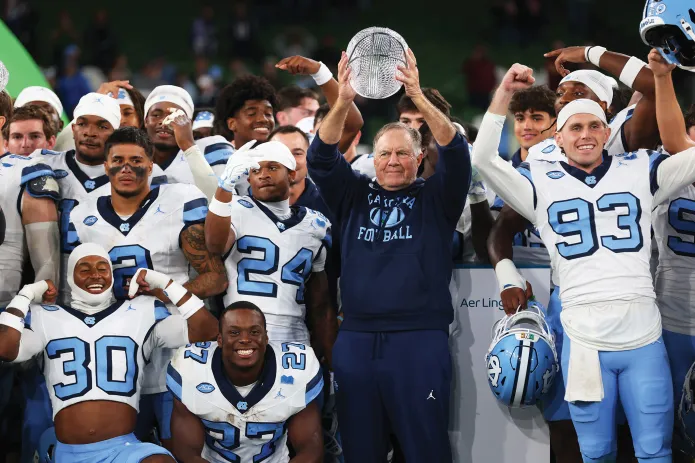
Although his second year in Chapel Hill has started off a bit better, with a 2-0 record, this whole episode feels like watching John Updike teaching high school English. Sure, he might be able to do it, but in the back of your mind, you have to be wondering: “Uh … what’s he doing there, exactly?”
Did Belichick take the job strictly as an on-ramp back to the NFL? Was he thinking that if he won enough games in a power conference, everyone would be reminded of the old Belichick, and a desperate owner would, eventually, come calling? Or does he genuinely want to coach college football? Should we take him at his word when he says so? The evidence points in both directions at once.
I put the question to retired Boston Globe columnist Bob Ryan, who has covered Belichick longer and more closely than almost anyone. Ryan’s first instinct was to remind me what kind of person we are talking about. Belichick, he said, is a “complete football creature.” Ryan doesn’t believe that there has ever been a coach who knew more about the game, including its history, or who could dissect any position on the field, including (famously) a dissertation on the long snapper.
He is “the most football-centric person” imaginable, “absolutely infatuated with football,” Ryan said. Yes, Belichick desperately wanted to stay in the NFL, but that door closed, and he was not ready to walk away from the sport itself. North Carolina offered him a program, a massive salary, and a chance to keep doing the only thing he has ever really wanted to do.
That explanation has the ring of truth. After all, Belichick did not leave the NFL on his own terms after the 2023 season; he and the Patriots mutually parted ways following a 4-13 campaign that capped a decline that had commenced in quarterback Tom Brady’s final season with the team. In the subsequent hiring cycle, he drew serious interest from only one team, the Atlanta Falcons. Other vacancies were filled with younger coaches or with structures that limited a head coach’s personnel power. By the time the 2025 cycle approached, he had already chosen to sign with North Carolina rather than risk another winter of silence. The buyout language in his UNC contract, $10 million if he left before June 2025, dropping to $1 million afterward, looked like insurance against exactly that temptation. He stayed.
Whether he can actually succeed at UNC is a different matter. College football in 2026 is a transfer-portal and NIL economy. Indiana Hoosiers coach Curt Cignetti proved how quickly it can be exploited. Indiana, historically the losingest program in the FBS, hired him after the 2023 season. Two years later, the Hoosiers were national champions, 16-0, after Cignetti restocked the roster through the portal and built a culture that believed it could beat anyone. Belichick’s first season at North Carolina featured massive roster turnover and an offense that ranked near the bottom of the country. This year, he brought in Bobby Petrino to run the offense and added portal pieces, including quarterback Billy Edwards Jr. The early returns are encouraging on the scoreboard, though still modest on the film.
On Aug. 29 in Dublin, Ireland, the Tar Heels beat the Texas Christian University Horned Frogs 15-10 in a game that was ugly, low-scoring, and defensive — the kind of slog Belichick once specialized in. Two weeks later, they handled the East Tennessee State Buccaneers by a score of 35-3 in their home opener. That is 2-0, but a team that went 4–8 a year ago does not become a playoff contender by beating the Buccaneers of the Southern Conference. The schedule stiffens immediately: Clemson on the road on Sept. 19, and a gauntlet that includes Notre Dame, Miami, and Louisville. Personnel still decides these things, and to be sure, Belichick has always been a personnel guy. The question is whether he and his staff are willing, or able, to play the portal game with the same ruthlessness as Cignetti.
The off-field noise has not helped. Defensive coordinator Steve Belichick, the coach’s son, has been on medical leave since early August and did not travel to Ireland. Longtime Belichick associate Michael Lombardi, hired as general manager, was placed on administrative leave in late July and resigned on Sept. 3 amid a university investigation into the football program.
And then there’s Belichick’s girlfriend, Jordon Hudson, who has been a constant presence in the media coverage — sideline appearances, public-records requests, the whole carnival. None of this is the story Belichick wants attached to a program he is trying to rebuild at age 74. He has addressed the investigation in clipped, process-oriented language and otherwise kept his focus on the next opponent, which is the only mode he has ever known.
MIKE VRABEL’S NON-CONFESSION CONFESSION
Maybe the story is simpler than we might imagine — as simple as the story of a man who is, as Bob Ryan puts it, “a complete football creature.” This is a man who has spent his entire adult life inside football, who was told the NFL no longer wanted him, and who found a place that would still let him coach, to the tune of many millions. The Tar Heels are not the Patriots. UNC does not have the infrastructure, the talent pipeline, or the institutional memory of winning that Belichick spent a quarter-century constructing in New England. Basketball will always be the main event in Chapel Hill. Football is the project he chose.
The early 2-0 record is a start, nothing more. If Belichick can win enough of the games that matter — steal one from Notre Dame or Miami, handle the in-state rivals, reach a bowl — he may yet leave Chapel Hill with something resembling dignity rather than as a cautionary tale about a legend who stayed too long. A return to the NFL looks remote. Respectability within the sport he has never been able to quit is still achievable. That, more than any secret master plan, is probably what he is chasing now.
Daniel Ross Goodman (@DanRossGoodman) is a Washington Examiner contributing writer and teaches theology and religious studies at St. John’s University. His next book, Dante’s Guide to Life: How The Divine Comedy Can Change Our Fortunes, Our World, and Ourselves, will be published this fall by Angelico Press.