
Consider a thought experiment. The year is 2030, two years after the Democrats have retaken the Congress and/or the White House. What does higher education look like?
DEI has been restored as the central administrative and ideological pillar of college and university life. Institutions have once again made race and gender the focal point of teaching, with formal demands to insert “relevant” content in every course, and are again shaping faculties and student bodies to “look like America” by formalizing racial and gender preferences.
“Diversity,” in the sense of a never-ending quest for grievance and minority representation, again marginalizes traditional education, Americans of European descent, and vilifies the Euro-American tradition and Western Civilization as the sources of all evil, past and present. Correspondingly, other civilizations, notably Muslim, are touted as the ultimate example of wisdom, justice, tolerance, and inclusion.
America’s borders are once again open, with millions rushing to fill the rosters of the refugee-migrant industry, the homeless industry, and others, all serviced by NGOs paid for by the government. Illegal immigrants already present are amnestied and given citizenship. The expectation is that migrants will be Democratic clients. Higher education will benefit through set-asides aimed at refugees, underserved communities, and other euphemisms for non-Americans.
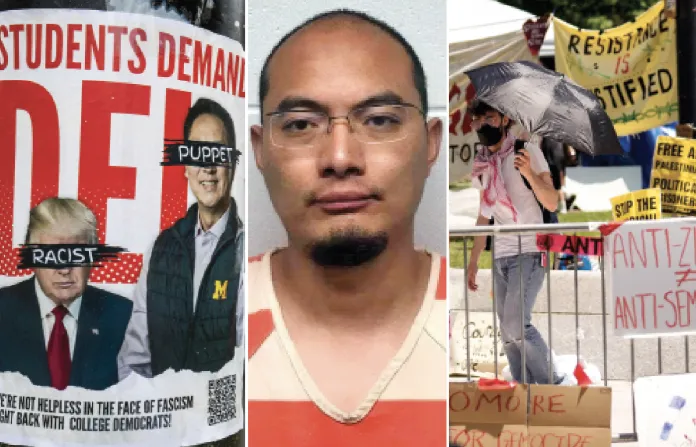
Foreign students will again be admitted in enormous numbers, sometimes comprising 50% or more of a student body. This will be again rationalized in terms of “soft power,” the idea that higher education is one of America’s greatest exports, that true cultural understanding can only be achieved by direct exposure to non-American cultures, and that foreign students are an irreplaceable source of revenue for institutions facing all manner of financial crises. Campus cultures will reflect this demographic shift as Israel, America, capitalism, and the West are protested, sometimes violently.
Research funds from the National Institutes of Health and the National Science Foundation will be unleashed, with the emphasis again on minority capacity building and vague investigations of underserved communities and indigenous epistemologies. Chinese students will again flow into American labs and resume stealing billions of dollars of intellectual property. The amount of science actually done will remain roughly the same, but the amount universities skim from grants will comprise a meaningful portion of their operating budgets, giving them the opportunity to avoid confronting deeper financial problems.
Faculty and student unions will once again reign supreme, the former in the classroom and in terms of “shared governance,” the latter on the quad and in contract negotiations. Efforts to tame the anti-American, anti-Western, and anti-Israel foundations of fields such as anthropology and Middle East studies will be discarded, as will those to control encampments and other violent disruptions aimed at Jews. Violent and hateful speech will reign again in the name of free speech. Meanwhile, the permanent underclass of graduate students and adjuncts will grow to service institutions while the number of real faculty declines.
Institutions that do not fall in line with renewed orthodoxies will suffer at the hands of Congress and the administrative state. Funds to institutions that have taken stands in favor of true freedom of speech, or worse, the Trump administration, will be paused or cut while endless investigations are undertaken to root out “bias.” The DEI commissars who run higher education institutions, along with HR departments, will sit in new and old Star Chambers, from Congress to the newly reinvigorated Department of Education to state legislatures.
The result will be European-style overproduction of college graduates, more disgruntled students thrown unprepared into a workforce shaped by artificial intelligence, and a smaller cadre of Jacobins ready to tear up politics and society. National cohesion will be a direct target of the new higher ed, since it represents nationalistic claptrap such as equality under the law rather than the critical race theory premise that all disparity signifies racism.
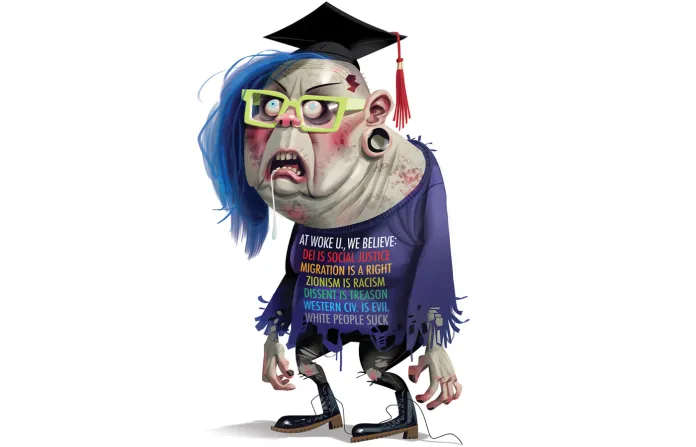
In short, higher education faces the prospect of becoming a zombie. Institutions will continue to be hollowed out of meaning and purpose; public trust will plummet to even lower levels than now; and more money than ever will flow to keep the zombie alive as it serves its one purpose: to support the party and its narratives. Republicans, as ever, will complain and do nothing.
The reckoning can come now or come later. The fundamental question of what a college or university education is for needs to be asked now (or 20 years ago) before elections bring the zombie back to life and make long-overdue reckonings impossible.
What is the purpose of the individual student and for society? Is it to create thoughtful American citizens cognizant of the Western tradition from which democracy sprang, or something else? Is it to instill an appreciation for beauty and excellence or to pummel the young with ugliness? Is it to inspire lofty goals or impossible utopianism? Is the system designed on the one hand to produce revolutionary socialists who hate everything that came before, and on the other to act as an extension of American industry?
But the sad reality is that not all institutions can or should survive. Hundreds of small colleges close every year due to under-enrollment and financial mismanagement. Some could be revived as centers for properly understood liberal arts education, but not all. Gigantic research universities are also closing regional campuses and underperforming departments. So be it. At the end of the day, higher education is a vital industry, not a charity.
But institutions that survive need a sense of purpose and a clear-cut identity, well expressed through narratives that resonate with families. Whether it is possible, for example, for Catholic schools to successfully reclaim their Catholic identities in terms of values and behaviors, is unclear. But every institution potentially has a story to tell, about its values, about its approach, and about the future.
All elections have consequences. But the challenge for 2028 and beyond is to eschew politicians, Democrat and Republican, who promise to bring back policies that supported American higher education’s descent into a bitter, joyless husk promoting resentment. The future of higher ed can be bright if we choose wisely.
Alex Joffe is the Director of Strategic Affairs for the Association for the Study of the Middle East and Africa (ASMEA). Asaf Romirowsky is the Executive Director of Association for the Study of the Middle East and Africa (ASMEA) & Scholars for Peace in the Middle East (SPME). The opinions expressed here are the authors’ own and do not reflect those of ASMEA or its members.