
All traditions must be created. Conservatism, as we know it, is a tradition created after 1945. It rested on two pillars. Each was a synthesis, constructed for the needs of its time. Its ideology was the “Burke to Kirk” syllabus, a heritage of liberty from Edmund Burke to Russell Kirk. Burke and Kirk were patricians, “elitists” as we would now say. The intellectual license to govern still needed a popular stamp. The “fusionism” of Frank Meyer identified the tripartite voter alliance that could win elections at home and the Cold War abroad: social conservatives, free-marketeers, and a forward foreign policy.
This alliance peaked in the 2000 elections and the patriotic unity that followed the 9/11 attacks. It started to crack in 2003, with the misconceived and unpopular Iraq War. It came apart entirely after the crash of 2008. Since then, we have seen the emergence of a “New Right” in America. Some of the New Right’s roots are in the Old Right: The rise of Donald Trump raised the ghosts of Andrew Jackson, the Know Nothings, the Old Right, and Pat Buchanan’s 1990s presidential campaigns. But the New Right is also innovative and future-oriented. It coalesced around Trump in 2016 and currently orbits the second Trump White House with an eye on the 2028 succession. It has assembled the elements of what I would call a “second fusionism.”
Its factions are, like the first fusionists, odd and often uncomfortable bedfellows: Big Tech idealists rushing to a post-humanist future and white identitarians recoiling from the reality of multiracial America, Catholic post-liberals dismissing the Constitution and libertarian traditionalists hoping to save it, “Civilizationist” defenders of the West and isolationists who loathe Israel. But this is how big tents are made and filled. The techies have the means that will run the coming systems of government and a lot of money. The dissident intellectuals supply ideas that can be sifted into a ruling ideology. The digital identitarians have the numbers, especially among the young.
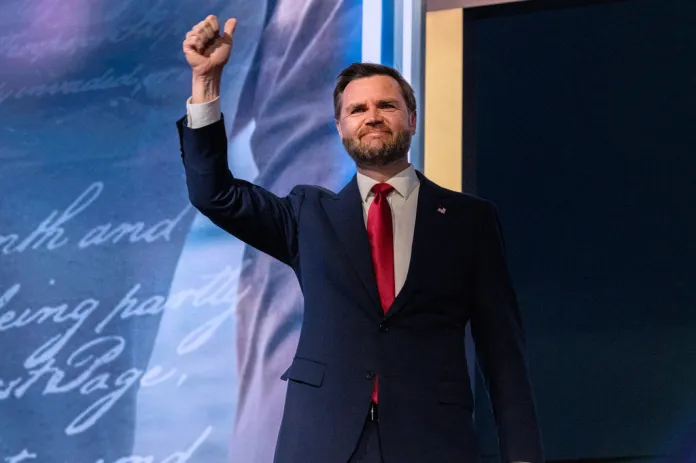
The second fusionists have a narrow base. Their candidate is Vice President JD Vance. He is one of them, at least for now, and he must placate all of these factions if he is to become the 2028 Republican nominee. The prize? Power over the richest and most powerful society in human history. The stakes? The future of the ideals that the American system was designed to exemplify and, for all its failures, succeeds in embodying: liberty, privacy, democracy, and the rule of law. I use the present tense not because those ideals are realized everywhere in America today, but because we should not “black pill” about the future, especially in America.
We tell ourselves that democracy requires good losers. But American history suggests a winner-take-all pattern closer to that of the Roman Republic. Every 80 years or so, a party installs a ruling ethos and does its best to expel the losers. We call those moments the American Revolution, the Civil War, and the New Deal. The crisis of our time arrived right on time. The first question of politics arises again: “Who rules?” This leads to the second question of politics: “Who won?”
A TECHNOLOGICAL REVOLUTION TESTS OUR EXPERIMENT IN SELF-GOVERNMENT
Trump’s victory in the 2024 elections naturally opened the question of the Republican nominee for 2028. The factions at the court of King Donald started to feud in the first weeks of the second Trump presidency. The war of Republican succession began in September 2025 after the murder of Charlie Kirk. So far, its terms are those of the Second Fusionism, not the first, because those are the terms of the antagonists of the pre-2016 order. Kirk, a young and personable influencer, strained to bridge the pre- and post-2016 divide, and reconcile classical liberalism with the new identity politics, and party politics with the new media. We should now speak of “Burke to Kirk” as the ideological descent from Edmund Burke to Charlie Kirk.
We should also ask the third question of politics: “Who lost?” Kirk lost in the worst way possible. First by being murdered, and then through the posthumous desecration of his character and ideas by erstwhile friends such as Tucker Carlson, Candace Owens, Megyn Kelly, and the other bottom-feeders of the “podcast Right.” Their racism and their mob assault on reason shares friends and enemies with a similarly calculated and fervid assault on the conservative think tanks in Washington, D.C., in the names of “America First” and Vance’s 2028 candidacy. It is too early to say whether these linked movements are winning. But their initial successes are defeats for the American virtues of reason and tolerance. When Vance hedges and blusters to hold his coalition together, he creates footage for the attack ads of 2028.
Dominic Green (@drdominicgreen) is a Washington Examiner columnist and a fellow of the Royal Historical Society.