
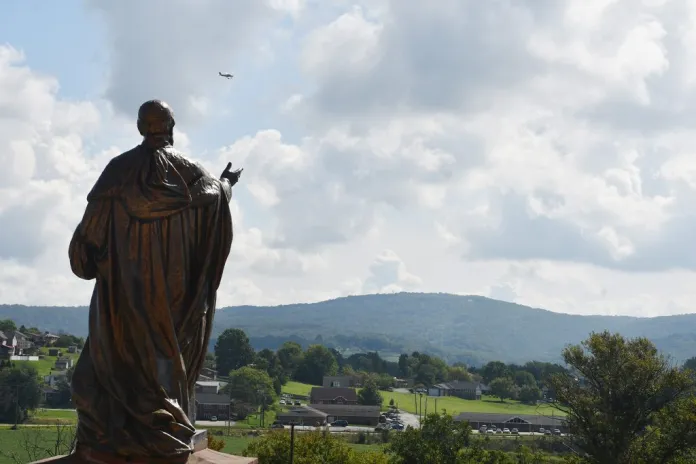
LATROBE, Pennsylvania — The late afternoon sun catches the twin spires of the Archabbey Basilica at St. Vincent College, casting a long shadow across the pristine practice fields of the Pittsburgh Steelers’ training camp.
For 60 years, this rural patch of Westmoreland County has played host to an annual cross-cultural pilgrimage. Here, the secular spectacle of professional football doesn’t just collide with ancient faith; it pulls up a chair and makes itself at home.
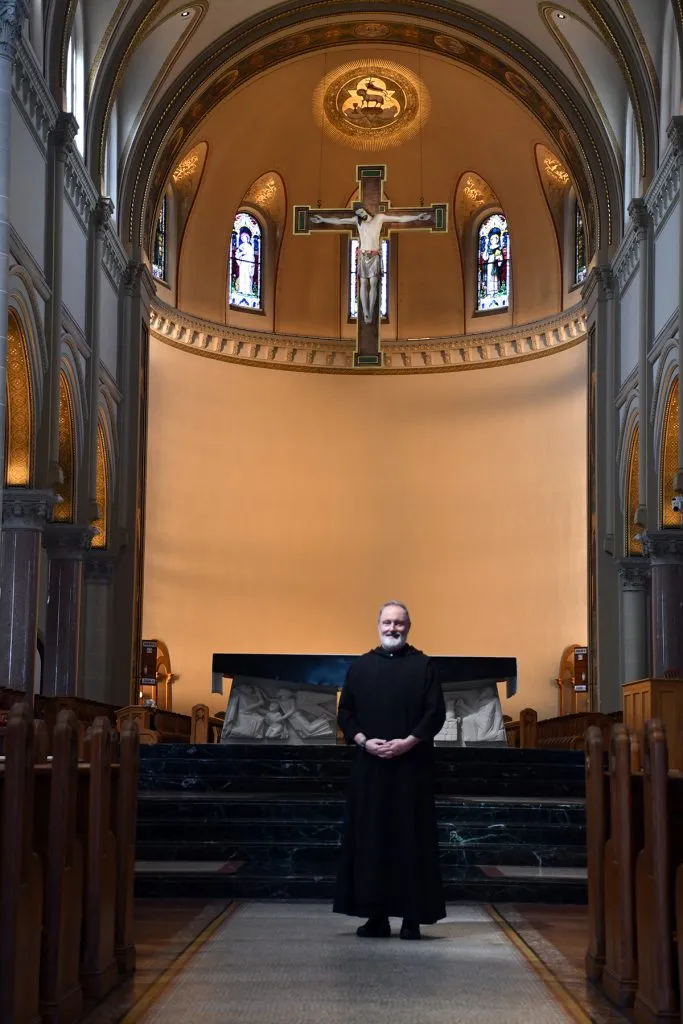
Last year, the prior of the basilica, Father Maximilian Maxwell, gained accidental national fame. A “fluky,” miraculous game-winning play by the Steelers occurred shortly after he had blessed the team’s end zone. The moment snowballed into a viral sensation, a reality Father Max meets with humble Catholic humor: “It was not on my bingo card, no,” he says, smiling.
Yet while the public marveled at what looked like a divine assist, Father Max knows that the real miracle isn’t a game-winning touchdown. It is the quiet, fierce, and increasingly bold relationship that modern American athletes are forging with God, a relationship that anchors them through the brutal highs and lows of professional sports.
For decades, society has drifted toward a narrative that faith is fading from modern life. But on the campus of St. Vincent, a different reality unfolds. Behind the glitz of the NFL and high-stakes college football, young men are fiercely holding on to the center.
Take former Penn State quarterback Drew Allar, now one of three backup quarterbacks for the Steelers, whose steady composure on the field is directly tethered to a deeper, internal foundation.
When Allar first arrived at college, thrust into the pressure cooker of major college athletics and separated from his family, he found himself at a crossroads. He didn’t just survive the transition; he rooted himself.
“I definitely leaned on it more once I first got to college,” Allar explains in an interview reflecting on his faith. “It’s a new chapter where you have to learn on your own and live on your own. That’s when my connection with my faith and rooting with my faith really clicked for me,” Allah said at the Steelers practice field on Pittsburgh’s South Side.
For Allar, this spiritual maturation was accelerated by teammates, including his former center, Nick Dawkins, as well as campus pastors. In a world that equates a person’s worth with their statistics or the dollar amount on their contract, Allar uses his faith as a shield against the distortion of fame.
“At the end of the day, all the fame and money, it really doesn’t matter at all,” Allar says flatly. “It’s just about the type of person you are at the end of the day.”
This desire to remain grounded isn’t happening in a vacuum. It is a culture nurtured by institutions that understand that athleticism is, at its root, biblical.
“For generations and generations, men and women have used athleticism and spirituality to go hand in hand,” Father Max observes. He notes that while faith used to be viewed as a strictly private or family-based concept, it is now spilling over into everyday life.
Teams are taking a knee together, praying openly before and after competitions — not to ask for a victory, but to express gratitude for the raw, miraculous gifts of human ability.
Will Howard, who, along with Allar, is one of three backup quarterbacks to Steeler quarterback Aaron Rodgers, said faith’s role in his life is everything: “I’ve been really big on it this camp, and I just feel like I continue to be rooted in my faith.”
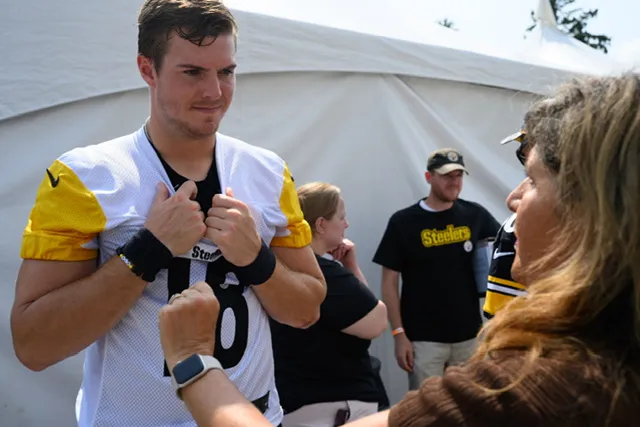
“And good or bad, I go to him, and he helps me with everything,” he said of his relationship with God. “And I listen to my scripture every morning, walk into the weight room to the cafeteria, and that helps me just get off to a good start in my morning. And as much as I can just think about him and keep my thoughts revolving around the greater of the universe.”
“I marvel at the athletic gift and skill and ability that God Creator gave to athletes,” Father Max says. “When we use whatever gifts we’re given … if we are aware of those gifts and we give thanks to our creator for those gifts, then we have success in doing what we’re called to do.”
The Steelers organization, led by the devoutly Catholic Rooney family, has intentionally fostered this environment. Every year at training camp, Father Paul Taylor, president of St. Vincent, hosts a special “Steelers Mass” at the basilica. The event brings the front office, the players, and local parishioners together into a single pew.
There is also a Mass held on game day for players, coaches, and staff at Acrisure Stadium, in the press conference room, which Father Max often officiates.
In that space, the numbers on the jerseys disappear. The multimillion-dollar contracts are forgotten. The athletes are no longer distant gladiators on a field; they are human beings, sitting side by side with ordinary people, bowing their heads in a shared human experience.
“They’re one with us praying,” Father Max says of the players. “That’s not hallmark or sentiment. People go away changed by seeing that.”
What journalists and fans are witnessing across the sports landscape, from training camps in Pennsylvania to packed stadiums nationwide, is a generation of athletes rejecting the idea that they must compartmentalize their souls.
Whether it is a backup quarterback preparing for the heavy weight of an unexpected opportunity, or a starting star navigating the crushing anxiety of a looming season, prayer has become an essential tool for survival. It provides a moment to step away from the noise, the critics, and the intense physical danger of the game.
SALENA ZITO: UNDER A VIVID BLUE SKY, A PENNSYLVANIA FIELD WHISPERS THE NAME OF THE FALLEN
As Father Max notes, kneeling on the grass or pausing before a game offers something deeply therapeutic and holy. “It gives us the opportunity to transcend ourselves and focus our intentions,” he said. “It has that grace-filled moment … to transcend ourselves.”
In an era defined by unpredictable highs and devastating lows, these athletes are discovering that putting God at the center doesn’t guarantee a win on the scoreboard. Instead, it gives them something far more valuable: a baseline of peace, a shield of humility, and the reminder that a game can never dictate their true worth.