
PITTSBURGH — The yellow suspension cables of the Roberto Clemente Bridge cut across the sky like guitar strings, and beneath them, on a bank of the Allegheny, a small crowd was gathering one summer evening a few years back.
A young man descended into the river fully clothed. Then a woman. Then another man. On the shore, hands were raised. Some people were crying. Some were laughing. Music played in the background. A pastor lowered them one by one, beneath the surface of one of the three rivers that define the shape of the city.
It looked spontaneous. Almost accidental. In a way, it was both.
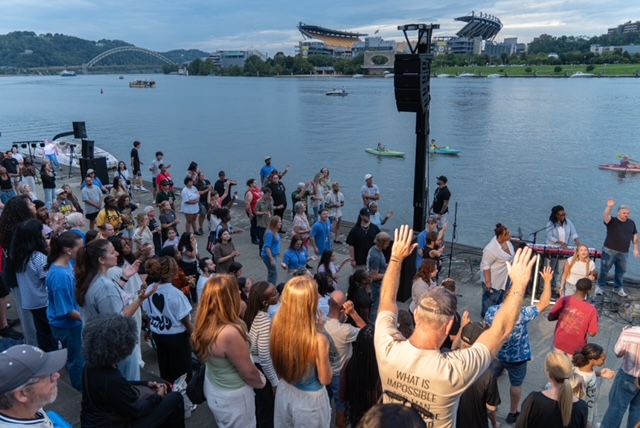
It was the beginning of something that has now grown large enough that, on the last Sunday of August this year, more than a thousand people came to Point State Park to worship. Even more to get deeply baptized. Baptisms in the river went on for more than two hours.
Even onlookers along the bridge, or those enjoying a day of boating or fishing in the river, looked on with respect and amazement.
It is a movement that has grown, from that first baptism a few years ago to now spilling onto the University of Pittsburgh’s football field, into the Petersen Events Center, and into the beds of pickup trucks parked at revival services that draw thousands of young people.
In its own quiet way, it is part of a broader story about how a generation of Americans is finding its way back to God. Yet it is a story that many of the country’s biggest surveys and cultural gatekeepers are still struggling to see.
The pastor at the center of it is Jason Howard, who leads a nondenominational church called The Sanctuary in the city’s Strip District.
Howard said that the first river baptism was a bit of an improvisation.
“A number of years ago, we were renting a venue for church on Sundays, before we had our own building,” Howard said. “The venue wasn’t available for a particular Sunday, so we had church outside at the Point as a last resort. People felt so compelled by worshipping in the center of the city that we kept being asked to do it in following years.”
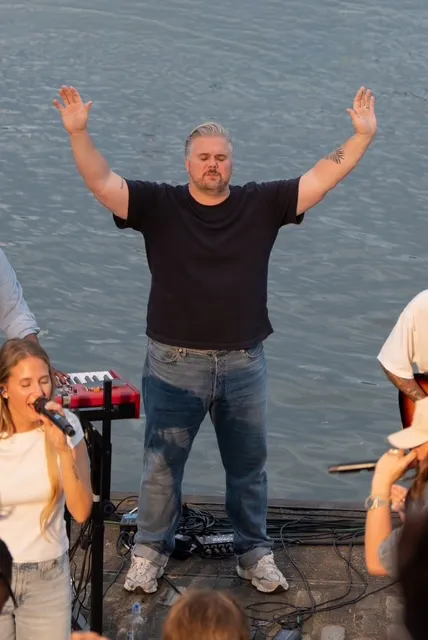
On one of those outdoor Sundays, his phone rang on the drive down to the Point.
“A couple who had recently accepted Jesus and started coming to church called me while I was on the way to the Point for that evening’s service and told me that they needed to be baptized because they wanted to solidify the change that had happened in their life,” Howard said. “I told them to come to the Point that evening and we’d find a way to do it.”
Someone had arrived at the service by boat. Howard asked to borrow it, motored out into the current, and pulled the couple into the river with him. What was supposed to be one baptism, or maybe two, became something else.
“That night, dozens of people spontaneously made the decision to get into the river and be baptized,” Howard said. “Over the last few years, we have baptized hundreds and hundreds of people in the Allegheny River.”
This summer, no one could keep count.
“We estimate over 1,000 people came to Point State Park to worship on Sunday,” Howard said. “So many people came down for prayer and baptisms that we couldn’t keep count. We were baptizing people in the river for over two hours, often multiple people at a time. Sometimes, entire families [were baptized] at the same time.”
SALENA ZITO: A CENTURY ON, SAN ROCCO TRADITION ENDURES
What has changed at The Sanctuary, Howard said, is not just the size of the crowd. Rather, it is the age and intensity of it.
“Since COVID, we have seen a flood of people start coming to our church. Especially — but not only — young people,” he said. “There is a hunger for God like I have never seen before.”
He said that 10 years ago, the church might have seen a dozen students from the University of Pittsburgh on a Sunday morning. But “over the last year, we have seen hundreds of Pitt students come to our events, our Sunday services, and get baptized. And what’s also different is the passion. These young people do not have a casual relationship with God and church. They are passionate, committed, and on fire for God. They are bringing their friends to hear about Jesus with more enthusiasm than I have ever seen.”
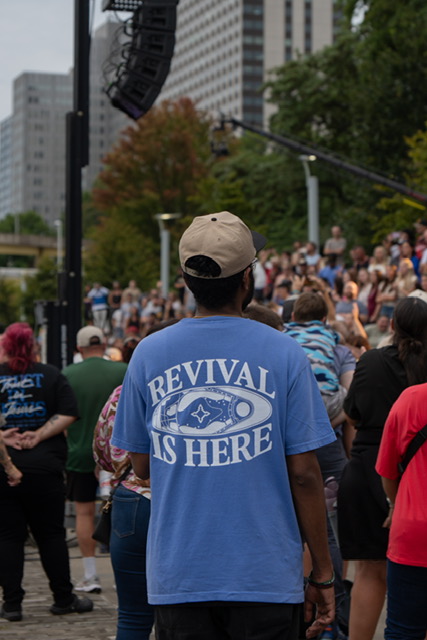
If you ask him what is driving it, he returns, again and again, to two words: peace and purpose.
“The most common issue we hear from young people is that they struggle with mental health,” Howard said. “However, when they begin a relationship with God, they find peace and freedom. Their personal connection to God brings them health in their souls in a way that nothing else can. These young people are desperate for purpose, for belonging, for peace, and only a relationship with Jesus satisfies those needs.”
“We have a need for God,” he added. “It’s part of our design. When people have a personal experience with God, it brings a wholeness and stability to life that you can’t find anywhere else.”
What began at the river has since walked itself onto campus in cleats.
In the spring of 2025, Jake Overman, a redshirt senior tight end on the University of Pittsburgh football team, founded a student-athlete-led ministry called Pitt Purpose, aimed at reaching his teammates and fellow students with the Gospel. A California native who transferred to Pitt to play, Overman had come to faith during college and started praying with a handful of teammates in the locker room. Within months, more than 30 Pitt athletes had made public professions of faith, and the football team had started its own Bible study.
Then, on the evening of Sept. 18, 2025, Overman and Howard partnered on something bigger.
They called it “Pitt for Jesus.” They held it on Mazeroski Field, in the shadow of the Cathedral of Learning. There was live worship music, free food, prayer, and a row of portable baptism tubs set out on the grass. More than 600 students turned out. Sixteen ministries and 15 varsity sports were represented. Sixty-five people made professions of faith. Eighty were baptized on the field, including Pitt baseball player Gavin Chillot and softball player Macy Hamilton, all in front of teammates and coaches and strangers. By the end of the fall, more than 45 Pitt football players had publicly declared their faith in Christ.
Howard described how the collaboration came together.
“He became a passionate Christian after having an encounter with God during college,” Howard said of Overman. “Since he was transferred to Pitt to play, he has led numerous other players to accept Jesus and get baptized. He had a vision of a large worship gathering on campus. Our church was able to partner with him and Life Church in Bridgeville to pull off the event after he was able to get permission from the university to hold a large event on Mazeroski Field, near the Cathedral of Learning.”
It did not stop there. A follow-on revival at Pitt’s Petersen Events Center drew more than 5,000 young people, with several hundred baptized. Many of them, for lack of tubs, used the beds of pickup trucks parked outside the arena.
For years, the dominant story about American religion has been one of decline and the rise of the “nones,” the emptying pews, the graying of the mainline. But a closer look at the newest numbers suggests that the picture on the ground is more complicated than the headlines, and much more complicated than the skeptics allow.
The decadeslong slide in American Christianity has, at minimum, paused. The Pew Research Center’s 2023-24 Religious Landscape Study, based on a sample of 36,908 U.S. adults, found that the Christian share of the U.S. population has been “relatively stable since 2019” after years of steady decline.
Among young adults, the shift in tone is even more striking. Gallup’s 2024-25 polling found that 42% of young men ages 18 to 29 now say religion is “very important” in their lives — a jump of 14 percentage points from just two years earlier. Monthly religious attendance among young men has climbed from 33% in 2022-23 to 40% in 2024-25, marking its highest level in over a decade.
The Barna Group, which has tracked American church life for four decades, reports that in 2025, 43% of men and 36% of women said that they regularly attended church on a weekly basis. This is both the largest gender gap that The Barna Group has recorded in 25 years of tracking, as well as a reversal of a decadeslong pattern in which women were consistently more likely to attend. Among Gen Z men specifically, commitment to Jesus rose from 52% in 2019 to 67% in 2025. For millennial men, the figure now stands at 71%.
Perhaps most tellingly, Barna’s study found that Gen Z and millennial Christians are now the most consistent churchgoers of any generation. The typical Gen Z churchgoer attends 1.9 weekends per month, the typical millennial, 1.8. This is up from about one weekend per month during the pandemic, and higher than the 1.6-weekend average for U.S. adults overall.
Where are these young people going? Not to the denominations that their grandparents built. According to the 2020 U.S. Religion Census, 6.5 million more Americans now attend nondenominational churches than a decade earlier. That growth is concentrated among people under 40. Pew data show the share of Americans identifying as nondenominational Protestants has grown 58% since 2007.
Pew itself has cautioned that its own data do not yet show a nationwide “revival.” Pew notes that today’s young adults remain less religious on average than young adults were a decade ago.
But even Pew’s more skeptical read confirms that the trend line has stopped falling. Gallup, Barna, and PRRI are all picking up a real shift, particularly among young men, and inside the fast-growing nondenominational world where churches such as The Sanctuary live.
If you ask Howard why so much of the country keeps missing what he sees every Sunday, he doesn’t hesitate.
“I think that so much of our culture has considered faith to be peripheral to what matters in society, or even considers it a sign of being uneducated or un-evolved,” he said. “We’ve viewed ourselves as being more enlightened than to need God. So people can’t understand why someone would build their lives on top of faith in God. But the truth is, that life doesn’t work well without the stability and wholeness that can only come from God.”
SALENA ZITO: ARTHURDALE’S NEW DEAL EXPERIMENT, AND THE DEBATE OVER SOCIALISM
Part of the blind spot, he argues, is that the country’s storytellers have gotten stuck looking through one lens.
“It seems like everyone wants to see everything through a political lens — is this Right or is this Left? But most people don’t see their lives through that lens,” Howard said. “But they do know whether or not they have peace and wholeness. They do know whether or not they feel loved, seen, and known.”
That is the pivot the national conversation has yet to make.
Faith in America is still largely discussed in the categories of decline, denomination, and partisanship. But the young people wading into the Allegheny in their T-shirts and jeans do not appear to be voting with a party ballot. They are voting with their bodies, in a cold river, in the middle of a city built on pits. They are voting for peace, for belonging, for something older and steadier than the moment they were born into.
The numbers are beginning to catch up.
The coverage has not.