
Senate Minority Leader Chuck Schumer (D-NY) spent decades telling Jewish audiences that his name meant something important. In a 2010 interview with Jewish radio host Nachum Segal, Schumer said it “comes from the word shomer, guardian, watcher. My ancestors were guardians of the ghetto wall in Chortkov. And I believe Hashem gave me that name. One of my roles, very important in the United States Senate, is to be a shomer — to be the shomer Yisrael. And I will continue to be that with every bone in my body.” On the Senate floor in 2024, in what was billed as the most important speech of his career, he called himself the first Jewish majority leader in American history and the highest-ranking Jewish elected official the country has ever produced. He wrote a book last year titled Antisemitism in America: A Warning.
However, on Aug. 5, he endorsed Michigan Democratic Senate candidate Abdul el Sayed, who won the primary the night before.
El Sayed, a former Detroit health commissioner, spent the primary campaign explicitly arguing that Schumer should be replaced as Democratic leader. He had told the New York Post the weekend before his win that Schumer had “given all of us ample reason to question” his leadership, and that Sen. Chris Van Hollen (D-MD), who Democrats would install instead, “would be perfect.” Within hours of the result, Schumer and Sen. Kirsten Gillibrand (D-NY) released a joint statement praising el Sayed’s “energetic campaign” and pledging to help send him to the Senate.

The endorsement was not really a surprise. Schumer needs the seat. Michigan is one of the handful of states that will decide whether Democrats retake the majority in November, and as the sitting minority leader, Schumer was in a tough spot. However, Democrats have waxed poetic about “principles” and “democracy” for more than a decade, and here was Schumer, the guardian as he calls himself, endorsing a candidate he would rain down fire on if he were a Republican.
El Sayed has called the Israeli government “bloodthirsty” and described its conduct in Gaza as “genocide.” When a man rammed a car into a synagogue in West Bloomfield, Michigan, during preschool hours in March, in an attack authorities linked to the driver’s grief over a brother killed fighting for Hezbollah, el Sayed did not condemn it. He explained it, telling voters that “hurt people hurt people,” and he stood by the comment months later when reporters asked him to reconsider it. He campaigned alongside anti-American streamer Hasan Piker, who has said he would choose the terrorist organization Hamas over Israel “every single time” and mused about whether America “deserved” the Sept. 11 attacks. Piker has called orthodox Jews “inbred” and went further than el Sayed, calling Israel a “bloodthirsty, violent pig dog.”
El Sayed’s first endorsement from any Jewish organization came from Jewish Voice for Peace Action, an anti-Zionist group that does not recognize Israel’s right to exist within any borders. The American Israel Public Affairs Committee, which spent more than $30 million trying to stop el Sayed, called his nomination proof of “a fiercely anti-Israel candidate” ascending inside a major party.
El Sayed insists his objection is to AIPAC’s influence and Israeli government policy, not to Jews or Judaism, and after the primary, he told the New Yorker he could support a two-state solution. That is the line he offers every time the rhetoric catches up with him, and the excuse does not hold water. A candidate who explains away an attack on a synagogue full of preschoolers as the product of a man’s grief, who shares a stage with someone who has said he’d pick Hamas over Israel, and whose only organized Jewish support comes from a group that opposes Israel’s existence in any form, is not a critic of AIPAC. He has made his views well known, and no amount of “I love the Jewish people” changes what he has said.
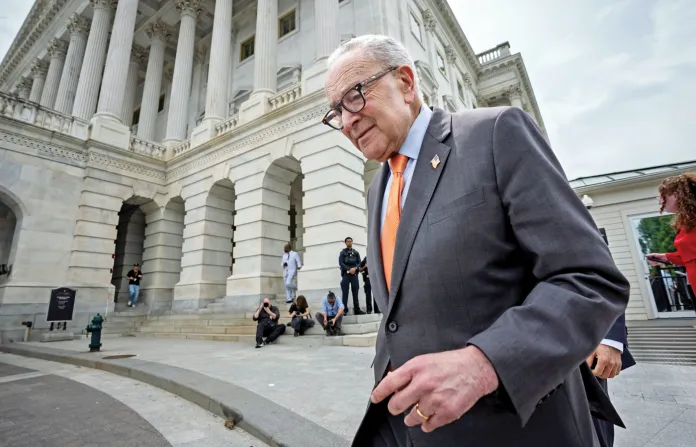
One might think this would not be something Schumer would just let go. Go back through what Schumer said since Hamas’s Oct. 7, 2023, attack. He traveled to Israel within weeks and told reporters in Tel Aviv that as “the first Jewish majority leader, and the highest-ranking Jewish elected official ever in America, I felt I had to be here.” He delivered a Senate address on antisemitism that November, calling it “a five-alarm fire,” distinguishing how seriously Jewish Americans regarded the threat from how casually, he said, many non-Jewish colleagues did. In March 2024, he gave the speech that made headlines around the world, calling for new elections in Israel and criticizing Prime Minister Benjamin Netanyahu, but was careful to specify he did so as “a staunch defender of Israel” and “shomer Yisrael.” Even his sharpest criticism of an Israeli government came wrapped in the same credential he’d been presenting to Jewish audiences for decades: “I am the guardian, and you can trust me.”
That framing held for decades because it never cost him anything he wasn’t willing to pay. It survived a Democratic administration and a Republican one, Netanyahu’s government and the war that followed Oct. 7, primary challenges from his left and criticism from his right. Schumer built an entire political identity on the claim that his Jewishness and his defense of Israel were not just positions but a part of who he was, fundamentally. The claim was somewhat plausible right up until it might cost him some real political capital, and he chose not to spend any of it.
Then Michigan happened, and the guardian discovered he had more important things to worry about.
Some in the Jewish community were blunt about what they saw happening. The Republican Jewish Coalition’s Matt Brooks said el Sayed’s nomination posed “a direct threat” to Jews in the state. The Jewish Democratic Council of America’s Halie Soifer wrote that el Sayed’s rhetoric toward AIPAC “can contribute to antisemitism” and called on him to renounce his association with Piker. She left him off her group’s endorsement list even as her party’s own Senate leader embraced him. A Jerusalem Post column, published days after the endorsement, said it marked a shift “from guardian of Israel to guardian of the caucus,” arguing that Schumer’s loyalty had not actually changed but had been built upon whatever would get Democrats back in control and save his job.
There is a straight line running through Schumer’s career, and it has less to do with his supposed defense of Israel than with his ability to maintain his position by focusing on whatever helps him and the Democratic Party. It helps to remember that Schumer has spent his entire adult life in elected office. He passed the New York bar exam in 1975 but never practiced a day as a lawyer, never worked in the private sector, instead choosing to run for the New York State Assembly straight out of Harvard Law School the year before.
In the 2010s and early 2020s, as he rose to Senate Democratic leader and then majority leader, it meant a coalition that included a large, engaged, and historically well-organized Jewish donor and voter base, to whom he pledged, repeatedly and at length, a kind of loyalty that went beyond ordinary politics. Now, that coalition includes primary voters in Michigan who nominated a candidate built in direct opposition to everything Schumer said he stood for on Israel, and Schumer decided that getting Democrats back in control of the Senate was more important than anything else.
This is exactly what Democrats have spent a decade accusing Republicans of doing with President Donald Trump: upending their principles in exchange for power. Every Republican who called Trump a threat to the Republican Party and conservative movement in 2016 and lined up behind him by 2020 got the same label from Schumer’s own party. They were called cowards, sellouts, and people who found out their convictions could be negotiated. Schumer doesn’t seem to have a breaking point. He endorsed Graham Platner in Maine despite Platner sporting a Nazi tattoo for nearly two years and lying about what he thought it meant. Now, he chose to endorse a candidate clearly hostile to Israel and the Jewish people, and he did not hesitate. He looked at a nominee who explained away an attack on a synagogue full of Jewish preschoolers, who stumped with a man who says he’d pick Hamas over Israel, whose only Jewish backers oppose Israel’s existence outright, and he decided that man was still worth an endorsement.
ABDUL EL SAYED IS AN AMERICAN TRAGEDY
Michigan is a state Trump carried in 2024, and the Democrats need to hold the seat if they want any chance of gaining the majority. A minority leader who withheld support from his own party’s nominee in a race this close would have handed his critics, the same ones already questioning whether he should lead the caucus at all, exactly the opening they wanted. That explains the endorsement. It does not excuse it.
Schumer cannot be the shomer Yisrael, sworn by blood and Hebrew faith to guard the Jewish people, and the party leader who stands behind a man who rationalized an attack on a synagogue and campaigns with an open sympathizer of America’s enemies. The two are incompatible. But if all he wants is power and to maintain his leadership status, he has to go against everything he said he was since being elected. For all his talk over the last 40-plus years, when push came to shove, Schumer took the path of least resistance. He is not a guardian and clearly does not care about the Jewish people or Israel. He is a party man whose fealty to Democrats overshadows all the years of rhetoric and speeches he made claiming his support of Israel and the Jewish community.
Jay Caruso (@JayCaruso) is a writer living in Florida.