
On Sept. 10, 2001, I was working in the newly refurbished Chelsea Market on 9th Avenue and 115th Street in Manhattan. In another life, the building was the Nabisco factory where the Oreo was invented, and where my wife’s grandfather had baked Mallomars and Fig Newtons decades earlier. The building was now a trendy tech-hub of loft spaces with exposed-brick walls upstairs and an artisan bakery downstairs. Oprah Winfrey’s television venture and a modeling agency were rumored to be our neighbors.
The building sat at the intersection of gentrifying Chelsea, the Meatpacking District, and West Village. At night, you might be propositioned by hulking transvestite prostitutes or walk past affluent young couples holding Starbucks lattes pushing a stroller. Usually both. One block south, a person would hit a cobblestone road anchored by a seedy sex club. The place is a Mexican restaurant now. There’s a lot of nostalgia about New York, but the neighborhood is far more pleasant now. A lot of things are nicer.
We could probably see the Twin Towers from the break room at the Major League Baseball online office where I worked, not that anyone ever seemed to notice. The Twin Towers were for tourists to marvel at and locals to use as a compass. In post-9/11 cultural depictions, the buildings were romanticized. But, in my memory, a lot of New Yorkers thought they were unsightly.
But you know what they say? You don’t know what you’ve got until 10 jihadi hijackers try to incinerate your city.
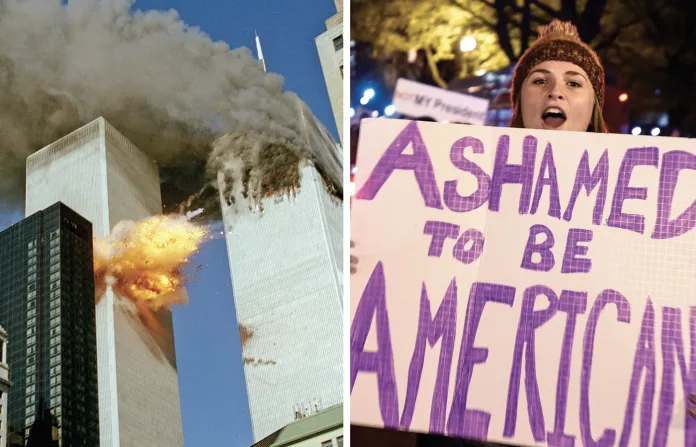
As it was, I wasn’t in the office when the planes hit. Being a sports journalist meant working nights and weekends. Though I was geographically close to the most traumatic event in modern American history, I watched the surreal carnage unfold on my television like most of my fellow citizens.
The most harrowing personal moment of the week came when I learned from my wife that one of the children in her early-education school had lost their firefighter dad in the towers. That was harrowing enough. In about a month or so, I went back to downtown New York covered in white dust. I felt a bond with every person who walked by.
Those who were around on Sept. 11 aren’t beneficiaries of any secret knowledge denied by previous generations. But they were likely the last generation, for a few months — or maybe only a few weeks — to collectively and intensely feel American.
Patriotism spiked dramatically following the Sept. 11 attacks, with most polls finding that 90% of people were extremely or very proud to be Americans. It is difficult to imagine a comparable sentiment materializing if we were attacked again. It is almost surely the case that a large contingent of the Left, especially among the young — and a not insignificant faction of the young Right — would blame the president or the United States or Israel. Twitter’s launch was still five years away when the Towers fell. You can imagine how a 9/11 event today would send millions immediately into conspiratorial wormholes.
There’s a palpable detestation of America on the Left. The younger you are, the less you are proud to be an American. Most polls show around 40% of Generation Z, the generation that didn’t experience Sept. 11, are “extremely” or “very” proud to be American. By comparison, roughly 60% of Millennials, 70% of Gen X, and over 80% of Baby Boomers feel strongly patriotic.
Only 25 years after 9/11, the mayor of New York is a man named Zohran Mamdani, who detests the foundational ideas of the nation, gins up violence against his Jewish constituents, and justifies and rationalizes terror. Young New Yorkers overwhelmingly voted for him. Mamdani and other ideological allies are widely celebrated in mainstream left-wing circles as the future of the Democratic Party.
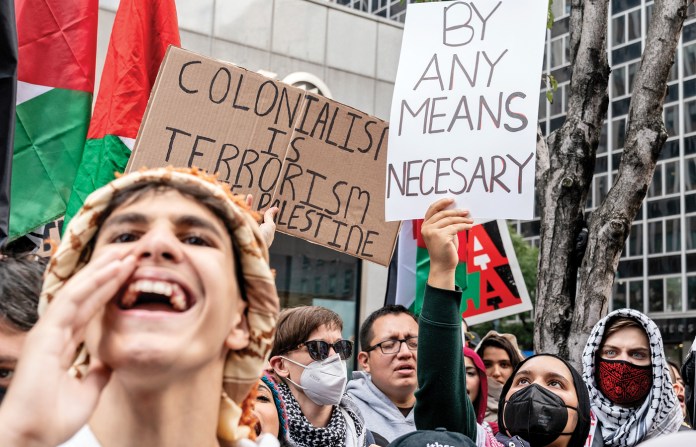
The only people dancing on Sept. 11 were in places like the West Bank. Palestinian terror groups, the originators of modern hijacking, helped make 9/11 possible. Yet, “democratic” socialists, a growing concern on the American Left, place Palestinianism at the center of their agenda.
Today the Democratic Party bigwigs have no compunction endorsing candidates like Michigan’s Abdul el Sayed, who blames the United States for “creating” terrorism, rationalizes the actions of would-be Hezbollah child murderers, and pals around with a popular socialist online personality who believes we deserved 9/11. Or, Dr. Adam Hamawy, almost certain to represent New Jersey’s 12th Congressional District next session, who not only reportedly volunteered with an al Qaeda-tied group in Bosnia, but was a good friend and defender of Omar “Blind Sheikh” Abdel Rahman who tried to bring down the Towers in 1993.
There is simply no way that any of us on 9/12 — I don’t care how liberal you were — would have believed this is where we were headed. The day of the attack, President George W. Bush, who comported himself with exceptional poise in those early days, told us that “terrorist attacks can shake the foundations of our biggest buildings, but they cannot touch the foundation of America.” He was wrong.
The American foundation appeared sturdy before Sept. 11. As with any era, an array of issues plagued society in the 1990s, but, in retrospect, politics was comparatively low-stakes and often quite frivolous. Conservative journalists scoured the Arkansas countryside searching for women that our lecherous president had bedded, but none of it was going to sink the republic. The impeachment of Bill Clinton over his lying about his dalliance with a young intern had the entertainment value of a Jerry Springer episode.
The Clintons might have operated the White House like one of the Five Families, but Washington more or less still worked. With the Gingrich Revolution of 1994 Republicans gained 54 seats in the House and eight in the Senate. Bill dropped most of Hillary’s big ideas, Congress crafted most of the laws, and Reaganism hit its stride, unleashing 30 years of unprecedented prosperity.
A few days after the 9/11 attack, George W. Bush told the country Islam was, despite all the rubble and marred and mangled metal at Ground Zero, a “religion of peace.” If that’s true, why won’t they let me on a plane with more than 3.4 ounces of water?
Perhaps Bush’s contention was understandable, given that the United States government would not want to create the perception that it was in conflict with the entire Islamic world or turn Americans against their Muslim neighbors. Indeed, idealistic notions about citizenry meant that there would be rare blowback against Muslim Americans.
The more enduring problem of the Sept. 11 world is that our openness inhibited many of us from wrestling with the hard truths about an ideology that precipitated 9/11, an ideology that even in its most moderate forms grates against our liberal ideals.
Before long, leftists wouldn’t even concede that terrorism and ideological Islam were connected. The inane neologism “Islamophobia” emerged, and practitioners of Islam were placed atop the hierarchy of the oppressed. Immigration into the United States from Islamic countries exploded after 9/11, just as our expectations of assimilation were being discarded. To maintain that our culture was preferable was an act of bigotry.
Without 9/11, there is no President Barack Obama. The future president, then an undistinguished Illinois state senator, first came to national attention delivering an antiwar speech on Oct. 2, 2002, in Chicago. His smooth, idealistic rhetoric and opposition to the impending invasion of Iraq would become a cornerstone of his success after the mercurial electorate moved to his position.
Adoring Obama fans, who had spent the Bush years insisting that “dissent was patriotic,” made an immediate U-turn and demanded “unity” once their man won the White House. Obama challenged Americans to have “a willingness to find meaning in something greater than themselves.” And that something was a massive, concentrated federal state. The era of big government was not over, as President Clinton had promised only a few years earlier.
Obama regularly conflated tolerance of individuals with tolerance of belief systems, demanding that Islam be immune from criticism. The same president who attempted to use the power of the state to compel the nuns of Little Sisters of the Poor (and other Christians) to buy birth control had the audacity to contend that an “attack on one faith is an attack on all our faiths.” In his 2012 address to the United Nation’s General Assembly, Obama warned that “the future must not belong to those who slander the prophet of Islam.”
Meanwhile, Obama didn’t believe we were especially exceptional — hey, the Brits and Greeks also thought of themselves in the same way. So it was predictable that he dramatically steered the Left away from the traditional conception of American patriotism. The president’s central foreign policy mission was lifting the Shia mullahs of the Islamic Republic of Iran, the top exporters of terror in the world, into a regional power.
Obama’s imperial presidency diminished the importance of governing norms of lawmaking that paved the way for Donald Trump. Trump was the excuse progressives needed to openly champion the dismantling of the Constitution. The Third World Marxism enveloping Democratic Party is Obama’s real legacy.
ABDUL EL SAYED IS AN AMERICAN TRAGEDY
Sept. 11 altered the trajectory of many lives. The reason I’m able to write this piece is that I decided to try my hand at political writing after 9/11. Oh, and because I am old. Many of my colleagues weren’t born yet or were too young to remember that day. It’s difficult to accept that it’s already been 25 years. Then again, old-timers always feel like history is racing by, though it’s surely not the case. Twenty-five years is a generation. Young people of 1966 weren’t obsessing over Pearl Harbor. Twenty-five years before 2001, it was 1976, the Bicentennial, which seemed worlds away from my life in 2001.
For me, Sept. 11 invites speculative counterhistories, about my own life and my country. What would the United States look like if the attacks of Sept. 11 had never occurred? As far as I can tell, 9/11 initiated a secondary generational political tragedy that’s still unfolding.
David Harsanyi (@davidharsanyi) is a senior writer for the Washington Examiner.