
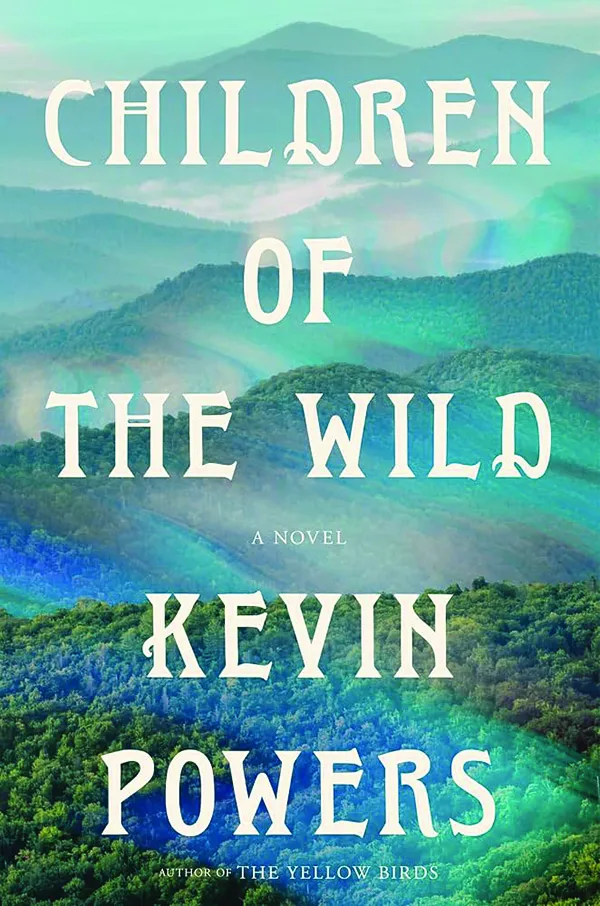
A student at Vanderbilt University, while World War I rages, Roy Young has his whole life ahead of him. More than this, he appears to have his life mapped out. After finishing his studies, he intends to return to Ewer’s Rock, Virginia, and successfully modernize and manage his family’s farm. He also expects to marry Samantha Hatton, the local minister’s daughter and his closest friend since childhood. But when Roy comes home for the winter break, he is forced to revise one of his best-laid plans after Sam deals him a blunt truth. And when he returns again in the summer of 1917, he sidelines his other aim, swapping his rural corner of Virginia for the battlefields of France.
Kevin Powers’s new novel follows Roy as he abandons his safe life and is propelled into the widespread chaos and indiscriminate slaughter of the Great War. But as its title suggests, Children of the Wild is the story of more than one individual. Powers charts the progress of Roy, Sam, and a third figure who comes between them. All three must overcome considerable challenges to remain positive and stay alive.
The beginning of the book, in Powers’s native Virginia, takes the form of a calm before the storm. Powers presents Roy as an arrogant young man, too confident in his abilities and too presumptuous about how his choices will turn out. He doesn’t truly love Sam; instead, “he loved the ease with which he could fit her into his vision of his life.” Sam brings him down a peg by rebuffing him and asserting her right to make her own decisions.
As Roy slinks back to college with his tail between his legs, the narrative switches to Sam as she makes a series of trips out of Ewer’s Rock and up into the highlands to get to know the “orphan in the wild” she has encountered there. He has no recollection of his family and no idea what his name is. “Never had one to know or not know,” he tells Sam. She notices “Ennis Duke” written on a label inside his greatcoat. The name sticks, and a passionate romance develops. Ennis agrees to come down from the mountain and live with Sam among the other “flatlanders.” There, he ingratiates himself with both Sam’s father and Roy’s family. He gets a job as a hand on Roy’s father’s estate and becomes adept with a gun as he guards the sheepfold. When a jealous and proprietorial Roy arrives back in town, he challenges Ennis to a fight, which, though it leaves them bruised and bloodied, brings them closer together. Roy sees his rival as a kindred spirit, both of them being “the kind of boys for whom violence was a native tongue.” Speaking the same language, the pair form a tight bond.
That bond is threatened when Roy enlists “to fight the Hun.” “I don’t know anything about Germans, Roy,” Ennis says. “Why would I want to kill them?” But soon he signs up, much to Sam’s despair. After having fought against each other in a dusty yard, the two men find themselves fighting side by side on the Western Front. Meanwhile, on the home front, Sam looks on helplessly as the influenza epidemic spreads and wreaks devastation. “Sometimes it’s hard not to think we live in the land of the dead,” she remarks. Lieutenant Young and Private Duke, as they are now known, navigate their own land of the dead, alert to German attacks yet unaware of what lies in store for them if they make it home in one piece.
It perhaps comes as no surprise to discover that the strongest part of Children of the Wild is that devoted to war. After all, Powers is a master chronicler of conflict. In his award-winning 2012 debut, The Yellow Birds, he reckoned with the Iraq war, the conflict in which he served as a machine-gunner with the Army, and in his 2018 follow-up, A Shout in the Ruins, he evoked the brutality of the Civil War. In both novels, he not only depicted battles lost and won, but also showed how the horrors and hardships endured or inflicted by soldiers continued to leave their mark long after truces had been signed and bodies had been buried.
In his new novel, Powers skillfully dramatizes each stage of his characters’ journeys from innocent civilians to fearsome soldiers. Ennis’s military career gets off to a bad start at Camp Lee when he announces that he can’t read or specify where he was born. However, he goes on to prove himself a crack shot at the firing range, and once in France, he earns a reputation as a star sharpshooter. Roy shows courage under fire as he leads his men into “a perfect little piece of hell.” Powers impresses with visceral scenes of savage bombardments and death-defying scrapes in front-line trenches, on open blasted land, in towns reduced to rubble, and in treacherous woods that one division calls Suicide Hill. Both men become battle-hardened, then war-ravaged. When fighting intensifies, one man goes missing, and the other runs out of ammunition. A keen sense of dread pervades the proceedings at this point and keeps us turning the pages to learn the protagonists’ fates.
It would be a spoiler to reveal what happens to Roy and Ennis. What is worth mentioning, though, is Powers’s well-crafted last act, which unfolds after the armistice. Hostilities in France might have ended, but trouble now brews at home as Roy’s old Vanderbilt roommate, Fintan Thoreau, throws his weight around. He refused to “give up Harvard Law over a little spat in Sarajevo.” Having become one of Virginia’s most influential figures, he harbors grand plans to take over Ewer’s Rock. Powers offers a gripping account of vengeance and a tender portrait of a man in search of redemption and completion.
NOVELIST SINGRID NUNEZ’S FINELY CRAFTED, BEAUTIFULLY WRITTEN SHORT STORIES
Elsewhere, that momentum is sporadically impaired by dream sequences or supposed premonitions (which Roy’s mother calls “signs and wonders”). Powers believes they are more interesting than they actually are. The narrative cranks back to life when characters aren’t relaying or decoding reveries but getting on with more grounded matters such as falling in love, strengthening friendships, and, above all, waging combat.
Powers’s blunt approach is particularly effective when describing Roy’s headstrong temperament or Ennis’s transformation into a trigger-happy killer of “Boche.” But nothing is more blunt than this warning the men receive, and refuse to heed, about war: “It doesn’t give. It only takes.” What it takes and how it does so make for affecting reading.
Malcolm Forbes has written for the Economist, the Wall Street Journal, and the Washington Post. He lives in Edinburgh.