
The world is an oligarchic place these days. While the relentless rise in international travel has diminished the traditional exclusivity of some early jet-set destinations, there have emerged several geographic poles where it is increasingly difficult for the common man to gain true access. These include Monaco, Swiss ski resorts such as Gstaad and St. Moritz, and, to a lesser extent, Dubai. Among the most desirable and secluded of these bolt holes for the super-rich (not the mere cosmopolitan wealthy, but the much rarer class of “have yachts”) is the small, French-owned, volcanic island of St. Barthelemy, known colloquially as St. Barth. It can be reached only by sea or by puddle jumper flight from places including St. Martin; there is no golf course, and, quite unusual for the region, its inhabitants are almost exclusively white (St. Martin’s population, just 15 miles away, is conversely almost entirely black).
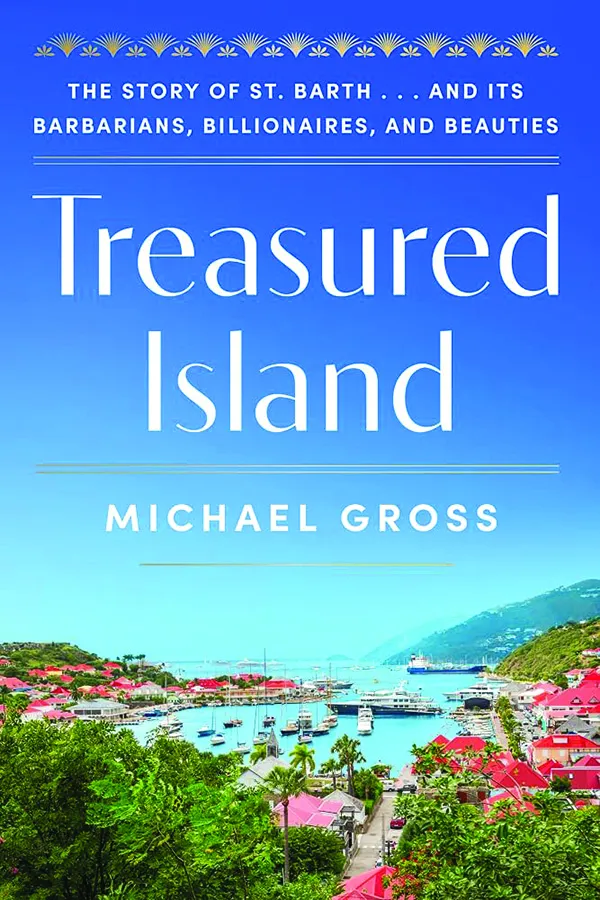
In Treasured Island: The Story of St. Barth … and Its Barbarians, Billionaires, and Beauties, his colorful, definitive, deeply researched new book, which borders on an oral history, the author (and seasoned St. Barth vacationer) Michael Gross profiles this small, beautiful island and the bizarre personalities who have transformed it from a sleepy, impoverished backwater into the pinnacle of elite luxury.
Located just north of St. Kitts and southeast of St. Martin in the West Indies, the 9-square-mile island, with a population of just over 10,000, has a remarkable and little-known history. Christopher Columbus is said to have named it after his brother upon discovering the isle in 1493. It was briefly taken over by the Knights of Malta until a band of seafaring Carib tribes arrived in canoes and massacred them. In 1784, Sweden’s king, Gustav III, traded the island with France in exchange for favorable access to the North Sea port of Gothenburg. At the time, St. Barth’s constituted the entirety of Sweden’s overseas empire; Gustav quickly established a free port and a haven for debtors there. Trade, largely in contraband, soon made the island very rich. By 1800, the capital, renamed Gustavia, had become Sweden’s sixth-largest town, and by 1813, the port had, rather impressively, processed one-fifth of American exports.
If the early 19th century had been a golden age for the Swedish-owned island, the latter half of the century constituted a period of growing irrelevance and steep economic decline. Stockholm, growing weary of its “costly indulgence” in the Western Hemisphere, tried in vain to offload the colonial real estate. A succession of prospective deals with Prussia, Italy, and the United States fell through. In 1878, it was returned to France after the latter wrote a large check and agreed to protect the island’s status as a free port.
In 1890, a Catholic priest imported latanier tree seedlings, a crop that gave rise to a small, though in hindsight slightly pathetic, woven goods trade, which constituted St. Barthelemy’s single export industry. Salt production, along with indigo and cotton planting, had all been abandoned by then. During the first half of the 20th century, the island was poor, depopulated, and without running water, electricity, or decent roads.
A new chapter began when the banker and Standard Oil heir David Rockefeller arrived in the late 1950s aboard his 95-foot ketch, the Wayfarer, with his wife Peggy in tow. The couple’s love for St. Barth “altered the island’s destiny,” Gross writes. Rockefeller sought to “prevent the construction of resorts by buying whenever possible the large coastal land that might come up for sale,” and took it upon himself “to shelter the island” from real-estate speculators and developers.
There was a time when the surest sign of immense wealth was in the defense of privacy and the pursuit of beauty. These days, the opposite appears to be true. If there was a time when oligarchic wealth seemed to inspire certain acts of noblesse oblige, today’s St. Barth, with its $100,000 nightclub tables and mega yachts, seems to represent a global ruling elite that has grown much more materialist, short-termist, and vulgar in its appetites.
If there is anything certain about life on the island, however, it is change. Gross’s secondhand accounts of the constantly evolving lifestyle range from the debauched (e.g., cocaine-fueled orgies and drug smuggling in the late 1970s; the first waves of celebrities, such as Jimmy Buffett and the band Fleetwood Mac) to the surprisingly deep political intrigue of the native population. In 1981, the Reagan administration’s crackdown put an end to an era when smugglers who frequented the island were targeted by U.S. drug authorities. Another era came to an end after the 2008 financial crisis, which temporarily halted the Wall Streeters who were, at the time, “St. Barth’s best customers.” In response, the island sought to attract visitors from places farther afield, such as China and Russia.
Island politics are revealed to be a vibrant affair, complete with occasional arson attacks and armed standoffs. Apart from long-standing debates over autonomy and local rule, partly resolved in 2007 when the island became a separate collectivity of France rather than remaining part of Guadeloupe, the development of the island and the rights of locals in the face of endless waves of foreign money remain a constant, critical issue. This has never been an easy balance. “Certain folks controlled the island and they were all on the take,” as the smuggler Barry Foy once recalled. “Money talked.”
Primarily a work of social reportage, Treasured Island covers a remarkable cast of characters and insular dramas. These range from the adventurer and alleged smuggler Remy de Haenen, who was the first to land an airplane on St. Barth and who the novelist Jean Raspail once profiled in his travel writing, to David Rockefeller’s Organization of American States-affiliated footman to the Russian oligarch Roman Abramovich. Rogues and brigands are the rule in this account, not the exception.
REVIEW: A GLIMPSE INTO A CITY’S SORDID DECLINE IN ‘LONDON FALLING’
One gets the impression that Gross laments the changing nature of the island, which used to be exclusive “not because it was expensive but because it catered to a self-selecting band of elite and adventurous travelers who disdained golf courses, high-rise concrete block hotels, gambling, and native music, and could live without television.” The author gives the impression that he would be more comfortable sailing with Rockefeller than getting bottle service at Nikki Beach with Tom Brady and Jake Paul, to name but two of the contemporary vacationers named herein.
In these pages, one begins to wonder whether the ostentatious ruling class of our epoch will stand the test of time, or eventually be swept away by unforeseen forces, like St. Barth’s notorious hurricanes.
Carson Becker is an American writer.