
Steven Spielberg’s latest big-budget adventure, Disclosure Day, came and went earlier this summer. Like Spielberg’s Close Encounters of the Third Kind (1977), the film predicted a day in the not too distant future when the cover-ups and conspiracies surrounding alleged extraterrestrial life have ended — when the world would finally possess undisputed proof that human beings were not the only intelligent life in the universe.
Alas, few cared. Though generally praised by critics, the movie flopped, making less than $116 million in the United States to date. The movie is now available to stream on Amazon Prime and other platforms. Anyone who did bother to show up in a movie theater saw the story of a heroine (Emily Blunt) fighting off government officials desperate to prevent said disclosure, lest a society ill-prepared for alien revelations rend itself to panicked, insane, smoldering wreckage.
Is it possible the movie passed like a flying saucer in the night because the subject matter is no longer compelling? Could it be that if Americans no longer questioned if those strange lights in the sky really exist or wondered what’s controlling them, they wouldn’t stop paying taxes, start stockpiling Chef Boyardee, or turn to worshiping Cthulhu?
We can largely credit the paranoid expectation of ET-induced societal collapse to the 1960 Brookings Report. Commissioned by NASA and officially titled “Proposed Studies on the Implications of Peaceful Space Activities for Human Affairs,” the 250-page tome compiled by the Brookings Institution in Washington, D.C., offered Congress and the White House “the implications of a discovery of extraterrestrial life.”
While only a small part of a report that explored everything from space commerce to aircraft design to the weather, that one speculative section discussing the pros and cons of withholding proof of ETs drove decades of arguments that the U.S. government already had proof of aliens but withheld it to prevent widespread fear and alarm.
The Cold War hush-hush of the early 1960s gave rise to the Brookings Report, but that murky stew first hit the stove over a decade earlier. Paranoia over unidentified flying objects — or, in 21st-century parlance, unidentified anomalous phenomena — dates back to World War II, when combat aviators first caught sight of “foo fighters” they couldn’t explain. Soon afterward, the endlessly publicized Roswell incident in New Mexico in 1947 gave Americans their first taste of rapidly shifting military explanations of strange events.
And, though never officially stated, the playbook of Project Blue Book called for a simple strategy: deny, obfuscate, and intimidate so that the average person doesn’t run screaming to grab their kitchen knives upon learning about little green men.
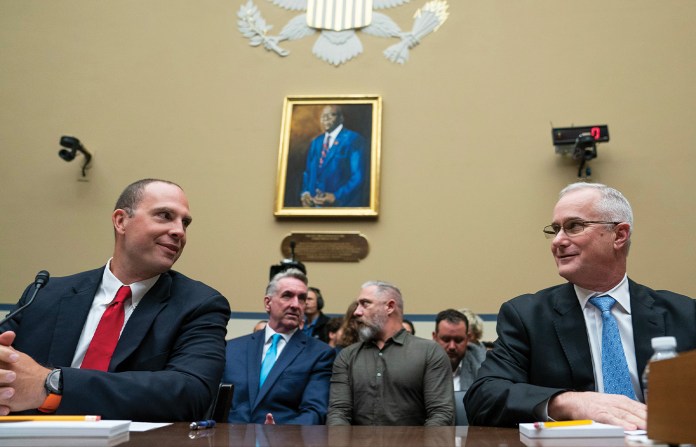
Cut to July 2023. On Capitol Hill, congressional representatives listened as witnesses and experts presented, on the public record and before the media, compelling military video from 2004 showing a small sphere flying above the ocean. Recorded voices of veteran Navy pilots shouted through their helmet radios in bewilderment at what that sphere could do.
UAP skeptics could only raise an eyebrow as retired Navy Cmdr. David Fravor described the object his F-18 pursued in vain as white or metallic and without wings, windows, or visible engines. Visual and radar data indicated the “Tic Tac” UAP descended 80,000 feet in less than a second during the pursuit, a maneuver requiring a speed of more than 45,000 miles per hour. That velocity would create more than 2,000g, tearing any concept of human airborne engineering to tiny metal fragments while its pilot exploded into a red mist.
This was open testimony before Congress. Did somebody change the plan? While none of the Tic Tac testimony counts as Klaatu phoning home from the White House lawn, it represented respected members of the military insisting upon the existence of UAPs. That’s the kind of “disclosure” we were told would have dogs and cats sleeping together.
Instead, the day after this testimony in 2023, people got out of bed. They made coffee. They went to work. They checked the baseball scores.
Where was our end of the world? We were promised societal chaos: devastation, death, war, horror, and a general questioning of everything it means to be human. The monuments would fall. The world’s religions, legal institutions, and economies would collapse when humanity faced the reality-shredding revelation about advanced, intelligent species outside of Earth.
This entire fizzle of our intergalactic firecracker begs the question of whether society already accepted the existence of aliens at some point before any big announcement could be made. We went from constant official denial and media ridicule to Netflix documentaries, feature films, and public testimony that all but take for granted that we have some very intelligent (but still unknown) neighbors.
The news arrived with a shrug and a yawn. Does anybody even care about aliens anymore?
Garfield Reeves-Stevens is one half of a successful husband-wife writing team with spouse Judith Reeves-Stevens. The author of thrillers such as Nighteyes and Children of the Shroud on his own — and the co-author of everything from episodes of Star Trek: Enterprise to Race to Mars — Reeves-Stevens believes Western societies had decades of science fiction and very real technological advancement to make the possibility of extraterrestrials seem less extraordinary than it once might have.
“The last few years have seen the disruptive explosion of AI, and right now we’re at the dawn of what I think will be an even more disruptive age of humanoid robots,” Reeves-Stevens said. “So, it can seem completely reasonable to accept that another great staple of sci-fi — aliens visiting Earth — is also real. As a result, there’s a common belief that the social upheaval people worried about in the 1950s and 1960s won’t be an issue today because popular culture has made the concept of aliens totally mainstream.”
As to why governments still deny the existence of UAPs, Reeves-Stevens imagines their thinking to go something like this: “‘They are real. We don’t know what they are. We can’t do anything about them.’ So, any government would want to deny a potential threat it doesn’t understand and can’t counter.”
Avi Loeb, director of the Galileo Project at Harvard University, believes that the public would welcome proof of alien life and understand the need to search for it perhaps more than government officials or academics. He compares the U.S. government withholding information on “nonhuman made technologies” to parents foolishly hiding information about the existence of neighbors from their children.
“A knock on the front door of our home could quiet down all loud conflicts within our family,” Loeb said. “The discovery of a neighbor is likely to bring together all humans because we are all in the same boat.”
Of course, all of the “Why not just tell us the truth?” sentiment flourishes under the assumption that Loeb’s “neighbors” are indeed neighborly and their disclosure would come with a friendly tip of a tinfoil hat. Reeves-Stevens reminds everyone that the emergence of superior civilizations with inhuman intentions could leave the public yearning for the days of blissful ignorance or the blase indifference that seems to govern public sentiment at present.
UFO REPORTING IS CAUGHT BETWEEN EXCESS SENSATIONALISM AND EXCESS SKEPTICISM
“It’s one thing to think of friendly space brothers and sisters arriving to give us the benefit of their advanced technology,” he said. “It’s quite another to discover that the government can’t protect us from being abducted and experimented upon by monstrous creatures who treat us like lab specimens.”
Of course, any public reaction to full disclosure or first contact would depend on the nature of the message. A direct threat from a higher intelligence able to reach Earth from across the stars could put an end to humanity, psychologically and practically. An amicable “hello” from on high might convince a divided human species to get along with itself a little better. As for now, while more compelling evidence of UAPs rolls through the media on a regular basis, whoever or whatever controls these crafts doesn’t seem to particularly care how humanity reacts. They’re coming anyway.
John Scott Lewinski (@johnlewinski) is a writer based in Milwaukee.