
I have been reading Tocqueville again lately, prompted by our nation’s semiquincentennial celebrations. Looking at where we are today, it is hard not to wonder: if Alexis de Tocqueville showed up in 2026, would he recognize modern America? More importantly, would he bet on us to last another 250 years? I believe he would judge America not by its politics alone, but by the habits and character that support its republic.
If America’s future will not be settled in Washington alone, then it will be decided in our families, churches, schools, and neighborhoods. These are the places where citizens are formed, and where Tocqueville would ask a central question: do we still possess the habits necessary to maintain our republic?
He would not likely turn to social media to measure the health of the republic. Tocqueville was most interested in the habits, associations, and institutions behind the politics of the day that taught Americans to govern themselves.
A quick stop in Washington, D.C., would likely be on his itinerary. Tocqueville respected the Constitution, including the separation of powers, the rule of law, and the safeguards it placed around liberty. But his stop in D.C. would end as quickly as it began.
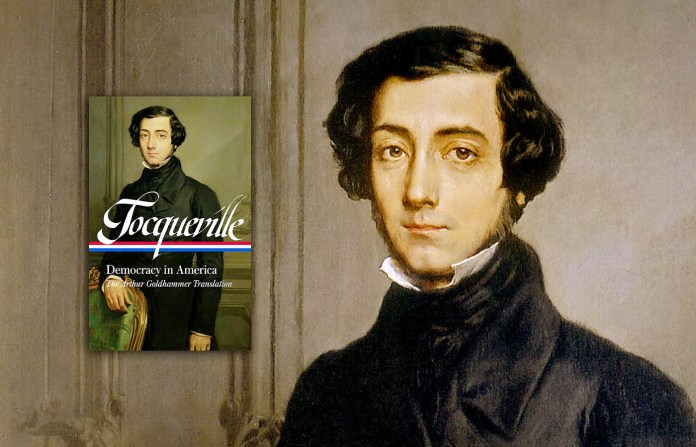
You see, Tocqueville was always pulled to places that seldom dominate news coverage: a town council meeting, a classroom, a church where members gather to collaborate on a community service project, or a neighborhood organizing after a storm. Most Americans would see ordinary community life. Tocqueville would see the structure that made liberty possible.
Tocqueville arrived in the United States in 1831, officially to study America’s prisons. What he ultimately produced was profound and enduring.
Coming from post-revolutionary France, he encountered the rough reality of the American frontier. He was truly fascinated by the American people and by how this democracy had succeeded when so many others had failed.
Imagine him watching two farmers pause their work to help a neighbor pull a stubborn stump from a field. Neither was compelled by law. They stopped because custom, duty, and mutual expectation made such assistance ordinary. So the Constitution alone could not explain America’s success. The deeper explanation lay in the habits of its people.
That is the layer of America many observers miss. Many obsess over the chaos of Washington, but Tocqueville kept his eyes on the ground. He spent nine months traveling the young republic, observing frontier settlements, growing cities, judges, ministers, merchants, legislators, farmers, and laborers. More than anything, he watched Americans live together.
He often noticed something Europeans found unusual: Americans were always forming committees, church societies, debating clubs, and improvement associations. Americans instinctively organized. To Tocqueville, these associations were more than civic; they were training grounds for self-government.
His resulting work, Democracy in America, remains a masterclass on the American experiment because he understood the conditions under which free societies flourish and the conditions under which they, almost without recognizing it, forget how to preserve liberty. He saw America’s strengths with unusual clarity, and he also saw dangers that would not fully emerge for generations. That balance of praise and warning explains his enduring lesson for America: Liberty depends on civic habits, not politics alone.
Everywhere he traveled, Tocqueville noticed a peculiar habit. Americans did not wait for government to solve every problem. They solved many themselves. When challenges arose, they did not ask what the government intended to do, but what they could accomplish together. He called this the “art of association.” It did practical work through libraries, charities, churches, and local groups, but it also trained citizens. Associations required people to organize, compromise, build, and contribute.
Leadership emerged through empathy, compromise, and practice. Trust accumulated through repeated effort. Responsibility spread across many rather than concentrating in a few. Ordinary organizations became schools of democratic life.
That insight explains why Democracy in America still matters nearly two centuries later. Tocqueville was studying not only constitutional mechanics but human formation. He wanted to understand how the people came to govern themselves.
He observed that we learn the responsibilities of citizenship long before we assume them as adults. Many think of citizenship beginning when we register to vote. Tocqueville understood that it begins much earlier: when children learn to keep promises, finish a job even though it’s tough, care about neighbors, and recognize that every community depends on people who contribute more to the whole than they consume for themselves.
In a republic, the best-designed constitutional framework cannot do the work alone if its citizens fail to govern themselves.
That is why Tocqueville’s admiration for America was never naive. Some of the most remarkable passages in Democracy in America are warnings, not celebrations. Most free societies do not lose liberty all at once. Instead, they gradually lose the habits that made liberty possible.
Unlike many political thinkers before him, Tocqueville did not imagine freedom disappearing only through sudden conquest or tyranny. He feared something far more discreet: citizens becoming increasingly absorbed in private pursuits while surrendering responsibilities earlier generations had assumed for themselves.
He called this tendency “individualism.” Family, work, and opportunity are blessings, not direct threats. A healthy society teaches us to first care for ourselves, then our families, neighbors, communities, and country. Danger arises when our circles of concern shrink as we withdraw from institutions that teach and reinforce citizenship, and when we begin to treat our citizenship as something we can delegate rather than practice.
The change is gradual. We attend fewer community meetings because we are busy. We volunteer less because we assume someone else will step forward. Neighborly connections weaken. Each decision seems insignificant.
Together, they reshape a society.
The empty chairs at meetings that still draw hundreds of comments online are illustrative. We have become very good at watching public life from a distance, and less practiced at sitting in the room with people who may see things differently than we do.
I saw this pattern clearly when a higher-density development proposal came before my city while I was serving as mayor. The online discussion was intense with people assuming motives, assigning blame, or demanding action. But when the meeting began, attendance was much smaller than the comment thread suggested. That difference mattered. Local government works differently when people are present, hear one another, and have to speak as neighbors.
This happens not because we are bad people but because we are comfortable people. Prosperity makes withdrawal easier. As services move online and daily life requires less face-to-face interaction with neighbors, opportunities to practice civic responsibility and learn the art of association diminish. Tocqueville understood how easily democratic citizens drift toward private concerns. The danger is a subtle civic atrophy more than a dramatic moral collapse.
I saw this firsthand during my service as mayor. After years behind a city council dais, patterns emerged. Most meetings were sparsely attended unless an issue directly affected someone’s property value or quality of life. When a seat on the city council became vacant, my first thought was often less about who wanted to serve than who I might persuade to run. More than once, the copier barely had time to warm up before it finished printing the one or two candidate applications we received.
Those who did step forward were often the same handful of citizens who volunteered at the food pantry, coached youth sports, organized neighborhood cleanups, served on nonprofit boards, attended public meetings, and accepted appointments to local commissions. They rarely sought recognition. But they understood that communities do not sustain themselves. Their willingness to shoulder responsibility carried far more of our city’s civic burden than most people ever realized.
I can still picture a long-time planning commission member showing up again and again for work that rarely drew attention. It might have been setting up chairs before a meeting, helping with long-term planning, or answering the call when the city needed someone to take on an important project. None of it looked dramatic from the outside. But without people like that, much of local life would simply stop functioning.
That experience reminded me of something Tocqueville understood nearly two centuries earlier. Healthy communities are rarely sustained by large numbers of people doing extraordinary things. They endure because ordinary citizens develop the habit of serving, even when too few are willing to do so. Too often, however, we have become reactive citizens. We show up to complain or protest, but less often to build or contribute.
Yet the responsibilities of self-government never disappear. Children still need mentors. The elderly still need care. Food pantries still need volunteers. The only question is who will shoulder those responsibilities.
Tocqueville was concerned about the centralization of power that would weaken the ability for self-government. He was also worried that responsibility would migrate with it. When citizens, families, and communities surrender responsibilities they once carried, government often assumes them– often at a premium. The deeper loss is civic: Every responsibility transferred away from citizens is one fewer opportunity to practice self-government.
He did not frame the issue as government versus civil society. Constitutional government has legitimate responsibilities. His warning was different: If citizens gradually surrender too many responsibilities, they lose the habits those responsibilities once cultivated. A society may continue holding elections while its citizens become spectators rather than active participants.
The real erosion, Tocqueville suggested, produces not necessarily bigger government, but smaller citizens. That is the central danger America must resist.
If the perils that preoccupied Tocqueville were legitimate, his remedy deserves equal attention. Democracy renews itself through the steady formation of citizens capable of exercising freedom wisely. That formation begins long before campaigns or legislation. It begins in ordinary places that shape character.
We first learn responsibility within a family. Then it is reinforced through churches, schools, neighborhoods, local governments, and voluntary associations.
Families are often described as private institutions, but Tocqueville’s observations invite us to see them differently. Families are where children first discover that freedom is inseparable from responsibility. They learn that promises matter, that other people’s needs cannot just be ignored, and that every household depends upon both rights and obligations.
Every family’s story is different. Some children are raised by single parents, grandparents, foster families, or relatives. Others find stability through teachers, coaches, pastors, mentors, or neighbors. The point remains the same: Free societies depend upon places where rising generations learn trust, restraint, responsibility, and concern for others.
Over the years, I have watched families naturally strengthen others in the community by providing meals during illness, caring for children during hardship, mowing a neighbor’s lawn, quietly paying a bill, and extending habits of responsibility beyond their own front doors.
What mattered was not that anyone announced it publicly. It was that someone noticed a need and acted before being asked, and that others learned from the example. Those small acts are easy to overlook, but they are often where children first see what responsibility looks like in practice.
Family provides the foundation, but other institutions extend those lessons, creating a multiplying effect. Schools teach cooperation even when there is disagreement. Congregations remind us that our obligations extend beyond ourselves. Businesses cultivate trust and initiative. Volunteer organizations teach leadership and sacrifice. Neighborhoods encourage reciprocity. Local charities invite service. These institutions operate within a larger framework that many people misunderstand: federalism.
Federalism did more than divide political power. It multiplied opportunities for citizens to practice responsibility. Long before the Constitution, Americans had developed a habit of organizing communities through local self-government, shared obligations, and layered institutions. The Constitution preserved and strengthened those patterns, dispersing authority across state and national governments so that self-government could remain something citizens practiced rather than observed.
James Madison explained why the division of powers protects liberty. Tocqueville explained why practicing responsibility preserves it. Those insights belong together.
Together, they remind us that constitutional design and civic character were never intended to operate separately. America’s constitutional institutions presupposed citizens already accustomed to governing themselves in families, churches, neighborhoods, and local communities.
The Constitution established the framework of a free republic. America’s families, congregations, schools, voluntary associations, and local communities formed the citizens capable of sustaining it.
One provides the structure of liberty, while the other forms the character liberty requires.
As we celebrate America’s semiquincentennial, we should remember the extraordinary generation that established a constitutional republic unlike any the world has seen. We should celebrate those achievements with gratitude. But anniversaries are not only occasions for celebration. They are also moments for reflection.
Every American generation inherits two gifts. The first is a constitutional republic that has preserved liberty for nearly two and a half centuries. The second is a culture of citizenship, formed through institutions that taught Americans how to exercise that liberty responsibly. We did not create either inheritance, but we have been entrusted with both.
None of this denies today’s challenges. Families face real pressures. Communities experience fragmentation. Trust in institutions has weakened. Yet Tocqueville’s prescription remains available.
The Constitution remains indispensable, but no constitutional structure can sustain itself. Constitutional liberty endures only when the habits that support it endure as well. That means recommitting to the places and practices that form character.
It means strengthening families. It means supporting schools that cultivate character alongside learning.It means encouraging congregations and nonprofits that turn concern outward. It means reviving local governance so citizens recover the habit of deciding together.
That can begin with ordinary commitments: attending a budget meeting before a crisis arises, serving on a local board, helping with cleanup after a storm, volunteering for a youth program, or simply staying after a meeting long enough to talk with someone on the other side of an issue. These are not glamorous duties, but they are the practical work through which citizens learn to govern with one another.
Tocqueville understood that free societies are never self-sustaining. They endure because each generation accepts responsibility for forming the next. That work is incremental, often quiet, and rarely glamorous. Yet it remains among the most important work a free people can undertake.
GHOST OF ALEXIS DE TOCQUEVILLE RETURNS. WHAT AMERICA CAN LEARN FROM HIM
America’s semiquincentennial is therefore more than a celebration of the past. It is a test of our stewardship. The question is not whether we admire the Founders or appreciate the Constitution. It is whether we are renewing the institutions that have always formed the citizens upon whom constitutional self-government depends.
Tocqueville saw both the promise and the peril. Whether the promise endures now depends on us: on whether we are willing to raise the republic, one family, one neighborhood, and one generation at a time.
Rep. Jason E. Thompson serves District 3 in the Utah House of Representatives.